

THE PERIPHERAL DEEP SEAS
269
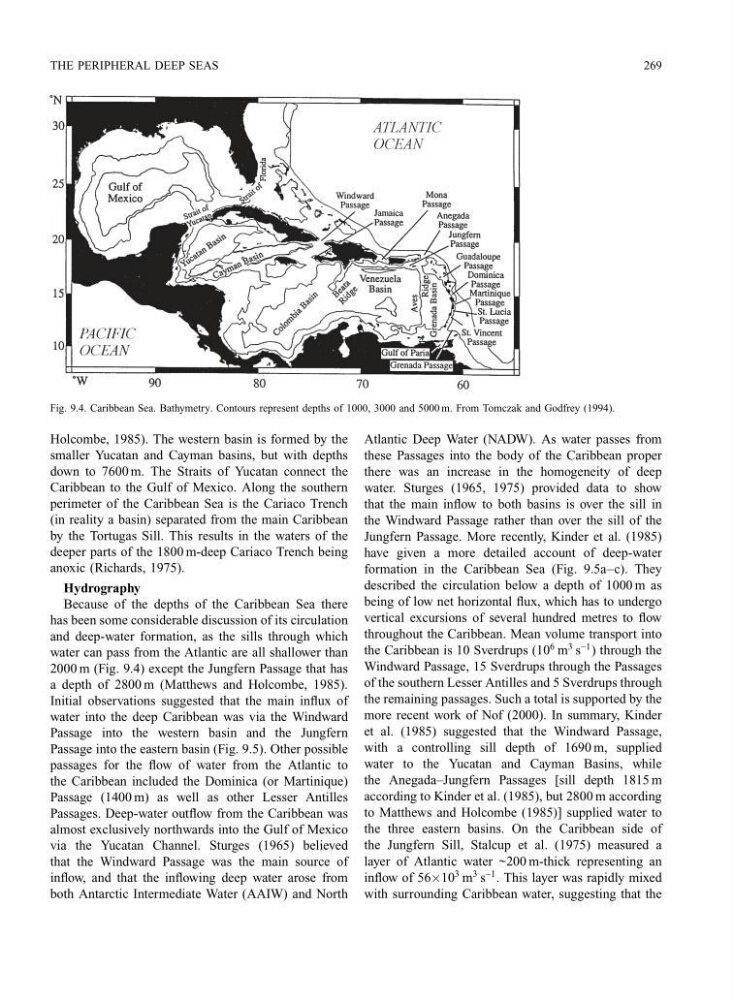
Fig. 9.4. Caribbean Sea. Bathymetry. Contours represent depths of 1000, 3000 and 5000 m. From Tomczak and Godfrey (1994).
Holcombe, 1985). The western basin is formed by the
smaller Yucatan and Cayman basins, but with depths
down to 7600 m. The Straits of Yucatan connect the
Caribbean to the Gulf of Mexico. Along the southern
perimeter of the Caribbean Sea is the Cariaco Trench
(in reality a basin) separated from the main Caribbean
by the Tortugas Sill. This results in the waters of the
deeper parts of the 1800 m-deep Cariaco Trench being
anoxic (Richards, 1975).
Hydrography
Because of the depths of the Caribbean Sea there
has been some considerable discussion of its circulation
and deep-water formation, as the sills through which
water can pass from the Atlantic are all shallower than
2000 m (Fig. 9.4) except the Jungfern Passage that has
a depth of 2800 m (Matthews and Holcombe, 1985).
Initial observations suggested that the main influx of
water into the deep Caribbean was via the Windward
Passage into the western basin and the Jungfern
Passage into the eastern basin (Fig. 9.5). Other possible
passages for the flow of water from the Atlantic to
the Caribbean included the Dominica (or Martinique)
Passage (1400 m) as well as other Lesser Antilles
Passages. Deep-water outflow from the Caribbean was
almost exclusively northwards into the Gulf of Mexico
via the Yucatan Channel. Sturges (1965) believed
that the Windward Passage was the main source of
inflow, and that the inflowing deep water arose from
both Antarctic Intermediate Water (AAIW) and North
Atlantic Deep Water (NADW). As water passes from
these Passages into the body of the Caribbean proper
there was an increase in the homogeneity of deep
water. Sturges (1965, 1975) provided data to show
that the main inflow to both basins is over the sill in
the Windward Passage rather than over the sill of the
Jungfern Passage. More recently, Kinder et al. (1985)
have given a more detailed account of deep-water
formation in the Caribbean Sea (Fig. 9.5a−c). They
described the circulation below a depth of 1000 m as
being of low net horizontal flux, which has to undergo
vertical excursions of several hundred metres to flow
throughout the Caribbean. Mean volume transport into
the Caribbean is 10 Sverdrups (10
6 m
3 s
−1 ) through the
Windward Passage, 15 Sverdrups through the Passages
of the southern Lesser Antilles and 5 Sverdrups through
the remaining passages. Such a total is supported by the
more recent work of Nof (2000). In summary, Kinder
et al. (1985) suggested that the Windward Passage,
with a controlling sill depth of 1690 m, supplied
water to the Yucatan and Cayman Basins, while
the Anegada–Jungfern Passages [sill depth 1815 m
according to Kinder et al. (1985), but 2800 m according
to Matthews and Holcombe (1985)] supplied water to
the three eastern basins. On the Caribbean side of
the Jungfern Sill, Stalcup et al. (1975) measured a
layer of Atlantic water ~200 m-thick representing an
inflow of 56×10
3 m
3 s
−1 . This layer was rapidly mixed
with surrounding Caribbean water, suggesting that the
269
Fig. 9.4. Caribbean Sea. Bathymetry. Contours represent depths of 1000, 3000 and 5000 m. From Tomczak and Godfrey (1994).
Holcombe, 1985). The western basin is formed by the
smaller Yucatan and Cayman basins, but with depths
down to 7600 m. The Straits of Yucatan connect the
Caribbean to the Gulf of Mexico. Along the southern
perimeter of the Caribbean Sea is the Cariaco Trench
(in reality a basin) separated from the main Caribbean
by the Tortugas Sill. This results in the waters of the
deeper parts of the 1800 m-deep Cariaco Trench being
anoxic (Richards, 1975).
Hydrography
Because of the depths of the Caribbean Sea there
has been some considerable discussion of its circulation
and deep-water formation, as the sills through which
water can pass from the Atlantic are all shallower than
2000 m (Fig. 9.4) except the Jungfern Passage that has
a depth of 2800 m (Matthews and Holcombe, 1985).
Initial observations suggested that the main influx of
water into the deep Caribbean was via the Windward
Passage into the western basin and the Jungfern
Passage into the eastern basin (Fig. 9.5). Other possible
passages for the flow of water from the Atlantic to
the Caribbean included the Dominica (or Martinique)
Passage (1400 m) as well as other Lesser Antilles
Passages. Deep-water outflow from the Caribbean was
almost exclusively northwards into the Gulf of Mexico
via the Yucatan Channel. Sturges (1965) believed
that the Windward Passage was the main source of
inflow, and that the inflowing deep water arose from
both Antarctic Intermediate Water (AAIW) and North
Atlantic Deep Water (NADW). As water passes from
these Passages into the body of the Caribbean proper
there was an increase in the homogeneity of deep
water. Sturges (1965, 1975) provided data to show
that the main inflow to both basins is over the sill in
the Windward Passage rather than over the sill of the
Jungfern Passage. More recently, Kinder et al. (1985)
have given a more detailed account of deep-water
formation in the Caribbean Sea (Fig. 9.5a−c). They
described the circulation below a depth of 1000 m as
being of low net horizontal flux, which has to undergo
vertical excursions of several hundred metres to flow
throughout the Caribbean. Mean volume transport into
the Caribbean is 10 Sverdrups (10
6 m
3 s
−1 ) through the
Windward Passage, 15 Sverdrups through the Passages
of the southern Lesser Antilles and 5 Sverdrups through
the remaining passages. Such a total is supported by the
more recent work of Nof (2000). In summary, Kinder
et al. (1985) suggested that the Windward Passage,
with a controlling sill depth of 1690 m, supplied
water to the Yucatan and Cayman Basins, while
the Anegada–Jungfern Passages [sill depth 1815 m
according to Kinder et al. (1985), but 2800 m according
to Matthews and Holcombe (1985)] supplied water to
the three eastern basins. On the Caribbean side of
the Jungfern Sill, Stalcup et al. (1975) measured a
layer of Atlantic water ~200 m-thick representing an
inflow of 56×10
3 m
3 s
−1 . This layer was rapidly mixed
with surrounding Caribbean water, suggesting that the