

242
Andrew CLARKE
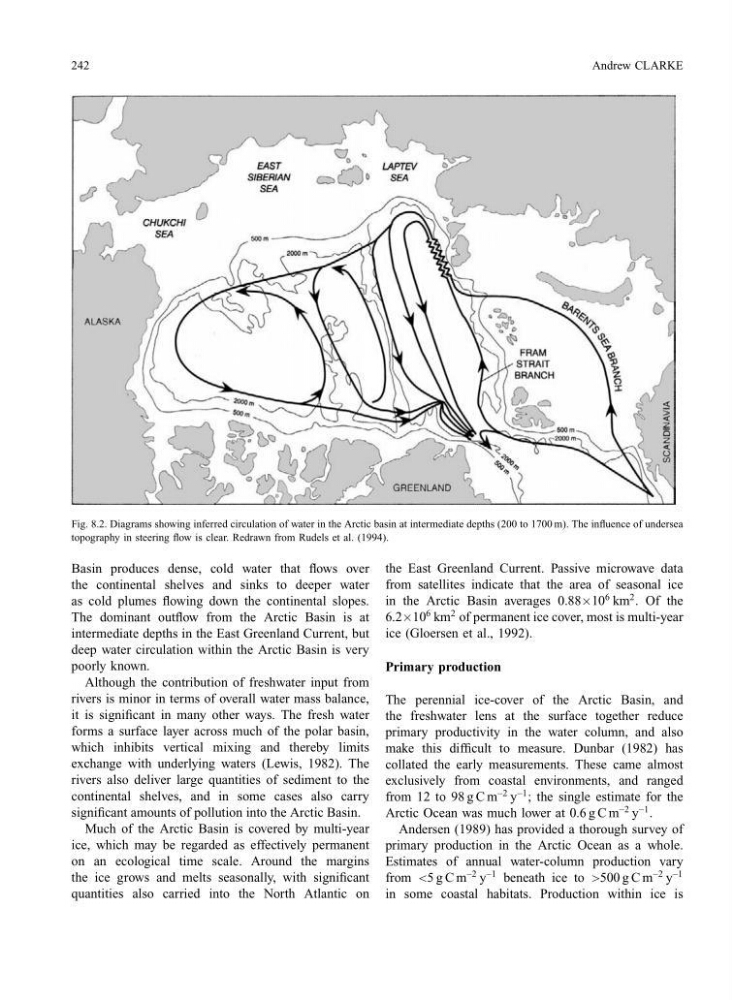
Fig. 8.2. Diagrams showing inferred circulation of water in the Arctic basin at intermediate depths (200 to 1700 m). The influence of undersea
topography in steering flow is clear. Redrawn from Rudels et al. (1994).
Basin produces dense, cold water that flows over
the continental shelves and sinks to deeper water
as cold plumes flowing down the continental slopes.
The dominant outflow from the Arctic Basin is at
intermediate depths in the East Greenland Current, but
deep water circulation within the Arctic Basin is very
poorly known.
Although the contribution of freshwater input from
rivers is minor in terms of overall water mass balance,
it is significant in many other ways. The fresh water
forms a surface layer across much of the polar basin,
which inhibits vertical mixing and thereby limits
exchange with underlying waters (Lewis, 1982). The
rivers also deliver large quantities of sediment to the
continental shelves, and in some cases also carry
significant amounts of pollution into the Arctic Basin.
Much of the Arctic Basin is covered by multi-year
ice, which may be regarded as effectively permanent
on an ecological time scale. Around the margins
the ice grows and melts seasonally, with significant
quantities also carried into the North Atlantic on
the East Greenland Current. Passive microwave data
from satellites indicate that the area of seasonal ice
in the Arctic Basin averages 0.88×10
6 km
2 . Of the
6.2×10
6 km
2 of permanent ice cover, most is multi-year
ice (Gloersen et al., 1992).
Primary production
The perennial ice-cover of the Arctic Basin, and
the freshwater lens at the surface together reduce
primary productivity in the water column, and also
make this difficult to measure. Dunbar (1982) has
collated the early measurements. These came almost
exclusively from coastal environments, and ranged
from 12 to 98 g C m
−2 y
−1 ; the single estimate for the
Arctic Ocean was much lower at 0.6 g C m
−2 y
−1 .
Andersen (1989) has provided a thorough survey of
primary production in the Arctic Ocean as a whole.
Estimates of annual water-column production vary
from <5 g C m
−2 y
−1 beneath ice to >500 g C m
−2 y
−1
in some coastal habitats. Production within ice is
Andrew CLARKE
Fig. 8.2. Diagrams showing inferred circulation of water in the Arctic basin at intermediate depths (200 to 1700 m). The influence of undersea
topography in steering flow is clear. Redrawn from Rudels et al. (1994).
Basin produces dense, cold water that flows over
the continental shelves and sinks to deeper water
as cold plumes flowing down the continental slopes.
The dominant outflow from the Arctic Basin is at
intermediate depths in the East Greenland Current, but
deep water circulation within the Arctic Basin is very
poorly known.
Although the contribution of freshwater input from
rivers is minor in terms of overall water mass balance,
it is significant in many other ways. The fresh water
forms a surface layer across much of the polar basin,
which inhibits vertical mixing and thereby limits
exchange with underlying waters (Lewis, 1982). The
rivers also deliver large quantities of sediment to the
continental shelves, and in some cases also carry
significant amounts of pollution into the Arctic Basin.
Much of the Arctic Basin is covered by multi-year
ice, which may be regarded as effectively permanent
on an ecological time scale. Around the margins
the ice grows and melts seasonally, with significant
quantities also carried into the North Atlantic on
the East Greenland Current. Passive microwave data
from satellites indicate that the area of seasonal ice
in the Arctic Basin averages 0.88×10
6 km
2 . Of the
6.2×10
6 km
2 of permanent ice cover, most is multi-year
ice (Gloersen et al., 1992).
Primary production
The perennial ice-cover of the Arctic Basin, and
the freshwater lens at the surface together reduce
primary productivity in the water column, and also
make this difficult to measure. Dunbar (1982) has
collated the early measurements. These came almost
exclusively from coastal environments, and ranged
from 12 to 98 g C m
−2 y
−1 ; the single estimate for the
Arctic Ocean was much lower at 0.6 g C m
−2 y
−1 .
Andersen (1989) has provided a thorough survey of
primary production in the Arctic Ocean as a whole.
Estimates of annual water-column production vary
from <5 g C m
−2 y
−1 beneath ice to >500 g C m
−2 y
−1
in some coastal habitats. Production within ice is