

228
Amanda W.J. DEMOPOULOS et al.
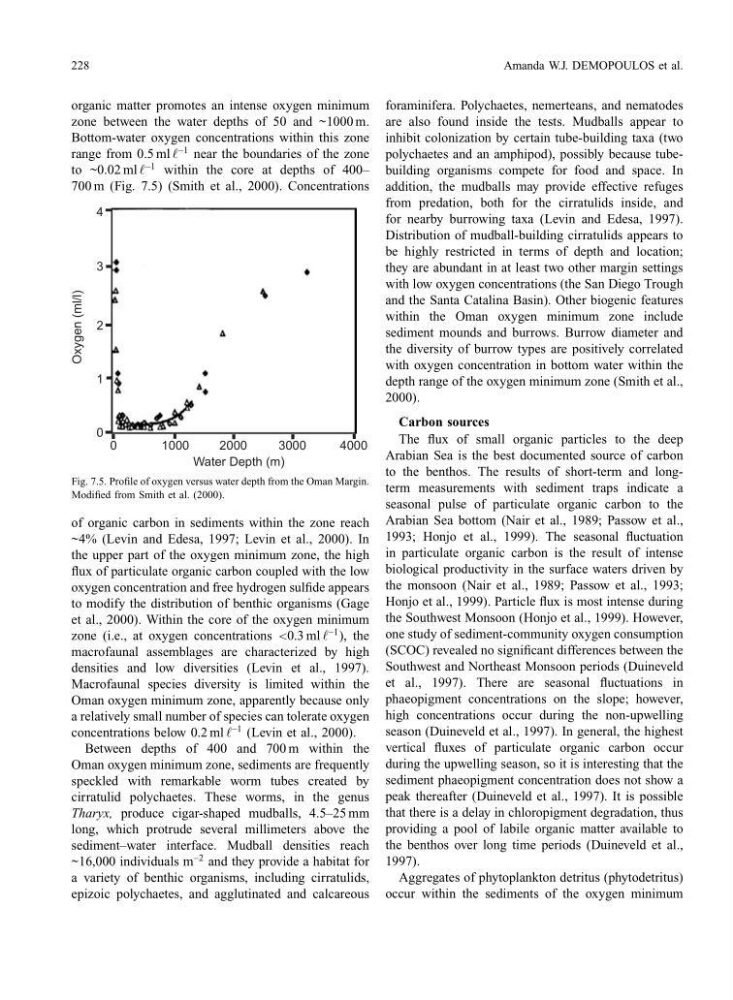
organic matter promotes an intense oxygen minimum
zone between the water depths of 50 and ~1000 m.
Bottom-water oxygen concentrations within this zone
range from 0.5 ml °
−1 near the boundaries of the zone
to ~0.02 ml °
−1 within the core at depths of 400–
700 m (Fig. 7.5) (Smith et al., 2000). Concentrations
1000
2000
3000
4000
0
0
1
2
3
4
Water Depth (m)
Oxygen (ml/l)
Fig. 7.5. Profile of oxygen versus water depth from the Oman Margin.
Modified from Smith et al. (2000).
of organic carbon in sediments within the zone reach
~4% (Levin and Edesa, 1997; Levin et al., 2000). In
the upper part of the oxygen minimum zone, the high
flux of particulate organic carbon coupled with the low
oxygen concentration and free hydrogen sulfide appears
to modify the distribution of benthic organisms (Gage
et al., 2000). Within the core of the oxygen minimum
zone (i.e., at oxygen concentrations <0.3 ml °
−1 ), the
macrofaunal assemblages are characterized by high
densities and low diversities (Levin et al., 1997).
Macrofaunal species diversity is limited within the
Oman oxygen minimum zone, apparently because only
a relatively small number of species can tolerate oxygen
concentrations below 0.2 ml °
−1 (Levin et al., 2000).
Between depths of 400 and 700 m within the
Oman oxygen minimum zone, sediments are frequently
speckled with remarkable worm tubes created by
cirratulid polychaetes. These worms, in the genus
Tharyx, produce cigar-shaped mudballs, 4.5–25 mm
long, which protrude several millimeters above the
sediment–water interface. Mudball densities reach
~16,000 individuals m
−2 and they provide a habitat for
a variety of benthic organisms, including cirratulids,
epizoic polychaetes, and agglutinated and calcareous
foraminifera. Polychaetes, nemerteans, and nematodes
are also found inside the tests. Mudballs appear to
inhibit colonization by certain tube-building taxa (two
polychaetes and an amphipod), possibly because tubebuilding organisms compete for food and space. In
addition, the mudballs may provide effective refuges
from predation, both for the cirratulids inside, and
for nearby burrowing taxa (Levin and Edesa, 1997).
Distribution of mudball-building cirratulids appears to
be highly restricted in terms of depth and location;
they are abundant in at least two other margin settings
with low oxygen concentrations (the San Diego Trough
and the Santa Catalina Basin). Other biogenic features
within the Oman oxygen minimum zone include
sediment mounds and burrows. Burrow diameter and
the diversity of burrow types are positively correlated
with oxygen concentration in bottom water within the
depth range of the oxygen minimum zone (Smith et al.,
2000).
Carbon sources
The flux of small organic particles to the deep
Arabian Sea is the best documented source of carbon
to the benthos. The results of short-term and longterm measurements with sediment traps indicate a
seasonal pulse of particulate organic carbon to the
Arabian Sea bottom (Nair et al., 1989; Passow et al.,
1993; Honjo et al., 1999). The seasonal fluctuation
in particulate organic carbon is the result of intense
biological productivity in the surface waters driven by
the monsoon (Nair et al., 1989; Passow et al., 1993;
Honjo et al., 1999). Particle flux is most intense during
the Southwest Monsoon (Honjo et al., 1999). However,
one study of sediment-community oxygen consumption
(SCOC) revealed no significant differences between the
Southwest and Northeast Monsoon periods (Duineveld
et al., 1997). There are seasonal fluctuations in
phaeopigment concentrations on the slope; however,
high concentrations occur during the non-upwelling
season (Duineveld et al., 1997). In general, the highest
vertical fluxes of particulate organic carbon occur
during the upwelling season, so it is interesting that the
sediment phaeopigment concentration does not show a
peak thereafter (Duineveld et al., 1997). It is possible
that there is a delay in chloropigment degradation, thus
providing a pool of labile organic matter available to
the benthos over long time periods (Duineveld et al.,
1997).
Aggregates of phytoplankton detritus (phytodetritus)
occur within the sediments of the oxygen minimum
Amanda W.J. DEMOPOULOS et al.
organic matter promotes an intense oxygen minimum
zone between the water depths of 50 and ~1000 m.
Bottom-water oxygen concentrations within this zone
range from 0.5 ml °
−1 near the boundaries of the zone
to ~0.02 ml °
−1 within the core at depths of 400–
700 m (Fig. 7.5) (Smith et al., 2000). Concentrations
1000
2000
3000
4000
0
0
1
2
3
4
Water Depth (m)
Oxygen (ml/l)
Fig. 7.5. Profile of oxygen versus water depth from the Oman Margin.
Modified from Smith et al. (2000).
of organic carbon in sediments within the zone reach
~4% (Levin and Edesa, 1997; Levin et al., 2000). In
the upper part of the oxygen minimum zone, the high
flux of particulate organic carbon coupled with the low
oxygen concentration and free hydrogen sulfide appears
to modify the distribution of benthic organisms (Gage
et al., 2000). Within the core of the oxygen minimum
zone (i.e., at oxygen concentrations <0.3 ml °
−1 ), the
macrofaunal assemblages are characterized by high
densities and low diversities (Levin et al., 1997).
Macrofaunal species diversity is limited within the
Oman oxygen minimum zone, apparently because only
a relatively small number of species can tolerate oxygen
concentrations below 0.2 ml °
−1 (Levin et al., 2000).
Between depths of 400 and 700 m within the
Oman oxygen minimum zone, sediments are frequently
speckled with remarkable worm tubes created by
cirratulid polychaetes. These worms, in the genus
Tharyx, produce cigar-shaped mudballs, 4.5–25 mm
long, which protrude several millimeters above the
sediment–water interface. Mudball densities reach
~16,000 individuals m
−2 and they provide a habitat for
a variety of benthic organisms, including cirratulids,
epizoic polychaetes, and agglutinated and calcareous
foraminifera. Polychaetes, nemerteans, and nematodes
are also found inside the tests. Mudballs appear to
inhibit colonization by certain tube-building taxa (two
polychaetes and an amphipod), possibly because tubebuilding organisms compete for food and space. In
addition, the mudballs may provide effective refuges
from predation, both for the cirratulids inside, and
for nearby burrowing taxa (Levin and Edesa, 1997).
Distribution of mudball-building cirratulids appears to
be highly restricted in terms of depth and location;
they are abundant in at least two other margin settings
with low oxygen concentrations (the San Diego Trough
and the Santa Catalina Basin). Other biogenic features
within the Oman oxygen minimum zone include
sediment mounds and burrows. Burrow diameter and
the diversity of burrow types are positively correlated
with oxygen concentration in bottom water within the
depth range of the oxygen minimum zone (Smith et al.,
2000).
Carbon sources
The flux of small organic particles to the deep
Arabian Sea is the best documented source of carbon
to the benthos. The results of short-term and longterm measurements with sediment traps indicate a
seasonal pulse of particulate organic carbon to the
Arabian Sea bottom (Nair et al., 1989; Passow et al.,
1993; Honjo et al., 1999). The seasonal fluctuation
in particulate organic carbon is the result of intense
biological productivity in the surface waters driven by
the monsoon (Nair et al., 1989; Passow et al., 1993;
Honjo et al., 1999). Particle flux is most intense during
the Southwest Monsoon (Honjo et al., 1999). However,
one study of sediment-community oxygen consumption
(SCOC) revealed no significant differences between the
Southwest and Northeast Monsoon periods (Duineveld
et al., 1997). There are seasonal fluctuations in
phaeopigment concentrations on the slope; however,
high concentrations occur during the non-upwelling
season (Duineveld et al., 1997). In general, the highest
vertical fluxes of particulate organic carbon occur
during the upwelling season, so it is interesting that the
sediment phaeopigment concentration does not show a
peak thereafter (Duineveld et al., 1997). It is possible
that there is a delay in chloropigment degradation, thus
providing a pool of labile organic matter available to
the benthos over long time periods (Duineveld et al.,
1997).
Aggregates of phytoplankton detritus (phytodetritus)
occur within the sediments of the oxygen minimum