

THE DEEP INDIAN OCEAN FLOOR
229
zone. Phytodetritus accumulations are usually thickest
in the fall, (up to 2 cm thick), but have also been
observed as a thin layer on the sediment surface during
the spring months (Prell and Murray, pers. comm.). The
deep oxygen minimum layer allows great quantities of
detrital material to sink to the deep sea, without being
recycled by mid-water consumers; this results in an
intense flux of labile organic material to the deep-sea
benthos (Gage et al., 2000). Thus, metazoan densities
and biomass observed in November may be a response
to the abundant phytodetritus available on the surface
sediments.
Faunal composition
Most of the quantitative data available for deepwater benthic metazoans in the oxygen minimum zone
were collected during November, which corresponds to
the onset of the Northeast Monsoon upwelling period
and is five months after the onset of the Southwest
Monsoon (Levin et al., 1997, 2000; Cook et al., 2000;
Gooday et al., 2000). Therefore, the abundance of
metazoans found during this period may result from
the seasonal pulse of organic matter. Sampling needs
to be conducted during other time periods to evaluate
any seasonal fluctuation in metazoan abundance and
biomass as a result of monsoonal forcing.
Megafauna: On the highly productive Oman margin, in the most intense oxygen-deficient layer, the
megafaunal assemblage has a high-biomass but low
diversity. Between 300 and 700 m, the community is
dominated by the spider crab Encephaloides armstrongi, a cocoon-dwelling mytilid (Amygdalum sp.),
and an ascidian (Styela gagetyleri) (Creasey et al.,
1997; Young and V´ azquez, 1997). At depths between
900 and 1000 m, oxygen levels and megafauna diversity increase, the community consisting primarily of
ophiacanthid ophiuroids, spider crabs, and galatheid
crabs, including an abundance of Munidopsis spp.
(Gage, 1995; Smallwood et al., 1999; Creasey et al.,
2000). The ophiacanthid Ophiolimna antarctica has a
density of 51 individuals m
−2 (Smallwood et al., 1999).
Encephaloides armstrongi is abundant throughout the
oxygen minimum zone on the Oman Margin and
appears to tolerate low oxygen concentrations (Creasey
et al., 1997; Smallwood et al., 1999). At 1000 m, the
density of crabs in general is approximately ten times
greater than that at 800 and 1250 m, with spider crabs
averaging 47 individuals m
−2 (Smallwood et al., 1999).
It is possible that this depth is a boundary between the
more significant oxygen minimum zone above and the
increasingly oxic conditions below (Smallwood et al.,
1999).
The high densities of spider crabs and ophiuroids in
the oxygen minimum zone have implications for the
burial of deposited organic material. Spider crabs and
ophiuroids may be highly mobile, and may resuspend
fine organic material from surface sediments; in
addition, phytoplankton-derived sterols are altered by
their digestive processes (Smallwood et al., 1999).
These megabenthic activities may influence the quality
of organic matter in organic-rich sediments on the
continental slope (Smallwood et al., 1999).
Macrofauna: The macrobenthos (for the Arabian
Sea, defined as animals retained on a 300 mm sieve)
are represented in the oxygen minimum zone by an
abundant, low-diversity soft-bodied fauna. Polychaetes
are the dominant group within this zone, defined by
the depth range 100–1000 m and oxygen concentrations <0.5 ml °
−1 (Herring et al., 1998). Spionids and
cirratulids are most common in the upper part of the
zone (400–700 m), where oxygen concentrations are
low (0.13 ml °
−1 ), and ampharetids and paraonids in the
lower portion (850–1000 m), where oxygen concentration increases to 0.29 ml °
−1 . Between 400 and 1000 m,
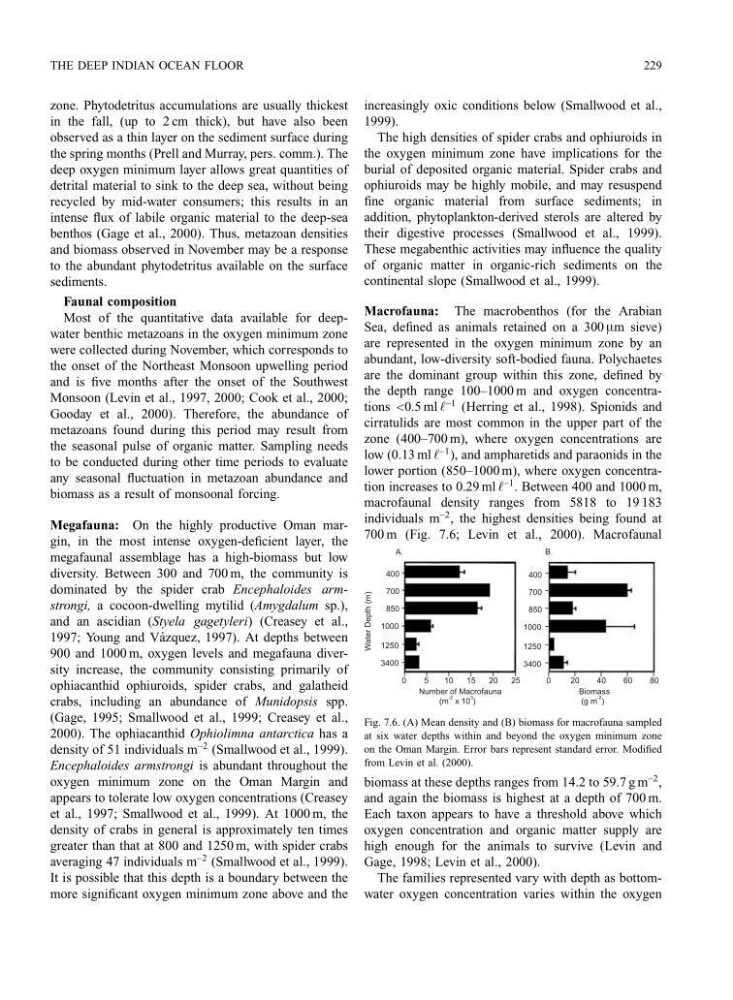
macrofaunal density ranges from 5818 to 19 183
individuals m
−2 , the highest densities being found at
700 m (Fig. 7.6; Levin et al., 2000). Macrofaunal
3400
1250
1000
850
700
400
3400
1250
1000
850
700
400
0
5
10
15
20
25
0
20
40
60
80
Number of Macrofauna
(m x 10 )
-2
3
Water Depth (m)
Biomass
(g m )
-2
A.
B.
Fig. 7.6. (A) Mean density and (B) biomass for macrofauna sampled
at six water depths within and beyond the oxygen minimum zone
on the Oman Margin. Error bars represent standard error. Modified
from Levin et al. (2000).
biomass at these depths ranges from 14.2 to 59.7 g m
−2 ,
and again the biomass is highest at a depth of 700 m.
Each taxon appears to have a threshold above which
oxygen concentration and organic matter supply are
high enough for the animals to survive (Levin and
Gage, 1998; Levin et al., 2000).
The families represented vary with depth as bottomwater oxygen concentration varies within the oxygen
229
zone. Phytodetritus accumulations are usually thickest
in the fall, (up to 2 cm thick), but have also been
observed as a thin layer on the sediment surface during
the spring months (Prell and Murray, pers. comm.). The
deep oxygen minimum layer allows great quantities of
detrital material to sink to the deep sea, without being
recycled by mid-water consumers; this results in an
intense flux of labile organic material to the deep-sea
benthos (Gage et al., 2000). Thus, metazoan densities
and biomass observed in November may be a response
to the abundant phytodetritus available on the surface
sediments.
Faunal composition
Most of the quantitative data available for deepwater benthic metazoans in the oxygen minimum zone
were collected during November, which corresponds to
the onset of the Northeast Monsoon upwelling period
and is five months after the onset of the Southwest
Monsoon (Levin et al., 1997, 2000; Cook et al., 2000;
Gooday et al., 2000). Therefore, the abundance of
metazoans found during this period may result from
the seasonal pulse of organic matter. Sampling needs
to be conducted during other time periods to evaluate
any seasonal fluctuation in metazoan abundance and
biomass as a result of monsoonal forcing.
Megafauna: On the highly productive Oman margin, in the most intense oxygen-deficient layer, the
megafaunal assemblage has a high-biomass but low
diversity. Between 300 and 700 m, the community is
dominated by the spider crab Encephaloides armstrongi, a cocoon-dwelling mytilid (Amygdalum sp.),
and an ascidian (Styela gagetyleri) (Creasey et al.,
1997; Young and V´ azquez, 1997). At depths between
900 and 1000 m, oxygen levels and megafauna diversity increase, the community consisting primarily of
ophiacanthid ophiuroids, spider crabs, and galatheid
crabs, including an abundance of Munidopsis spp.
(Gage, 1995; Smallwood et al., 1999; Creasey et al.,
2000). The ophiacanthid Ophiolimna antarctica has a
density of 51 individuals m
−2 (Smallwood et al., 1999).
Encephaloides armstrongi is abundant throughout the
oxygen minimum zone on the Oman Margin and
appears to tolerate low oxygen concentrations (Creasey
et al., 1997; Smallwood et al., 1999). At 1000 m, the
density of crabs in general is approximately ten times
greater than that at 800 and 1250 m, with spider crabs
averaging 47 individuals m
−2 (Smallwood et al., 1999).
It is possible that this depth is a boundary between the
more significant oxygen minimum zone above and the
increasingly oxic conditions below (Smallwood et al.,
1999).
The high densities of spider crabs and ophiuroids in
the oxygen minimum zone have implications for the
burial of deposited organic material. Spider crabs and
ophiuroids may be highly mobile, and may resuspend
fine organic material from surface sediments; in
addition, phytoplankton-derived sterols are altered by
their digestive processes (Smallwood et al., 1999).
These megabenthic activities may influence the quality
of organic matter in organic-rich sediments on the
continental slope (Smallwood et al., 1999).
Macrofauna: The macrobenthos (for the Arabian
Sea, defined as animals retained on a 300 mm sieve)
are represented in the oxygen minimum zone by an
abundant, low-diversity soft-bodied fauna. Polychaetes
are the dominant group within this zone, defined by
the depth range 100–1000 m and oxygen concentrations <0.5 ml °
−1 (Herring et al., 1998). Spionids and
cirratulids are most common in the upper part of the
zone (400–700 m), where oxygen concentrations are
low (0.13 ml °
−1 ), and ampharetids and paraonids in the
lower portion (850–1000 m), where oxygen concentration increases to 0.29 ml °
−1 . Between 400 and 1000 m,
macrofaunal density ranges from 5818 to 19 183
individuals m
−2 , the highest densities being found at
700 m (Fig. 7.6; Levin et al., 2000). Macrofaunal
3400
1250
1000
850
700
400
3400
1250
1000
850
700
400
0
5
10
15
20
25
0
20
40
60
80
Number of Macrofauna
(m x 10 )
-2
3
Water Depth (m)
Biomass
(g m )
-2
A.
B.
Fig. 7.6. (A) Mean density and (B) biomass for macrofauna sampled
at six water depths within and beyond the oxygen minimum zone
on the Oman Margin. Error bars represent standard error. Modified
from Levin et al. (2000).
biomass at these depths ranges from 14.2 to 59.7 g m
−2 ,
and again the biomass is highest at a depth of 700 m.
Each taxon appears to have a threshold above which
oxygen concentration and organic matter supply are
high enough for the animals to survive (Levin and
Gage, 1998; Levin et al., 2000).
The families represented vary with depth as bottomwater oxygen concentration varies within the oxygen