

76
Climatic Geomorphology
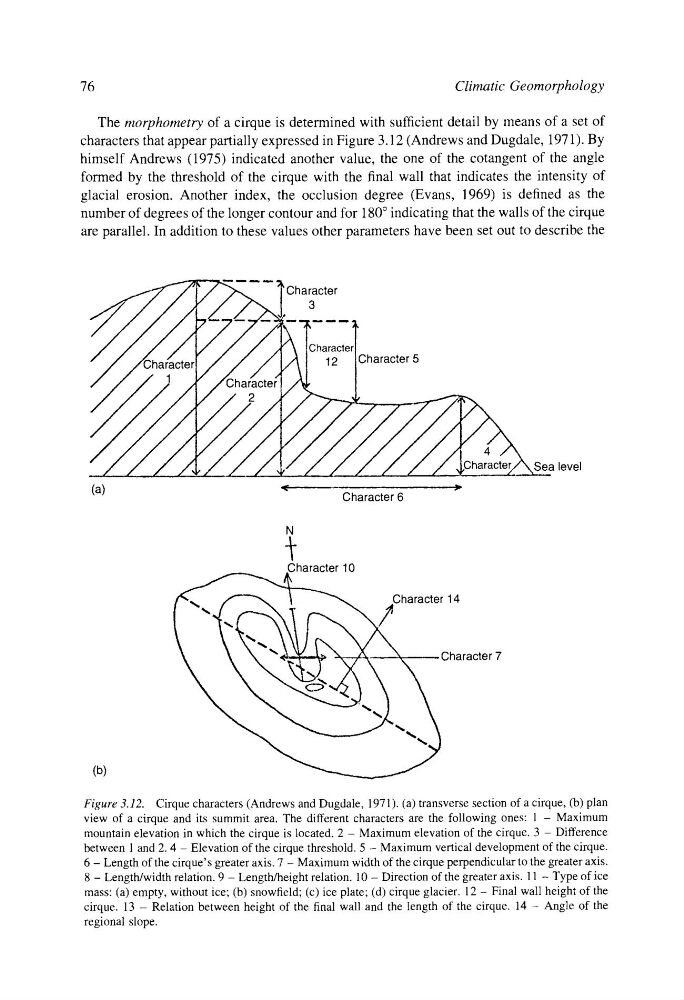
The morphometry of a cirque is determined with sufficient detail by means of a set of
characters that appear partially expressed in Figure 3.12 (Andrews and Dugdale, 1971). By
himself Andrews (1975) indicated another value, the one of the cotangent of the angle
formed by the threshold of the cirque with the final wall that indicates the intensity of
glacial erosion. Another index, the occlusion degree (Evans, 1969) is defined as the
number of degrees of the longer contour and for 180 ~ indicating that the walls of the cirque
are parallel. In addition to these values other parameters have been set out to describe the
Chi arac' er3
7-/
....
'
razte
/
12 Character 5
/ /" /
1 z'~ /Characte, /
/////" ""
,/ / //
ea
(a)
Character 6
N
#
Character 10
Character 14
!
Character 7
level
(b)
Figure 3.12. Cirque characters (Andrews and Dugdale, 1971). (a) transverse section of a cirque, (b) plan
view of a cirque and its summit area. The different characters are the following ones: 1 - Maximum
mountain elevation in which the cirque is located. 2 - Maximum elevation of the cirque. 3 - Difference
between 1 and 2.4 - Elevation of the cirque threshold. 5 - Maximum vertical development of the cirque.
6 - Length of the cirque' s greater axis. 7 - Maximum width of the cirque perpendicular to the greater axis.
8 - Length/width relation. 9 - Length/height relation. 10 - Direction of the greater axis. 11 - Type of ice
mass: (a) empty, without ice; (b) snowfield; (c) ice plate; (d) cirque glacier. 12 - Final wall height of the
cirque. 13 - Relation between height of the final wall and the length of the cirque. 14 - Angle of the
regional slope.
Climatic Geomorphology
The morphometry of a cirque is determined with sufficient detail by means of a set of
characters that appear partially expressed in Figure 3.12 (Andrews and Dugdale, 1971). By
himself Andrews (1975) indicated another value, the one of the cotangent of the angle
formed by the threshold of the cirque with the final wall that indicates the intensity of
glacial erosion. Another index, the occlusion degree (Evans, 1969) is defined as the
number of degrees of the longer contour and for 180 ~ indicating that the walls of the cirque
are parallel. In addition to these values other parameters have been set out to describe the
Chi arac' er3
7-/
....
'
razte
/
12 Character 5
/ /" /
1 z'~ /Characte, /
/////" ""
,/ / //
ea
(a)
Character 6
N
#
Character 10
Character 14
!
Character 7
level
(b)
Figure 3.12. Cirque characters (Andrews and Dugdale, 1971). (a) transverse section of a cirque, (b) plan
view of a cirque and its summit area. The different characters are the following ones: 1 - Maximum
mountain elevation in which the cirque is located. 2 - Maximum elevation of the cirque. 3 - Difference
between 1 and 2.4 - Elevation of the cirque threshold. 5 - Maximum vertical development of the cirque.
6 - Length of the cirque' s greater axis. 7 - Maximum width of the cirque perpendicular to the greater axis.
8 - Length/width relation. 9 - Length/height relation. 10 - Direction of the greater axis. 11 - Type of ice
mass: (a) empty, without ice; (b) snowfield; (c) ice plate; (d) cirque glacier. 12 - Final wall height of the
cirque. 13 - Relation between height of the final wall and the length of the cirque. 14 - Angle of the
regional slope.