

Glacial erosion
75
to the passage of the ice, perpetuated and emphasized by its action; at other times, glacial
erosion processes are the ones that generate these closed depressions.
2.4. Cirques
Cirques are, along with glacial valleys, the most spectacular forms of glacial erosion. The
texts on glacial geomorphology indicate that the word "cirque" was used for the first time
in the Pyrenees by Jean de Charpentier in 1823. On the other hand, various denotations for
cirque in different languages and countries do exist. We can consider the glacial cirque to
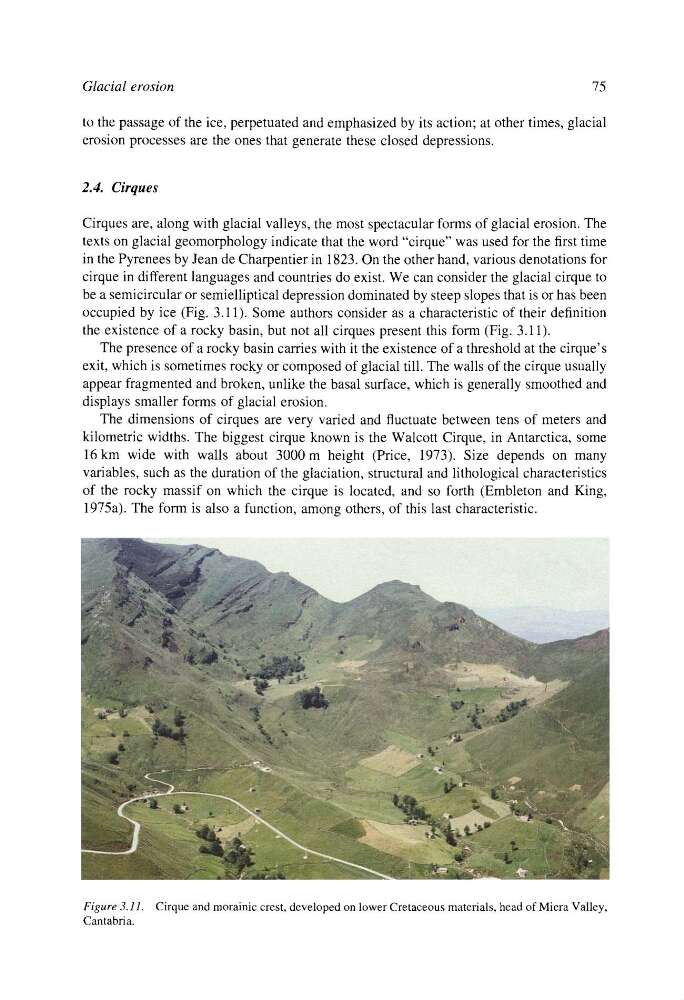
be a semicircular or semielliptical depression dominated by steep slopes that is or has been
occupied by ice (Fig. 3.11). Some authors consider as a characteristic of their definition
the existence of a rocky basin, but not all cirques present this form (Fig. 3.11).
The presence of a rocky basin carries with it the existence of a threshold at the cirque's
exit, which is sometimes rocky or composed of glacial till. The walls of the cirque usually
appear fragmented and broken, unlike the basal surface, which is generally smoothed and
displays smaller forms of glacial erosion.
The dimensions of cirques are very varied and fluctuate between tens of meters and
kilometric widths. The biggest cirque known is the Walcott Cirque, in Antarctica, some
16 km wide with walls about 3000m height (Price, 1973). Size depends on many
variables, such as the duration of the glaciation, structural and lithological characteristics
of the rocky massif on which the cirque is located, and so forth (Embleton and King,
1975a). The form is also a function, among others, of this last characteristic.
Figure 3.11. Cirque and morainic crest, developed on lower Cretaceous materials, head of Miera Valley,
Cantabria.
75
to the passage of the ice, perpetuated and emphasized by its action; at other times, glacial
erosion processes are the ones that generate these closed depressions.
2.4. Cirques
Cirques are, along with glacial valleys, the most spectacular forms of glacial erosion. The
texts on glacial geomorphology indicate that the word "cirque" was used for the first time
in the Pyrenees by Jean de Charpentier in 1823. On the other hand, various denotations for
cirque in different languages and countries do exist. We can consider the glacial cirque to
be a semicircular or semielliptical depression dominated by steep slopes that is or has been
occupied by ice (Fig. 3.11). Some authors consider as a characteristic of their definition
the existence of a rocky basin, but not all cirques present this form (Fig. 3.11).
The presence of a rocky basin carries with it the existence of a threshold at the cirque's
exit, which is sometimes rocky or composed of glacial till. The walls of the cirque usually
appear fragmented and broken, unlike the basal surface, which is generally smoothed and
displays smaller forms of glacial erosion.
The dimensions of cirques are very varied and fluctuate between tens of meters and
kilometric widths. The biggest cirque known is the Walcott Cirque, in Antarctica, some
16 km wide with walls about 3000m height (Price, 1973). Size depends on many
variables, such as the duration of the glaciation, structural and lithological characteristics
of the rocky massif on which the cirque is located, and so forth (Embleton and King,
1975a). The form is also a function, among others, of this last characteristic.
Figure 3.11. Cirque and morainic crest, developed on lower Cretaceous materials, head of Miera Valley,
Cantabria.