

74
Climatic Geomorphology
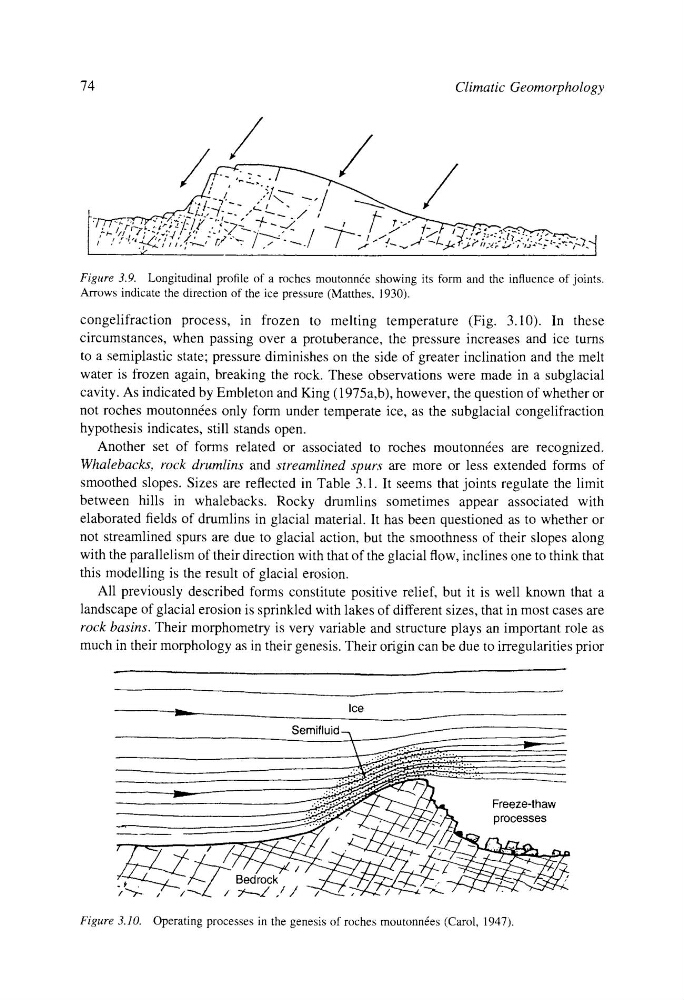
Figure 3.9. Longitudinal profile of a roches moutonn~e showing its form and the influence of joints.
Arrows indicate the direction of the ice pressure (Matthes, 1930).
congelifraction process, in frozen to melting temperature (Fig. 3.10). In these
circumstances, when passing over a protuberance, the pressure increases and ice turns
to a semiplastic state; pressure diminishes on the side of greater inclination and the melt
water is frozen again, breaking the rock. These observations were made in a subglacial
cavity. As indicated by Embleton and King (1975a,b), however, the question of whether or
not roches moutonn6es only form under temperate ice, as the subglacial congelifraction
hypothesis indicates, still stands open.
Another set of forms related or associated to roches moutonn6es are recognized.
Whalebacks, rock drumlins and streamlined spurs are more or less extended forms of
smoothed slopes. Sizes are reflected in Table 3.1. It seems that joints regulate the limit
between hills in whalebacks. Rocky drumlins sometimes appear associated with
elaborated fields of drumlins in glacial material. It has been questioned as to whether or
not streamlined spurs are due to glacial action, but the smoothness of their slopes along
with the parallelism of their direction with that of the glacial flow, inclines one to think that
this modelling is the result of glacial erosion.
All previously described forms constitute positive relief, but it is well known that a
landscape of glacial erosion is sprinkled with lakes of different sizes, that in most cases are
rock basins. Their morphometry is very variable and structure plays an important role as
much in their morphology as in their genesis. Their origin can be due to irregularities prior
Ice
Figure 3.10. Operating processes in the genesis of roches moutonn~es (Carol, 1947).
Climatic Geomorphology
Figure 3.9. Longitudinal profile of a roches moutonn~e showing its form and the influence of joints.
Arrows indicate the direction of the ice pressure (Matthes, 1930).
congelifraction process, in frozen to melting temperature (Fig. 3.10). In these
circumstances, when passing over a protuberance, the pressure increases and ice turns
to a semiplastic state; pressure diminishes on the side of greater inclination and the melt
water is frozen again, breaking the rock. These observations were made in a subglacial
cavity. As indicated by Embleton and King (1975a,b), however, the question of whether or
not roches moutonn6es only form under temperate ice, as the subglacial congelifraction
hypothesis indicates, still stands open.
Another set of forms related or associated to roches moutonn6es are recognized.
Whalebacks, rock drumlins and streamlined spurs are more or less extended forms of
smoothed slopes. Sizes are reflected in Table 3.1. It seems that joints regulate the limit
between hills in whalebacks. Rocky drumlins sometimes appear associated with
elaborated fields of drumlins in glacial material. It has been questioned as to whether or
not streamlined spurs are due to glacial action, but the smoothness of their slopes along
with the parallelism of their direction with that of the glacial flow, inclines one to think that
this modelling is the result of glacial erosion.
All previously described forms constitute positive relief, but it is well known that a
landscape of glacial erosion is sprinkled with lakes of different sizes, that in most cases are
rock basins. Their morphometry is very variable and structure plays an important role as
much in their morphology as in their genesis. Their origin can be due to irregularities prior
Ice
Figure 3.10. Operating processes in the genesis of roches moutonn~es (Carol, 1947).