

Glacial erosion
77
morphometric characteristics of a cirque. In general, these values lack precision because
they are taken from topographic maps and, in some cases, for some parameters the
subjectivity of the investigator plays a role. As indicated by Andrews (1975), however,
"the morphologic analysis of cirques can provide great information about the erosion
processes in the cirque, although only of a deductive type: morphology is an answer to
processes...".
In order to understand better the processes that have given rise to its form, it is
necessary to understand, among others, the structure and movement of ice in glacial
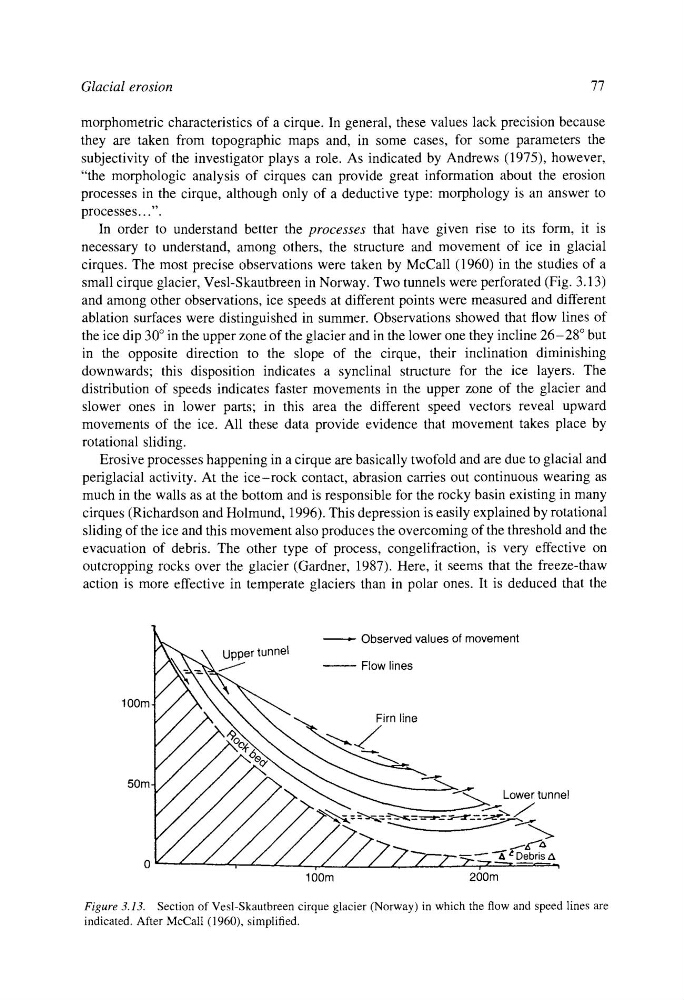
cirques. The most precise observations were taken by McCall (1960) in the studies of a
small cirque glacier, Vesl-Skautbreen in Norway. Two tunnels were perforated (Fig. 3.13)
and among other observations, ice speeds at different points were measured and different
ablation surfaces were distinguished in summer. Observations showed that flow lines of
the ice dip 30 ~ in the upper zone of the glacier and in the lower one they incline 26-28 ~ but
in the opposite direction to the slope of the cirque, their inclination diminishing
downwards; this disposition indicates a synclinal structure for the ice layers. The
distribution of speeds indicates faster movements in the upper zone of the glacier and
slower ones in lower parts; in this area the different speed vectors reveal upward
movements of the ice. All these data provide evidence that movement takes place by
rotational sliding.
Erosive processes happening in a cirque are basically twofold and are due to glacial and
periglacial activity. At the ice-rock contact, abrasion carries out continuous wearing as
much in the walls as at the bottom and is responsible for the rocky basin existing in many
cirques (Richardson and Holmund, 1996). This depression is easily explained by rotational
sliding of the ice and this movement also produces the overcoming of the threshold and the
evacuation of debris. The other type of process, congelifraction, is very effective on
outcropping rocks over the glacier (Gardner, 1987). Here, it seems that the freeze-thaw
action is more effective in temperate glaciers than in polar ones. It is deduced that the
l OOm
50m.
\
)
/
l
l
I
I
J
.~er tunnel
/
r
,
.
/
Observed values of movement
Flow lines
l OOm
Firn line
~.....~Lo~,r ~
tunnel
/
~
_~ ~-",,
U/~?~
ZT--' ZT-" ~'~,.. & ~ Debri s ~,
200m
Figure 3.13. Section of Vesl-Skautbreen cirque glacier (Norway) in which the flow and speed lines are
indicated. After McCall (1960), simplified.
77
morphometric characteristics of a cirque. In general, these values lack precision because
they are taken from topographic maps and, in some cases, for some parameters the
subjectivity of the investigator plays a role. As indicated by Andrews (1975), however,
"the morphologic analysis of cirques can provide great information about the erosion
processes in the cirque, although only of a deductive type: morphology is an answer to
processes...".
In order to understand better the processes that have given rise to its form, it is
necessary to understand, among others, the structure and movement of ice in glacial
cirques. The most precise observations were taken by McCall (1960) in the studies of a
small cirque glacier, Vesl-Skautbreen in Norway. Two tunnels were perforated (Fig. 3.13)
and among other observations, ice speeds at different points were measured and different
ablation surfaces were distinguished in summer. Observations showed that flow lines of
the ice dip 30 ~ in the upper zone of the glacier and in the lower one they incline 26-28 ~ but
in the opposite direction to the slope of the cirque, their inclination diminishing
downwards; this disposition indicates a synclinal structure for the ice layers. The
distribution of speeds indicates faster movements in the upper zone of the glacier and
slower ones in lower parts; in this area the different speed vectors reveal upward
movements of the ice. All these data provide evidence that movement takes place by
rotational sliding.
Erosive processes happening in a cirque are basically twofold and are due to glacial and
periglacial activity. At the ice-rock contact, abrasion carries out continuous wearing as
much in the walls as at the bottom and is responsible for the rocky basin existing in many
cirques (Richardson and Holmund, 1996). This depression is easily explained by rotational
sliding of the ice and this movement also produces the overcoming of the threshold and the
evacuation of debris. The other type of process, congelifraction, is very effective on
outcropping rocks over the glacier (Gardner, 1987). Here, it seems that the freeze-thaw
action is more effective in temperate glaciers than in polar ones. It is deduced that the
l OOm
50m.
\
)
/
l
l
I
I
J
.~er tunnel
/
r
,
.
/
Observed values of movement
Flow lines
l OOm
Firn line
~.....~Lo~,r ~
tunnel
/
~
_~ ~-",,
U/~?~
ZT--' ZT-" ~'~,.. & ~ Debri s ~,
200m
Figure 3.13. Section of Vesl-Skautbreen cirque glacier (Norway) in which the flow and speed lines are
indicated. After McCall (1960), simplified.