

72
Climatic Geomorphology
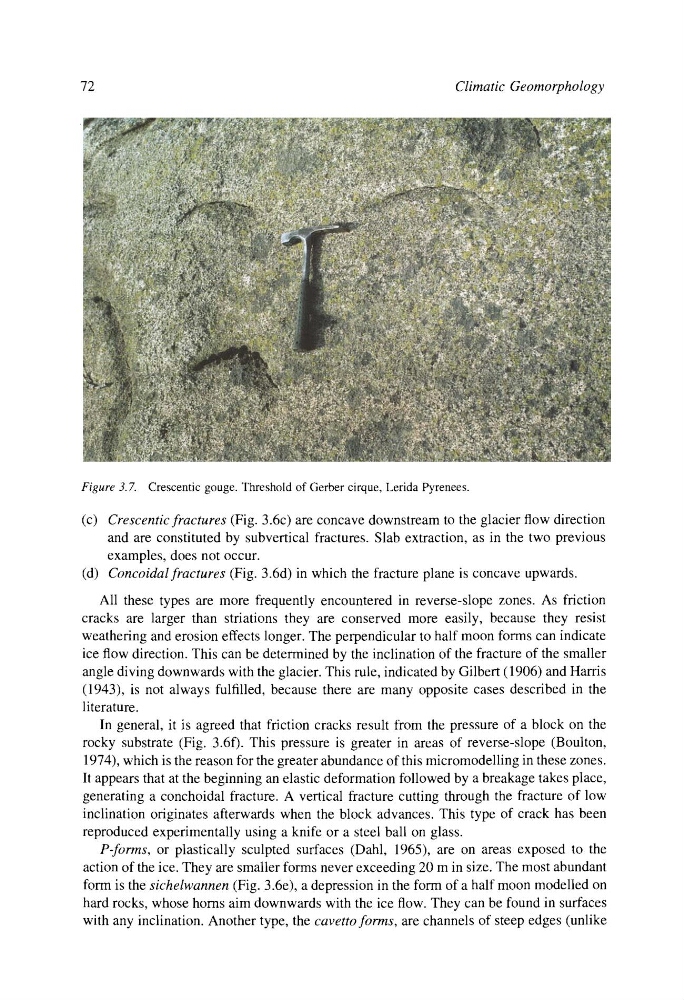
Figure 3.7. Crescentic gouge. Threshold of Gerber cirque, Lerida Pyrenees.
(c) Crescentic fractures (Fig. 3.6c) are concave downstream to the glacier flow direction
and are constituted by subvertical fractures. Slab extraction, as in the two previous
examples, does not occur.
(d) Concoidalfractures (Fig. 3.6d) in which the fracture plane is concave upwards.
All these types are more frequently encountered in reverse-slope zones. As friction
cracks are larger than striations they are conserved more easily, because they resist
weathering and erosion effects longer. The perpendicular to half moon forms can indicate
ice flow direction. This can be determined by the inclination of the fracture of the smaller
angle diving downwards with the glacier. This rule, indicated by Gilbert (1906) and Harris
(1943), is not always fulfilled, because there are many opposite cases described in the
literature.
In general, it is agreed that friction cracks result from the pressure of a block on the
rocky substrate (Fig. 3.6f). This pressure is greater in areas of reverse-slope (Boulton,
1974), which is the reason for the greater abundance of this micromodelling in these zones.
It appears that at the beginning an elastic deformation followed by a breakage takes place,
generating a conchoidal fracture. A vertical fracture cutting through the fracture of low
inclination originates afterwards when the block advances. This type of crack has been
reproduced experimentally using a knife or a steel ball on glass.
P-forms, or plastically sculpted surfaces (Dahl, 1965), are on areas exposed to the
action of the ice. They are smaller forms never exceeding 20 m in size. The most abundant
form is the sichelwannen (Fig. 3.6e), a depression in the form of a half moon modelled on
hard rocks, whose horns aim downwards with the ice flow. They can be found in surfaces
with any inclination. Another type, the cavetto forms, are channels of steep edges (unlike
Climatic Geomorphology
Figure 3.7. Crescentic gouge. Threshold of Gerber cirque, Lerida Pyrenees.
(c) Crescentic fractures (Fig. 3.6c) are concave downstream to the glacier flow direction
and are constituted by subvertical fractures. Slab extraction, as in the two previous
examples, does not occur.
(d) Concoidalfractures (Fig. 3.6d) in which the fracture plane is concave upwards.
All these types are more frequently encountered in reverse-slope zones. As friction
cracks are larger than striations they are conserved more easily, because they resist
weathering and erosion effects longer. The perpendicular to half moon forms can indicate
ice flow direction. This can be determined by the inclination of the fracture of the smaller
angle diving downwards with the glacier. This rule, indicated by Gilbert (1906) and Harris
(1943), is not always fulfilled, because there are many opposite cases described in the
literature.
In general, it is agreed that friction cracks result from the pressure of a block on the
rocky substrate (Fig. 3.6f). This pressure is greater in areas of reverse-slope (Boulton,
1974), which is the reason for the greater abundance of this micromodelling in these zones.
It appears that at the beginning an elastic deformation followed by a breakage takes place,
generating a conchoidal fracture. A vertical fracture cutting through the fracture of low
inclination originates afterwards when the block advances. This type of crack has been
reproduced experimentally using a knife or a steel ball on glass.
P-forms, or plastically sculpted surfaces (Dahl, 1965), are on areas exposed to the
action of the ice. They are smaller forms never exceeding 20 m in size. The most abundant
form is the sichelwannen (Fig. 3.6e), a depression in the form of a half moon modelled on
hard rocks, whose horns aim downwards with the ice flow. They can be found in surfaces
with any inclination. Another type, the cavetto forms, are channels of steep edges (unlike