

Labile landforms are rapidly modified under extreme events or they have limited
resistance to change. Their response is almost parallel to climate change. On the contrary,
sluggish landforms are subordinated to weak processes or present a large resistance to
change.
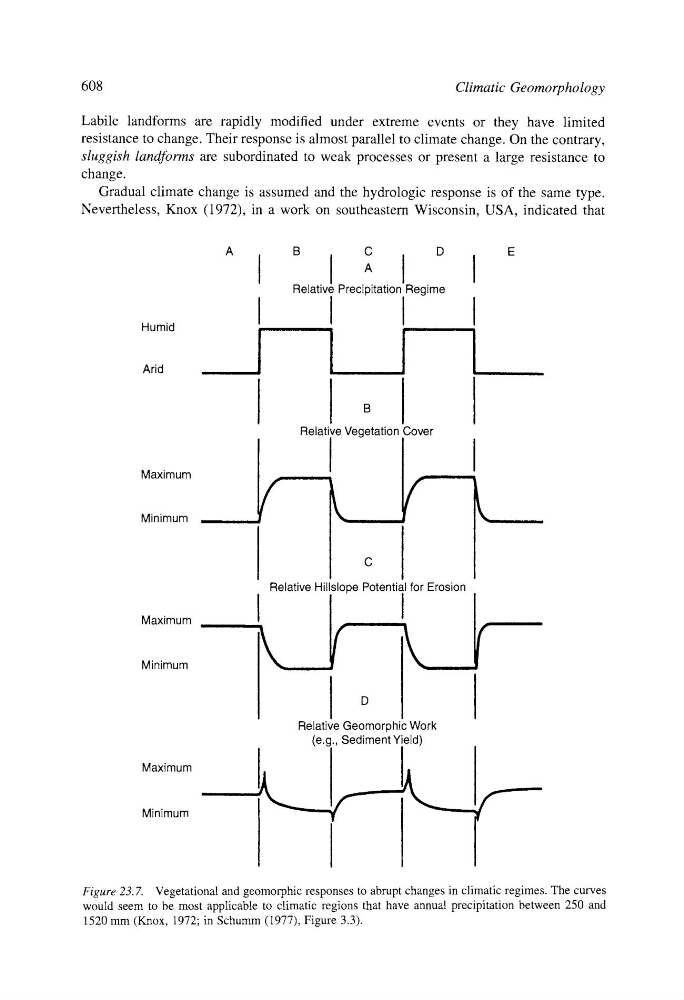
Gradual climate change is assumed and the hydrologic response is of the same type.
Nevertheless, Knox (1972), in a work on southeastern Wisconsin, USA, indicated that
Humid
Maximum
Minimum
A
B
C
D
E
Relative Precipitation Regime
I
I
. . . . 1
i
]
B
Relative Vegetation Cover
Maximum
Minimum
~
, , ,,,,
,
LIF-- L_ I
I
III
I I
II
Maximum
Relative Hillslope Potential for Erosion
D
Arid
Relative Geomorphic Work
(e.g., Sediment Yield)
Minimum
608
Climatic Geomorphology
Figure 23.7. Vegetational and geomorphic responses to abrupt changes in climatic regimes. The curves
would seem to be most applicable to climatic regions that have annual precipitation between 250 and
1520 mm (Knox, 1972; in Schumm (1977), Figure 3.3).