

Environmental change
607
reach a balance with the new conditions faster and permit carrying out the analysis of short
time spans. Temporal changes can be slow and gradual or sudden and catastrophic.
In general landforms present a slow response to climate change, so they commonly can be
analysed only for long time periods. To understand the more or less rapid changes in the
development of landscapes, it is necessary to know as well as possible the magnitude of
the processes and their temporal record. All this can lead to the understanding of the
sensitivity of geomophic systems (Allison and Thomas, 1993). It is possible to distinguish
those landscapes of high sensitivity to external impulse which respond rapidly to climate
change, such as fluvial channels. Insensitive systems are those whose response is slow and
present a strong resistance to change such as interfluve areas or the plains of Africa and
Australia. Insensitive areas commonly correspond to landforms originated on resistant
lithologies, whereas in sensitive zones small changes take place more rapidly, as is shown
in rilling areas (Brunsden and Thornes, 1979).
In desert areas, activation of the systems, which is necessary to produce a response on
the landscape, is generally much smaller than in other climatic zones. This indicates that
climatic sensitivity for arid zones landform generation is high because the relaxation time
necessary to reflect changes in the forms is low (Shaw and Thomas, 1993). These models
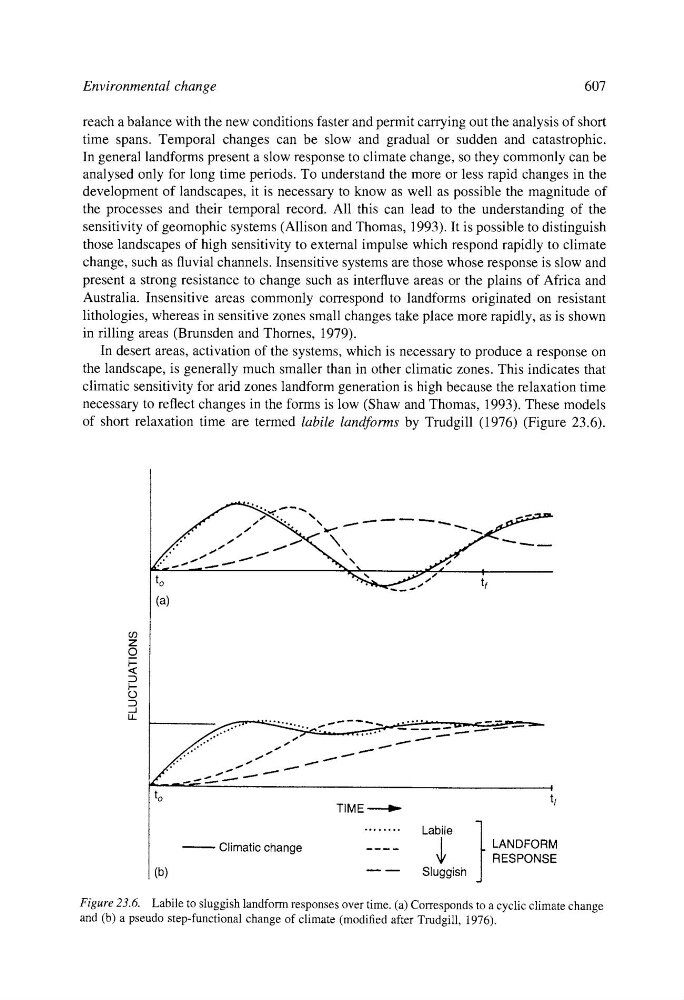
of short relaxation time are termed labile landforms by Trudgill (1976) (Figure 23.6).
to
"~'~,.~..~-_ .,,,,
tf
(a)
__
..,~._~n~,.,
~
,
(b)
-----.-- Climatic change
TIME
........ Labile~ -t
Sluggish
LANDFORM
RESPONSE
Figure 23.6. Labile to sluggish landform responses over time. (a) Corresponds to a cyclic climate change
and (b) a pseudo step-functional change of climate (modified after Trudgill, 1976).