

580
Climatic Geomorphology
6.2. Tower karst
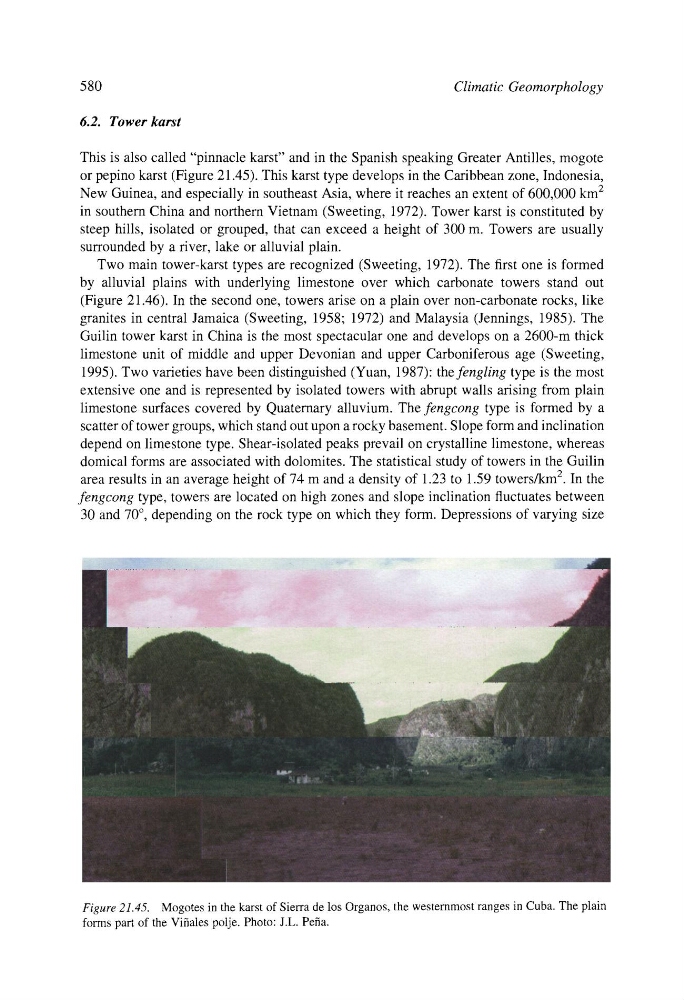
This is also called "pinnacle karst" and in the Spanish speaking Greater Antilles, mogote
or pepino karst (Figure 21.45). This karst type develops in the Caribbean zone, Indonesia,
New Guinea, and especially in southeast Asia, where it reaches an extent of 600,000 km 2
in southern China and northern Vietnam (Sweeting, 1972). Tower karst is constituted by
steep hills, isolated or grouped, that can exceed a height of 300 m. Towers are usually
surrounded by a fiver, lake or alluvial plain.
Two main tower-karst types are recognized (Sweeting, 1972). The first one is formed
by alluvial plains with underlying limestone over which carbonate towers stand out
(Figure 21.46). In the second one, towers arise on a plain over non-carbonate rocks, like
granites in central Jamaica (Sweeting, 1958; 1972) and Malaysia (Jennings, 1985). The
Guilin tower karst in China is the most spectacular one and develops on a 2600-m thick
limestone unit of middle and upper Devonian and upper Carboniferous age (Sweeting,
1995). Two varieties have been distinguished (Yuan, 1987): the fengling type is the most
extensive one and is represented by isolated towers with abrupt walls arising from plain
limestone surfaces covered by Quaternary alluvium. The fengcong type is formed by a
scatter of tower groups, which stand out upon a rocky basement. Slope form and inclination
depend on limestone type. Shear-isolated peaks prevail on crystalline limestone, whereas
domical forms are associated with dolomites. The statistical study of towers in the Guilin
area results in an average height of 74 m and a density of 1.23 to 1.59 towers/km 2. In the
fengcong type, towers are located on high zones and slope inclination fluctuates between
30 and 70 ~ depending on the rock type on which they form. Depressions of varying size
Figure 21.45. Mogotes in the karst of Sierra de los Organos, the westernmost ranges in Cuba. The plain
forms part of the Vifiales polje. Photo: J.L. Pefia.