

Tropical landforms
579
the dissolution and enlargement of a splitting plane, for which it can be considered as a
structural karren.
Cockpits are closed depressions with a star plan-form that develops at the cone foot
and are separated from each other by hill passes. This morphology is due to the intense
tropical heavy rains that cut gullies on slopes. Morphometric studies on the cone karst of
New Guinea seem to confirm this interpretation (Williams, 1972). In some cases,
cockpits are oriented following fracture lines. Where several cockpits coalesce, a glade is
generated (Sweeting, 1958; 1972), a Jamaican name equivalent to the uvala of the
temperate climate karst. Glades can present an irregular bottom, with small depressions
inside.
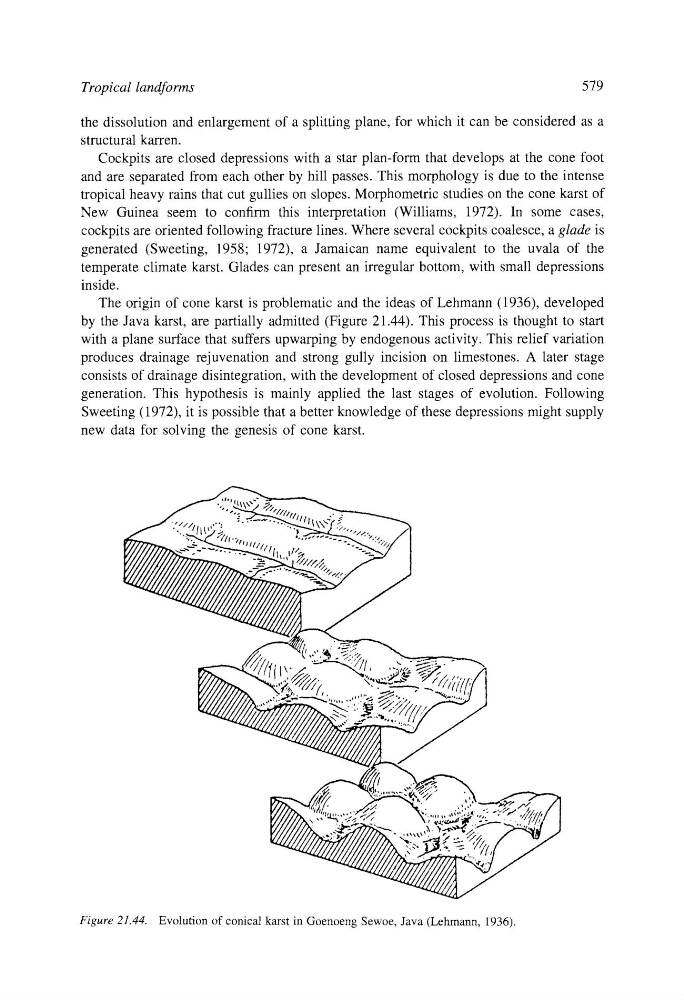
The origin of cone karst is problematic and the ideas of Lehmann (1936), developed
by the Java karst, are partially admitted (Figure 21.44). This process is thought to start
with a plane surface that suffers upwarping by endogenous activity. This relief variation
produces drainage rejuvenation and strong gully incision on limestones. A later stage
consists of drainage disintegration, with the development of closed depressions and cone
generation. This hypothesis is mainly applied the last stages of evolution. Following
Sweeting (1972), it is possible that a better knowledge of these depressions might supply
new data for solving the genesis of cone karst.
--_
Figure 21.44. Evolution of conical karst in Goenoeng Sewoe, Java (Lehmann, 1936).