

578
Climatic Geomorphology
6.1. Cone karst
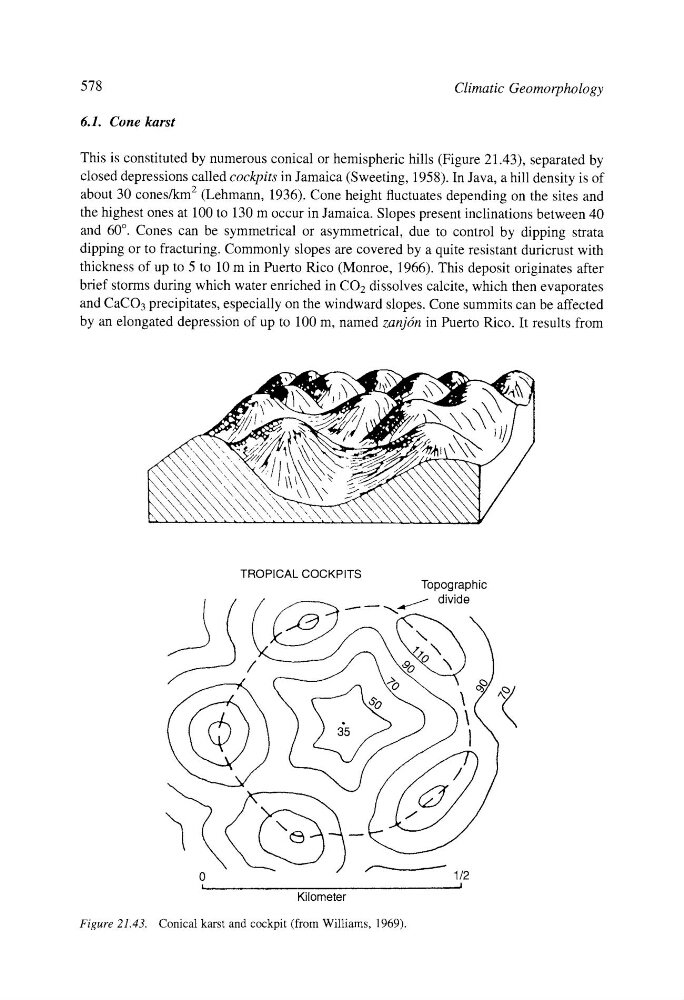
This is constituted by numerous conical or hemispheric hills (Figure 21.43), separated by
closed depressions called cockpits in Jamaica (Sweeting, 1958). In Java, a hill density is of
about 30 cones/km 2 (Lehmann, 1936). Cone height fluctuates depending on the sites and
the highest ones at 100 to 130 m occur in Jamaica. Slopes present inclinations between 40
and 60 ~ . Cones can be symmetrical or asymmetrical, due to control by dipping strata
dipping or to fracturing. Commonly slopes are covered by a quite resistant duricrust with
thickness of up to 5 to 10 m in Puerto Rico (Monroe, 1966). This deposit originates after
brief storms during which water enriched in CO2 dissolves calcite, which then evaporates
and CaCO3 precipitates, especially on the windward slopes. Cone summits can be affected
by an elongated depression of up to 100 m, named zanj6n in Puerto Rico. It results from
TROPICAL COCKPITS
Topographic
/ /, // ~
..-- -- ~.~,...,.~ divide,
0
1/2
I, .
.
.
.
.
Kilometer
Figure 21.43. Conical karst and cockpit (from Williams, 1969).