

Tropical landforms
553
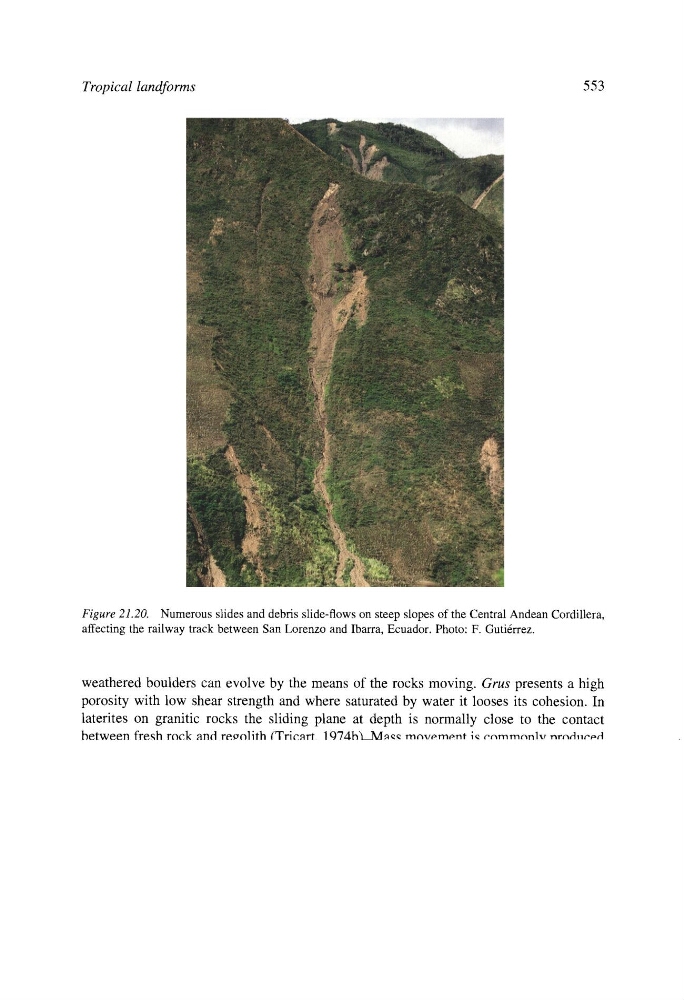
Figure 21.20. Numerous slides and debris slide-flows on steep slopes of the Central Andean Cordillera,
affecting the railway track between San Lorenzo and Ibarra, Ecuador. Photo: F. Guti~rrez.
weathered boulders can evolve by the means of the rocks moving. Grus presents a high
porosity with low shear strength and where saturated by water it looses its cohesion. In
laterites on granitic rocks the sliding plane at depth is normally close to the contact
between fresh rock and regolith (Tricart, 1974b). Mass movement is commonly produced
through rotational slides or slumps and block glides (Durgin, 1977). These slide types
prevail on the "meias laranjas" dome landform of southern Minas Gerais, Brazil (Tricart,
1974b). The existence of relict discontinuities in the regolith, including the basal
weathering surface and old sliding planes, favours water penetration which reduces shear
strength and can trigger translational slides. Some examples have been cited in the Sierra
de la Costa, Venezuela (Garner, 1960; in Tricart, 1974b).
Kaolinites existing in the regolith have a low shrinkage limit, by which they are
not cracked during dry periods. The presence of clay minerals of the 2:1 type
(montmorillonite), however, gives rise to an important contraction with fissure generation,
which allows rapid infiltration and the change to a liquid state, favouring slide generation.
553
Figure 21.20. Numerous slides and debris slide-flows on steep slopes of the Central Andean Cordillera,
affecting the railway track between San Lorenzo and Ibarra, Ecuador. Photo: F. Guti~rrez.
weathered boulders can evolve by the means of the rocks moving. Grus presents a high
porosity with low shear strength and where saturated by water it looses its cohesion. In
laterites on granitic rocks the sliding plane at depth is normally close to the contact
between fresh rock and regolith (Tricart, 1974b). Mass movement is commonly produced
through rotational slides or slumps and block glides (Durgin, 1977). These slide types
prevail on the "meias laranjas" dome landform of southern Minas Gerais, Brazil (Tricart,
1974b). The existence of relict discontinuities in the regolith, including the basal
weathering surface and old sliding planes, favours water penetration which reduces shear
strength and can trigger translational slides. Some examples have been cited in the Sierra
de la Costa, Venezuela (Garner, 1960; in Tricart, 1974b).
Kaolinites existing in the regolith have a low shrinkage limit, by which they are
not cracked during dry periods. The presence of clay minerals of the 2:1 type
(montmorillonite), however, gives rise to an important contraction with fissure generation,
which allows rapid infiltration and the change to a liquid state, favouring slide generation.