

552
Climatic Geomorphology
Flood basin
Levee and crevasse-splay
Fine grained channel-fill
Channel sands
0
miles
!0
9
.
.
.
.
.
,4,
4
,
A
J
Bluffs
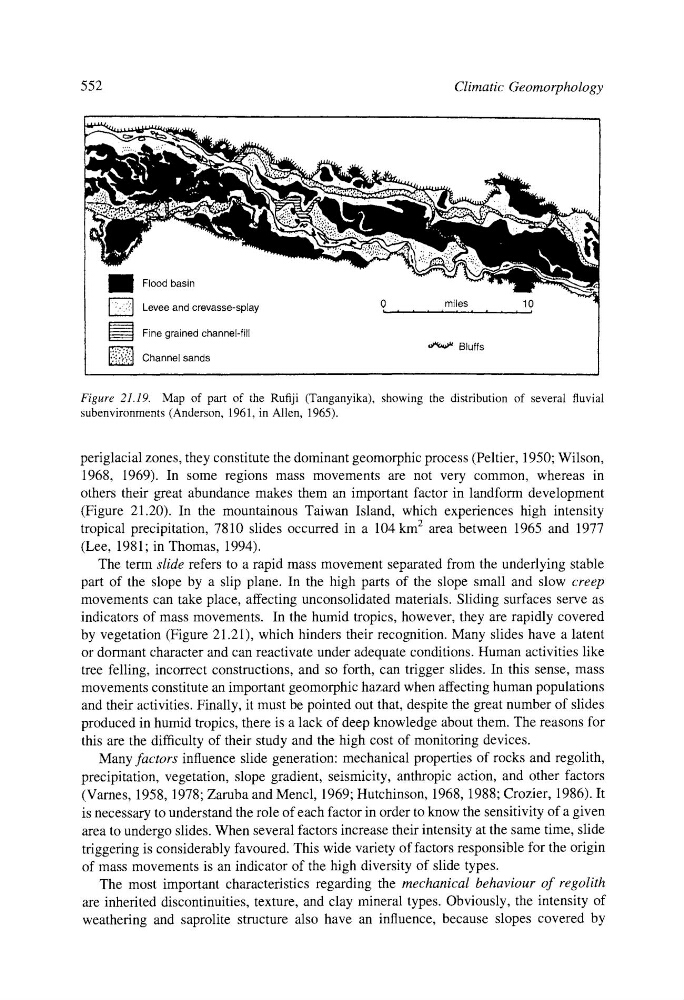
Figure 21.19. Map of part of the Rufiji (Tanganyika), showing the distribution of several fluvial
subenvironments (Anderson, 1961, in Allen, 1965).
periglacial zones, they constitute the dominant geomorphic process (Peltier, 1950; Wilson,
1968, 1969). In some regions mass movements are not very common, whereas in
others their great abundance makes them an important factor in landform development
(Figure 21.20). In the mountainous Taiwan Island, which experiences high intensity
tropical precipitation, 7810 slides occurred in a 104 km 2 area between 1965 and 1977
(Lee, 1981; in Thomas, 1994).
The term slide refers to a rapid mass movement separated from the underlying stable
part of the slope by a slip plane. In the high parts of the slope small and slow creep
movements can take place, affecting unconsolidated materials. Sliding surfaces serve as
indicators of mass movements. In the humid tropics, however, they are rapidly covered
by vegetation (Figure 21.21), which hinders their recognition. Many slides have a latent
or dormant character and can reactivate under adequate conditions. Human activities like
tree felling, incorrect constructions, and so forth, can trigger slides. In this sense, mass
movements constitute an important geomorphic hazard when affecting human populations
and their activities. Finally, it must be pointed out that, despite the great number of slides
produced in humid tropics, there is a lack of deep knowledge about them. The reasons for
this are the difficulty of their study and the high cost of monitoring devices.
Many factors influence slide generation: mechanical properties of rocks and regolith,
precipitation, vegetation, slope gradient, seismicity, anthropic action, and other factors
(Varnes, 1958, 1978; Zaruba and Mencl, 1969; Hutchinson, 1968, 1988; Crozier, 1986). It
is necessary to understand the role of each factor in order to know the sensitivity of a given
area to undergo slides. When several factors increase their intensity at the same time, slide
triggering is considerably favoured. This wide variety of factors responsible for the origin
of mass movements is an indicator of the high diversity of slide types.
The most important characteristics regarding the mechanical behaviour of regolith
are inherited discontinuities, texture, and clay mineral types. Obviously, the intensity of
weathering and saprolite structure also have an influence, because slopes covered by
Climatic Geomorphology
Flood basin
Levee and crevasse-splay
Fine grained channel-fill
Channel sands
0
miles
!0
9
.
.
.
.
.
,4,
4
,
A
J
Bluffs
Figure 21.19. Map of part of the Rufiji (Tanganyika), showing the distribution of several fluvial
subenvironments (Anderson, 1961, in Allen, 1965).
periglacial zones, they constitute the dominant geomorphic process (Peltier, 1950; Wilson,
1968, 1969). In some regions mass movements are not very common, whereas in
others their great abundance makes them an important factor in landform development
(Figure 21.20). In the mountainous Taiwan Island, which experiences high intensity
tropical precipitation, 7810 slides occurred in a 104 km 2 area between 1965 and 1977
(Lee, 1981; in Thomas, 1994).
The term slide refers to a rapid mass movement separated from the underlying stable
part of the slope by a slip plane. In the high parts of the slope small and slow creep
movements can take place, affecting unconsolidated materials. Sliding surfaces serve as
indicators of mass movements. In the humid tropics, however, they are rapidly covered
by vegetation (Figure 21.21), which hinders their recognition. Many slides have a latent
or dormant character and can reactivate under adequate conditions. Human activities like
tree felling, incorrect constructions, and so forth, can trigger slides. In this sense, mass
movements constitute an important geomorphic hazard when affecting human populations
and their activities. Finally, it must be pointed out that, despite the great number of slides
produced in humid tropics, there is a lack of deep knowledge about them. The reasons for
this are the difficulty of their study and the high cost of monitoring devices.
Many factors influence slide generation: mechanical properties of rocks and regolith,
precipitation, vegetation, slope gradient, seismicity, anthropic action, and other factors
(Varnes, 1958, 1978; Zaruba and Mencl, 1969; Hutchinson, 1968, 1988; Crozier, 1986). It
is necessary to understand the role of each factor in order to know the sensitivity of a given
area to undergo slides. When several factors increase their intensity at the same time, slide
triggering is considerably favoured. This wide variety of factors responsible for the origin
of mass movements is an indicator of the high diversity of slide types.
The most important characteristics regarding the mechanical behaviour of regolith
are inherited discontinuities, texture, and clay mineral types. Obviously, the intensity of
weathering and saprolite structure also have an influence, because slopes covered by