

554
Climatic Geomorphology
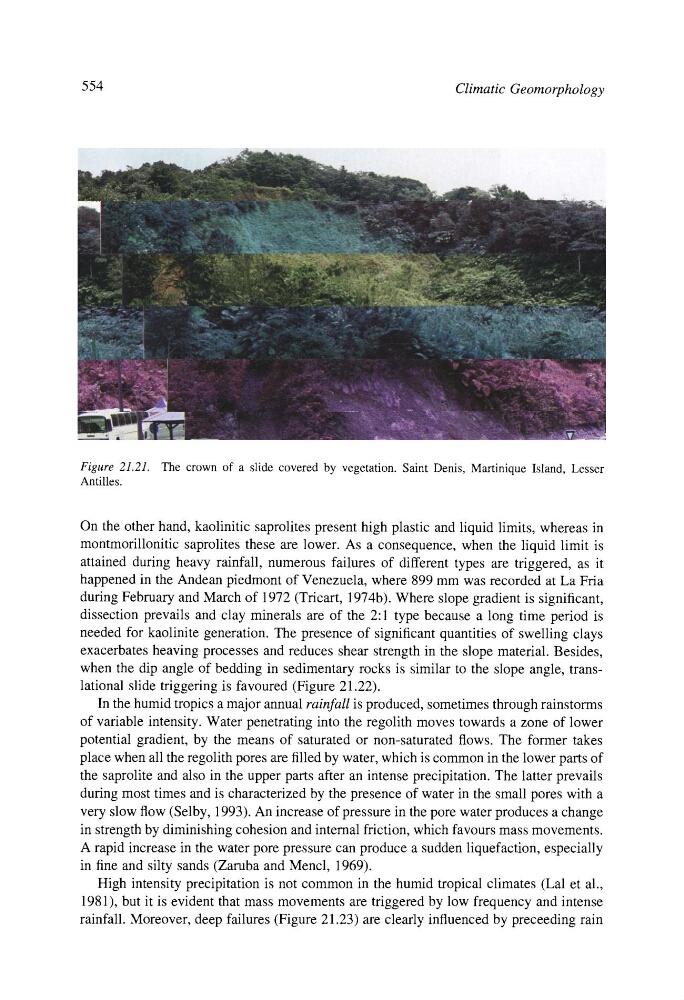
Figure 21.21. The crown of a slide covered by vegetation. Saint Denis, Martinique Island, Lesser
Antilles.
On the other hand, kaolinitic saprolites present high plastic and liquid limits, whereas in
montmorillonitic saprolites these are lower. As a consequence, when the liquid limit is
attained during heavy rainfall, numerous failures of different types are triggered, as it
happened in the Andean piedmont of Venezuela, where 899 mm was recorded at La Fria
during February and March of 1972 (Tricart, 1974b). Where slope gradient is significant,
dissection prevails and clay minerals are of the 2:1 type because a long time period is
needed for kaolinite generation. The presence of significant quantities of swelling clays
exacerbates heaving processes and reduces shear strength in the slope material. Besides,
when the dip angle of bedding in sedimentary rocks is similar to the slope angle, translational slide triggering is favoured (Figure 21.22).
In the humid tropics a major annual rainfall is produced, sometimes through rainstorms
of variable intensity. Water penetrating into the regolith moves towards a zone of lower
potential gradient, by the means of saturated or non-saturated flows. The former takes
place when all the regolith pores are filled by water, which is common in the lower parts of
the saprolite and also in the upper parts after an intense precipitation. The latter prevails
during most times and is characterized by the presence of water in the small pores with a
very slow flow (Selby, 1993). An increase of pressure in the pore water produces a change
in strength by diminishing cohesion and internal friction, which favours mass movements.
A rapid increase in the water pore pressure can produce a sudden liquefaction, especially
in fine and silty sands (Zaruba and Mencl, 1969).
High intensity precipitation is not common in the humid tropical climates (Lal et al.,
1981), but it is evident that mass movements are triggered by low frequency and intense
rainfall. Moreover, deep failures (Figure 21.23) are clearly influenced by preceeding rain
Climatic Geomorphology
Figure 21.21. The crown of a slide covered by vegetation. Saint Denis, Martinique Island, Lesser
Antilles.
On the other hand, kaolinitic saprolites present high plastic and liquid limits, whereas in
montmorillonitic saprolites these are lower. As a consequence, when the liquid limit is
attained during heavy rainfall, numerous failures of different types are triggered, as it
happened in the Andean piedmont of Venezuela, where 899 mm was recorded at La Fria
during February and March of 1972 (Tricart, 1974b). Where slope gradient is significant,
dissection prevails and clay minerals are of the 2:1 type because a long time period is
needed for kaolinite generation. The presence of significant quantities of swelling clays
exacerbates heaving processes and reduces shear strength in the slope material. Besides,
when the dip angle of bedding in sedimentary rocks is similar to the slope angle, translational slide triggering is favoured (Figure 21.22).
In the humid tropics a major annual rainfall is produced, sometimes through rainstorms
of variable intensity. Water penetrating into the regolith moves towards a zone of lower
potential gradient, by the means of saturated or non-saturated flows. The former takes
place when all the regolith pores are filled by water, which is common in the lower parts of
the saprolite and also in the upper parts after an intense precipitation. The latter prevails
during most times and is characterized by the presence of water in the small pores with a
very slow flow (Selby, 1993). An increase of pressure in the pore water produces a change
in strength by diminishing cohesion and internal friction, which favours mass movements.
A rapid increase in the water pore pressure can produce a sudden liquefaction, especially
in fine and silty sands (Zaruba and Mencl, 1969).
High intensity precipitation is not common in the humid tropical climates (Lal et al.,
1981), but it is evident that mass movements are triggered by low frequency and intense
rainfall. Moreover, deep failures (Figure 21.23) are clearly influenced by preceeding rain