

542
Climatic Geomorphology
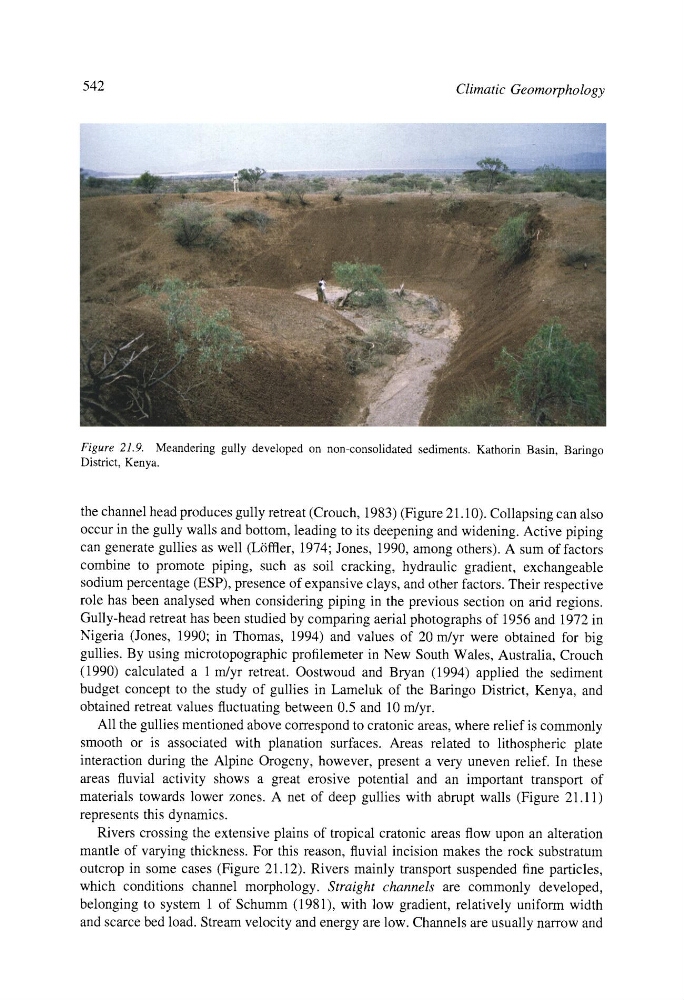
Figure 21.9. Meandering gully developed on non-consolidated sediments. Kathorin Basin, Baringo
District, Kenya.
the channel head produces gully retreat (Crouch, 1983) (Figure 21.10). Collapsing can also
occur in the gully walls and bottom, leading to its deepening and widening. Active piping
can generate gullies as well (L6ffler, 1974; Jones, 1990, among others). A sum of factors
combine to promote piping, such as soil cracking, hydraulic gradient, exchangeable
sodium percentage (ESP), presence of expansive clays, and other factors. Their respective
role has been analysed when considering piping in the previous section on arid regions.
Gully-head retreat has been studied by comparing aerial photographs of 1956 and 1972 in
Nigeria (Jones, 1990; in Thomas, 1994) and values of 20 m/yr were obtained for big
gullies. By using microtopographic profilemeter in New South Wales, Australia, Crouch
(1990) calculated a 1 m/yr retreat. Oostwoud and Bryan (1994) applied the sediment
budget concept to the study of gullies in Lameluk of the Baringo District, Kenya, and
obtained retreat values fluctuating between 0.5 and 10 m/yr.
All the gullies mentioned above correspond to cratonic areas, where relief is commonly
smooth or is associated with planation surfaces. Areas related to lithospheric plate
interaction during the Alpine Orogeny, however, present a very uneven relief. In these
areas fluvial activity shows a great erosive potential and an important transport of
materials towards lower zones. A net of deep gullies with abrupt walls (Figure 21.11)
represents this dynamics.
Rivers crossing the extensive plains of tropical cratonic areas flow upon an alteration
mantle of varying thickness. For this reason, fluvial incision makes the rock substratum
outcrop in some cases (Figure 21.12). Rivers mainly transport suspended fine particles,
which conditions channel morphology. Straight channels are commonly developed,
belonging to system 1 of Schumm (1981), with low gradient, relatively uniform width
and scarce bed load. Stream velocity and energy are low. Channels are usually narrow and
Climatic Geomorphology
Figure 21.9. Meandering gully developed on non-consolidated sediments. Kathorin Basin, Baringo
District, Kenya.
the channel head produces gully retreat (Crouch, 1983) (Figure 21.10). Collapsing can also
occur in the gully walls and bottom, leading to its deepening and widening. Active piping
can generate gullies as well (L6ffler, 1974; Jones, 1990, among others). A sum of factors
combine to promote piping, such as soil cracking, hydraulic gradient, exchangeable
sodium percentage (ESP), presence of expansive clays, and other factors. Their respective
role has been analysed when considering piping in the previous section on arid regions.
Gully-head retreat has been studied by comparing aerial photographs of 1956 and 1972 in
Nigeria (Jones, 1990; in Thomas, 1994) and values of 20 m/yr were obtained for big
gullies. By using microtopographic profilemeter in New South Wales, Australia, Crouch
(1990) calculated a 1 m/yr retreat. Oostwoud and Bryan (1994) applied the sediment
budget concept to the study of gullies in Lameluk of the Baringo District, Kenya, and
obtained retreat values fluctuating between 0.5 and 10 m/yr.
All the gullies mentioned above correspond to cratonic areas, where relief is commonly
smooth or is associated with planation surfaces. Areas related to lithospheric plate
interaction during the Alpine Orogeny, however, present a very uneven relief. In these
areas fluvial activity shows a great erosive potential and an important transport of
materials towards lower zones. A net of deep gullies with abrupt walls (Figure 21.11)
represents this dynamics.
Rivers crossing the extensive plains of tropical cratonic areas flow upon an alteration
mantle of varying thickness. For this reason, fluvial incision makes the rock substratum
outcrop in some cases (Figure 21.12). Rivers mainly transport suspended fine particles,
which conditions channel morphology. Straight channels are commonly developed,
belonging to system 1 of Schumm (1981), with low gradient, relatively uniform width
and scarce bed load. Stream velocity and energy are low. Channels are usually narrow and