

Tropical landforms
543
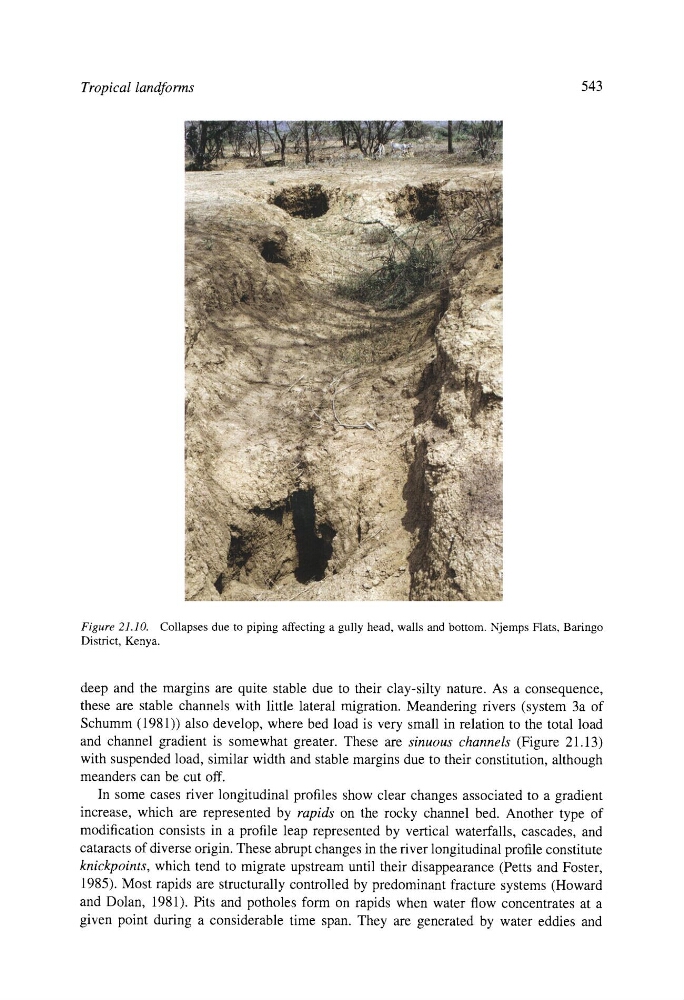
Figure 21.10. Collapses due to piping affecting a gully head, walls and bottom. Njemps Flats, Baringo
District, Kenya.
deep and the margins are quite stable due to their clay-silty nature. As a consequence,
these are stable channels with little lateral migration. Meandering rivers (system 3a of
Schumm (1981)) also develop, where bed load is very small in relation to the total load
and channel gradient is somewhat greater. These are sinuous channels (Figure 21.13)
with suspended load, similar width and stable margins due to their constitution, although
meanders can be cut off.
In some cases fiver longitudinal profiles show clear changes associated to a gradient
increase, which are represented by rapids on the rocky channel bed. Another type of
modification consists in a profile leap represented by vertical waterfalls, cascades, and
cataracts of diverse origin. These abrupt changes in the river longitudinal profile constitute
knickpoints, which tend to migrate upstream until their disappearance (Petts and Foster,
1985). Most rapids are structurally controlled by predominant fracture systems (Howard
and Dolan, 1981). Pits and potholes form on rapids when water flow concentrates at a
given point during a considerable time span. They are generated by water eddies and
543
Figure 21.10. Collapses due to piping affecting a gully head, walls and bottom. Njemps Flats, Baringo
District, Kenya.
deep and the margins are quite stable due to their clay-silty nature. As a consequence,
these are stable channels with little lateral migration. Meandering rivers (system 3a of
Schumm (1981)) also develop, where bed load is very small in relation to the total load
and channel gradient is somewhat greater. These are sinuous channels (Figure 21.13)
with suspended load, similar width and stable margins due to their constitution, although
meanders can be cut off.
In some cases fiver longitudinal profiles show clear changes associated to a gradient
increase, which are represented by rapids on the rocky channel bed. Another type of
modification consists in a profile leap represented by vertical waterfalls, cascades, and
cataracts of diverse origin. These abrupt changes in the river longitudinal profile constitute
knickpoints, which tend to migrate upstream until their disappearance (Petts and Foster,
1985). Most rapids are structurally controlled by predominant fracture systems (Howard
and Dolan, 1981). Pits and potholes form on rapids when water flow concentrates at a
given point during a considerable time span. They are generated by water eddies and