

540
Climatic Geomorphology
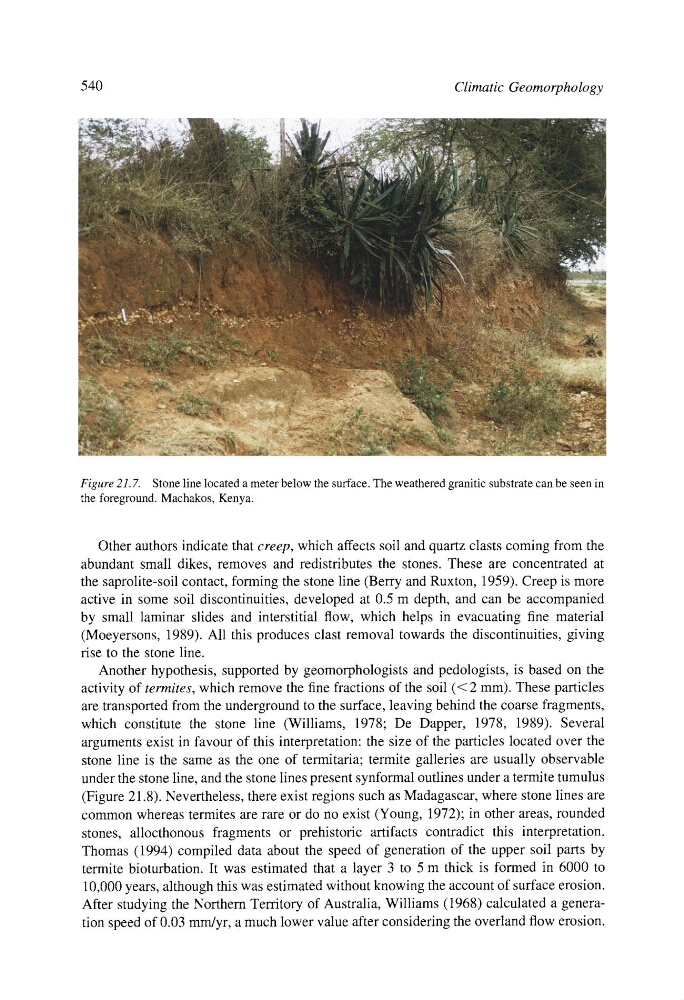
Figure 21.7. Stone line located a meter below the surface. The weathered granitic substrate can be seen in
the foreground. Machakos, Kenya.
Other authors indicate that creep, which affects soil and quartz clasts coming from the
abundant small dikes, removes and redistributes the stones. These are concentrated at
the saprolite-soil contact, forming the stone line (Berry and Ruxton, 1959). Creep is more
active in some soil discontinuities, developed at 0.5 m depth, and can be accompanied
by small laminar slides and interstitial flow, which helps in evacuating fine material
(Moeyersons, 1989). All this produces clast removal towards the discontinuities, giving
rise to the stone line.
Another hypothesis, supported by geomorphologists and pedologists, is based on the
activity of termites, which remove the fine fractions of the soil (< 2 mm). These particles
are transported from the underground to the surface, leaving behind the coarse fragments,
which constitute the stone line (Williams, 1978; De Dapper, 1978, 1989). Several
arguments exist in favour of this interpretation: the size of the particles located over the
stone line is the same as the one of termitaria; termite galleries are usually observable
under the stone line, and the stone lines present synformal outlines under a termite tumulus
(Figure 21.8). Nevertheless, there exist regions such as Madagascar, where stone lines are
common whereas termites are rare or do no exist (Young, 1972); in other areas, rounded
stones, allocthonous fragments or prehistoric artifacts contradict this interpretation.
Thomas (1994) compiled data about the speed of generation of the upper soil parts by
termite bioturbation. It was estimated that a layer 3 to 5 m thick is formed in 6000 to
10,000 years, although this was estimated without knowing the account of surface erosion.
After studying the Northern Territory of Australia, Williams (1968) calculated a generation speed of 0.03 mm/yr, a much lower value after considering the overland flow erosion.
Climatic Geomorphology
Figure 21.7. Stone line located a meter below the surface. The weathered granitic substrate can be seen in
the foreground. Machakos, Kenya.
Other authors indicate that creep, which affects soil and quartz clasts coming from the
abundant small dikes, removes and redistributes the stones. These are concentrated at
the saprolite-soil contact, forming the stone line (Berry and Ruxton, 1959). Creep is more
active in some soil discontinuities, developed at 0.5 m depth, and can be accompanied
by small laminar slides and interstitial flow, which helps in evacuating fine material
(Moeyersons, 1989). All this produces clast removal towards the discontinuities, giving
rise to the stone line.
Another hypothesis, supported by geomorphologists and pedologists, is based on the
activity of termites, which remove the fine fractions of the soil (< 2 mm). These particles
are transported from the underground to the surface, leaving behind the coarse fragments,
which constitute the stone line (Williams, 1978; De Dapper, 1978, 1989). Several
arguments exist in favour of this interpretation: the size of the particles located over the
stone line is the same as the one of termitaria; termite galleries are usually observable
under the stone line, and the stone lines present synformal outlines under a termite tumulus
(Figure 21.8). Nevertheless, there exist regions such as Madagascar, where stone lines are
common whereas termites are rare or do no exist (Young, 1972); in other areas, rounded
stones, allocthonous fragments or prehistoric artifacts contradict this interpretation.
Thomas (1994) compiled data about the speed of generation of the upper soil parts by
termite bioturbation. It was estimated that a layer 3 to 5 m thick is formed in 6000 to
10,000 years, although this was estimated without knowing the account of surface erosion.
After studying the Northern Territory of Australia, Williams (1968) calculated a generation speed of 0.03 mm/yr, a much lower value after considering the overland flow erosion.