

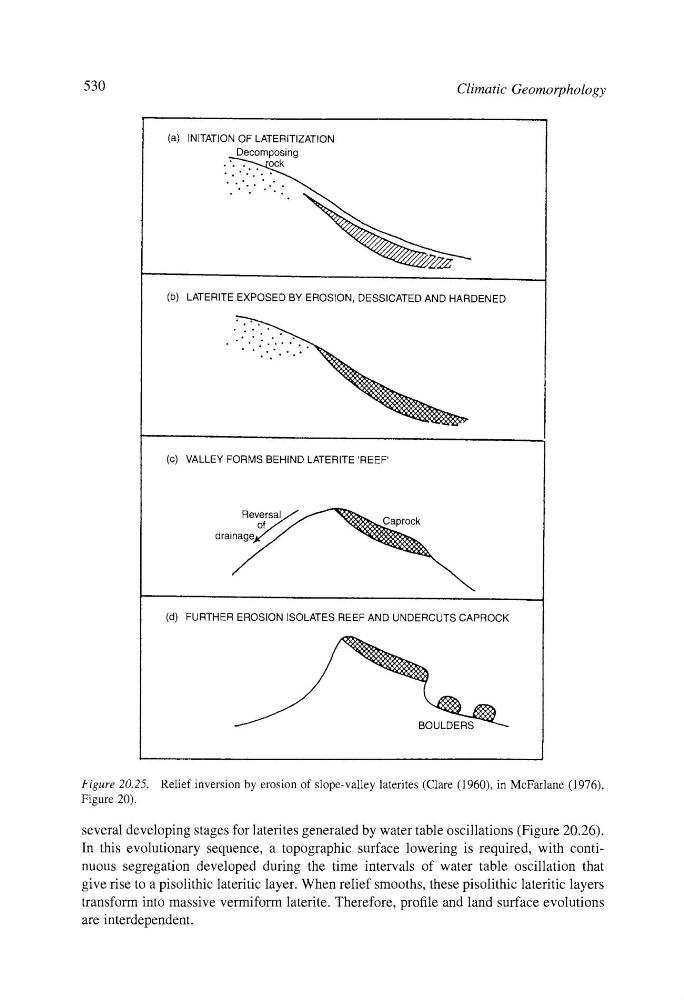
(a) INITATION OF LATERITIZATION
Decomposing
9 "..
ock
~176
Climatic Geomorphology
530
(b) LATERITE EXPOSED BY EROSION, DESSICATED AND HARDENED
(c) VALLEY FORMS BEHIND LATERITE 'REEF'
Reversal J ~
...
,
of~~
",,~~proc~
drai~
. . . . .
(d) FURTHER EROSION ISOLATES REEF AND UNDERCUTS CAPROCK
Figure 20.25. Relief inversion by erosion of slope-valley laterites (Clare (1960), in McFarlane (1976),
Figure 20).
several developing stages for laterites generated by water table oscillations (Figure 20.26).
In this evolutionary sequence, a topographic surface lowering is required, with continuous segregation developed during the time intervals of water table oscillation that
give rise to a pisolithic lateritic layer. When relief smooths, these pisolithic lateritic layers
transform into massive vermiform laterite. Therefore, profile and land surface evolutions
are interdependent.
Decomposing
9 "..
ock
~176
Climatic Geomorphology
530
(b) LATERITE EXPOSED BY EROSION, DESSICATED AND HARDENED
(c) VALLEY FORMS BEHIND LATERITE 'REEF'
Reversal J ~
...
,
of~~
",,~~proc~
drai~
. . . . .
(d) FURTHER EROSION ISOLATES REEF AND UNDERCUTS CAPROCK
Figure 20.25. Relief inversion by erosion of slope-valley laterites (Clare (1960), in McFarlane (1976),
Figure 20).
several developing stages for laterites generated by water table oscillations (Figure 20.26).
In this evolutionary sequence, a topographic surface lowering is required, with continuous segregation developed during the time intervals of water table oscillation that
give rise to a pisolithic lateritic layer. When relief smooths, these pisolithic lateritic layers
transform into massive vermiform laterite. Therefore, profile and land surface evolutions
are interdependent.