

The humid tropics: weathering and laterites
531
l:o:l ""i
...
~176176
9 9
oOo
(a)
Oo0
...
(b)
~176 9 ~
;~
(c)
- - -
(~)
~i:i 0~
~ .-...(e)
!i;i!:i:!iii: i
,........
(f)
'"':'.'".
(g)
W.T
Water table
V//A
OoO
Pisoliths presently
~ ~
forming
9 o~
Pisoliths no longer
9 9
forming
~
Massive vermiform
laterite
(h)
(i)
(J)
(k)
(I)
(m)
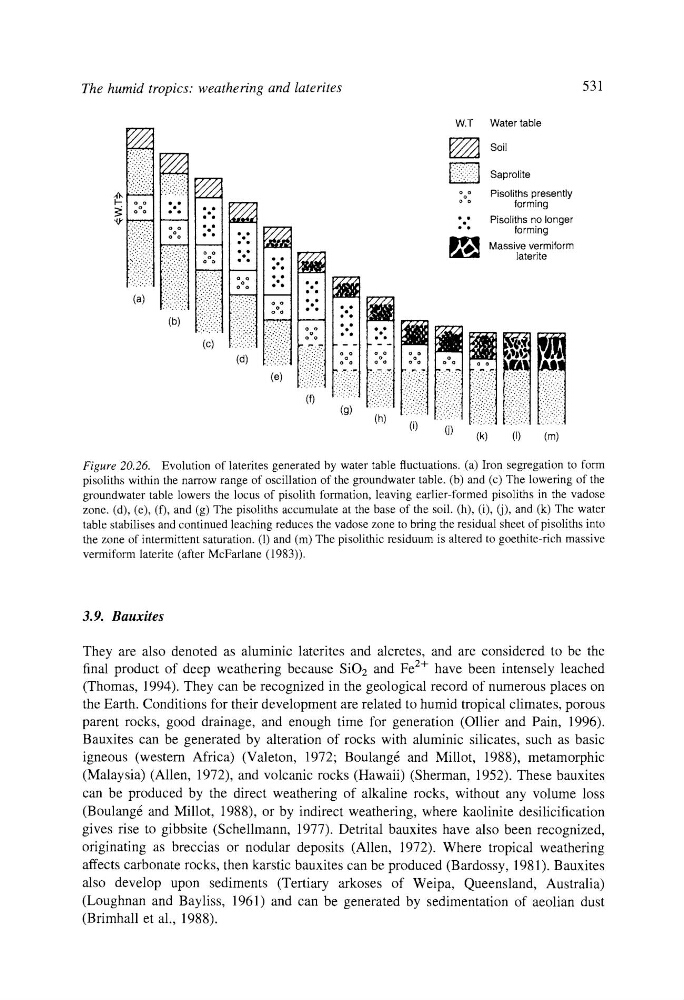
Figure 20.26. Evolution of laterites generated by water table fluctuations. (a) Iron segregation to form
pisoliths within the narrow range of oscillation of the groundwater table. (b) and (c) The lowering of the
groundwater table lowers the locus of pisolith formation, leaving earlier-formed pisoliths in the vadose
zone. (d), (e), (f), and (g) The pisoliths accumulate at the base of the soil. (h), (i), (j), and (k) The water
table stabilises and continued leaching reduces the vadose zone to bring the residual sheet of pisoliths into
the zone of intermittent saturation. (1) and (m) The pisolithic residuum is altered to goethite-rich massive
vermiform laterite (after McFarlane (1983)).
3.9. Bauxites
They are also denoted as aluminic laterites and alcretes, and are considered to be the
final product of deep weathering because SiO2 and Fe z+ have been intensely leached
(Thomas, 1994). They can be recognized in the geological record of numerous places on
the Earth. Conditions for their development are related to humid tropical climates, porous
parent rocks, good drainage, and enough time for generation (Ollier and Pain, 1996).
Bauxites can be generated by alteration of rocks with aluminic silicates, such as basic
igneous (western Africa) (Valett9 1972; Boulang6 and Milll9 1988), metamorphic
(Malaysia) (Allen, 1972), and volcanic rocks (Hawaii) (Sherman, 1952). These bauxites
can be produced by the direct weathering of alkaline rocks, without any volume loss
(Boulang~ and Milll9 1988), or by indirect weathering, where kaolinite desilicification
gives rise to gibbsite (Schellmann, 1977). Detrital bauxites have also been recognized,
originating as breccias or nodular deposits (Allen, 1972). Where tropical weathering
affects carbonate rocks, then karstic bauxites can be produced (Bardossy, 1981). Bauxites
also develop upon sediments (Tertiary arkoses of Weipa, Queensland, Australia)
(Loughnan and Bayliss, 1961) and can be generated by sedimentation of aeolian dust
(Brimhall et al., 1988).
531
l:o:l ""i
...
~176176
9 9
oOo
(a)
Oo0
...
(b)
~176 9 ~
;~
(c)
- - -
(~)
~i:i 0~
~ .-...(e)
!i;i!:i:!iii: i
,........
(f)
'"':'.'".
(g)
W.T
Water table
V//A
OoO
Pisoliths presently
~ ~
forming
9 o~
Pisoliths no longer
9 9
forming
~
Massive vermiform
laterite
(h)
(i)
(J)
(k)
(I)
(m)
Figure 20.26. Evolution of laterites generated by water table fluctuations. (a) Iron segregation to form
pisoliths within the narrow range of oscillation of the groundwater table. (b) and (c) The lowering of the
groundwater table lowers the locus of pisolith formation, leaving earlier-formed pisoliths in the vadose
zone. (d), (e), (f), and (g) The pisoliths accumulate at the base of the soil. (h), (i), (j), and (k) The water
table stabilises and continued leaching reduces the vadose zone to bring the residual sheet of pisoliths into
the zone of intermittent saturation. (1) and (m) The pisolithic residuum is altered to goethite-rich massive
vermiform laterite (after McFarlane (1983)).
3.9. Bauxites
They are also denoted as aluminic laterites and alcretes, and are considered to be the
final product of deep weathering because SiO2 and Fe z+ have been intensely leached
(Thomas, 1994). They can be recognized in the geological record of numerous places on
the Earth. Conditions for their development are related to humid tropical climates, porous
parent rocks, good drainage, and enough time for generation (Ollier and Pain, 1996).
Bauxites can be generated by alteration of rocks with aluminic silicates, such as basic
igneous (western Africa) (Valett9 1972; Boulang6 and Milll9 1988), metamorphic
(Malaysia) (Allen, 1972), and volcanic rocks (Hawaii) (Sherman, 1952). These bauxites
can be produced by the direct weathering of alkaline rocks, without any volume loss
(Boulang~ and Milll9 1988), or by indirect weathering, where kaolinite desilicification
gives rise to gibbsite (Schellmann, 1977). Detrital bauxites have also been recognized,
originating as breccias or nodular deposits (Allen, 1972). Where tropical weathering
affects carbonate rocks, then karstic bauxites can be produced (Bardossy, 1981). Bauxites
also develop upon sediments (Tertiary arkoses of Weipa, Queensland, Australia)
(Loughnan and Bayliss, 1961) and can be generated by sedimentation of aeolian dust
(Brimhall et al., 1988).