

The humid tropics: weathering and laterites
529
3.8.4. Laterite genesis
One of the first hypotheses indicates that laterite originates from a weathering profile
where the pallid zone looses iron, which is transferred to the laterite. This iron
enrichment is produced by capillarity and by seasonal fluctuations of the water table. The
capillary rising seems to be ineffective and overemphasized (Goudie, 1973). Moreover,
when the pallid zone presents a thickness of about 60 m the capillarity mechanism
results are hardly acceptable. Water table oscillations, especially in climates with humid
and dry seasons, favour the movement of dissolved iron. When the groundwater table
rises, the iron moves and precipitates in the higher parts of the profile (McFarlane,
1976, 1983).
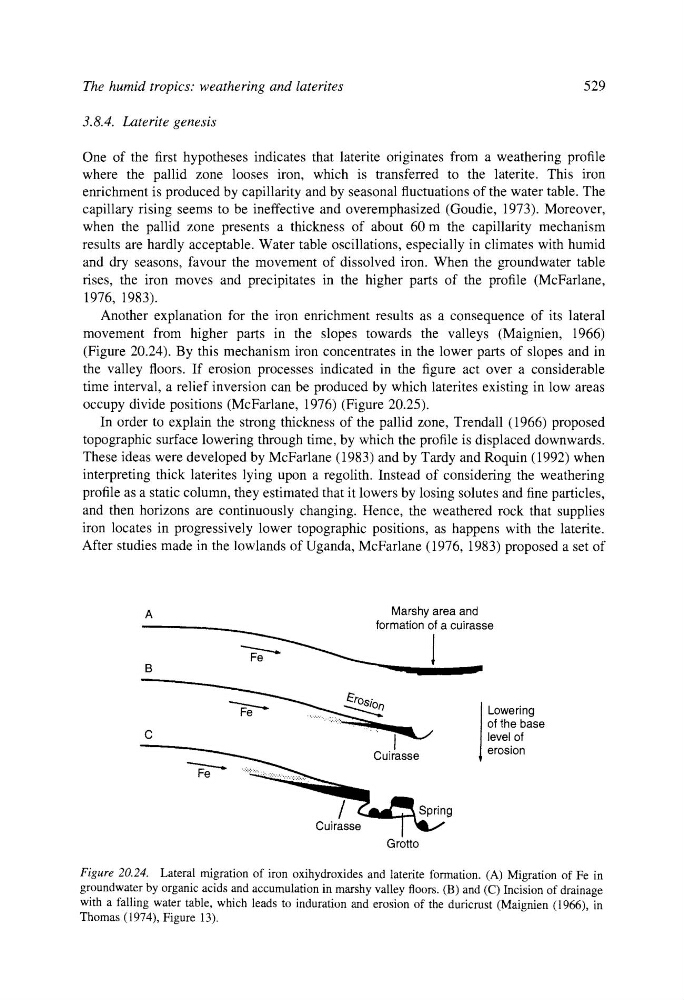
Another explanation for the iron enrichment results as a consequence of its lateral
movement from higher parts in the slopes towards the valleys (Maignien, 1966)
(Figure 20.24). By this mechanism iron concentrates in the lower parts of slopes and in
the valley floors. If erosion processes indicated in the figure act over a considerable
time interval, a relief inversion can be produced by which laterites existing in low areas
occupy divide positions (McFarlane, 1976) (Figure 20.25).
In order to explain the strong thickness of the pallid zone, Trendall (1966) proposed
topographic surface lowering through time, by which the profile is displaced downwards.
These ideas were developed by McFarlane (1983) and by Tardy and Roquin (1992) when
interpreting thick laterites lying upon a regolith. Instead of considering the weathering
profile as a static column, they estimated that it lowers by losing solutes and fine particles,
and then horizons are continuously changing. Hence, the weathered rock that supplies
iron locates in progressively lower topographic positions, as happens with the laterite.
After studies made in the lowlands of Uganda, McFarlane (1976, 1983) proposed a set of
A
Marshy area and
,
formation of a cuirasse
B
~.~rosi on
I-e
. ........
- - ~'-.....l~ml~
C
..... I
Cuirasse
"~
....:~ ,,:::
Fe
............ : ...................... : .........
Grotto
Lowering
of the base
level of
erosion
Figure 20.24. Lateral migration of iron oxihydroxides and laterite formation. (A) Migration of Fe in
groundwater by organic acids and accumulation in marshy valley floors. (B) and (C) Incision of drainage
with a falling water table, which leads to induration and erosion of the duricrust (Maignien (1966), in
Thomas (1974), Figure 13).
529
3.8.4. Laterite genesis
One of the first hypotheses indicates that laterite originates from a weathering profile
where the pallid zone looses iron, which is transferred to the laterite. This iron
enrichment is produced by capillarity and by seasonal fluctuations of the water table. The
capillary rising seems to be ineffective and overemphasized (Goudie, 1973). Moreover,
when the pallid zone presents a thickness of about 60 m the capillarity mechanism
results are hardly acceptable. Water table oscillations, especially in climates with humid
and dry seasons, favour the movement of dissolved iron. When the groundwater table
rises, the iron moves and precipitates in the higher parts of the profile (McFarlane,
1976, 1983).
Another explanation for the iron enrichment results as a consequence of its lateral
movement from higher parts in the slopes towards the valleys (Maignien, 1966)
(Figure 20.24). By this mechanism iron concentrates in the lower parts of slopes and in
the valley floors. If erosion processes indicated in the figure act over a considerable
time interval, a relief inversion can be produced by which laterites existing in low areas
occupy divide positions (McFarlane, 1976) (Figure 20.25).
In order to explain the strong thickness of the pallid zone, Trendall (1966) proposed
topographic surface lowering through time, by which the profile is displaced downwards.
These ideas were developed by McFarlane (1983) and by Tardy and Roquin (1992) when
interpreting thick laterites lying upon a regolith. Instead of considering the weathering
profile as a static column, they estimated that it lowers by losing solutes and fine particles,
and then horizons are continuously changing. Hence, the weathered rock that supplies
iron locates in progressively lower topographic positions, as happens with the laterite.
After studies made in the lowlands of Uganda, McFarlane (1976, 1983) proposed a set of
A
Marshy area and
,
formation of a cuirasse
B
~.~rosi on
I-e
. ........
- - ~'-.....l~ml~
C
..... I
Cuirasse
"~
....:~ ,,:::
Fe
............ : ...................... : .........
Grotto
Lowering
of the base
level of
erosion
Figure 20.24. Lateral migration of iron oxihydroxides and laterite formation. (A) Migration of Fe in
groundwater by organic acids and accumulation in marshy valley floors. (B) and (C) Incision of drainage
with a falling water table, which leads to induration and erosion of the duricrust (Maignien (1966), in
Thomas (1974), Figure 13).