

516
Climatic Geomorphology
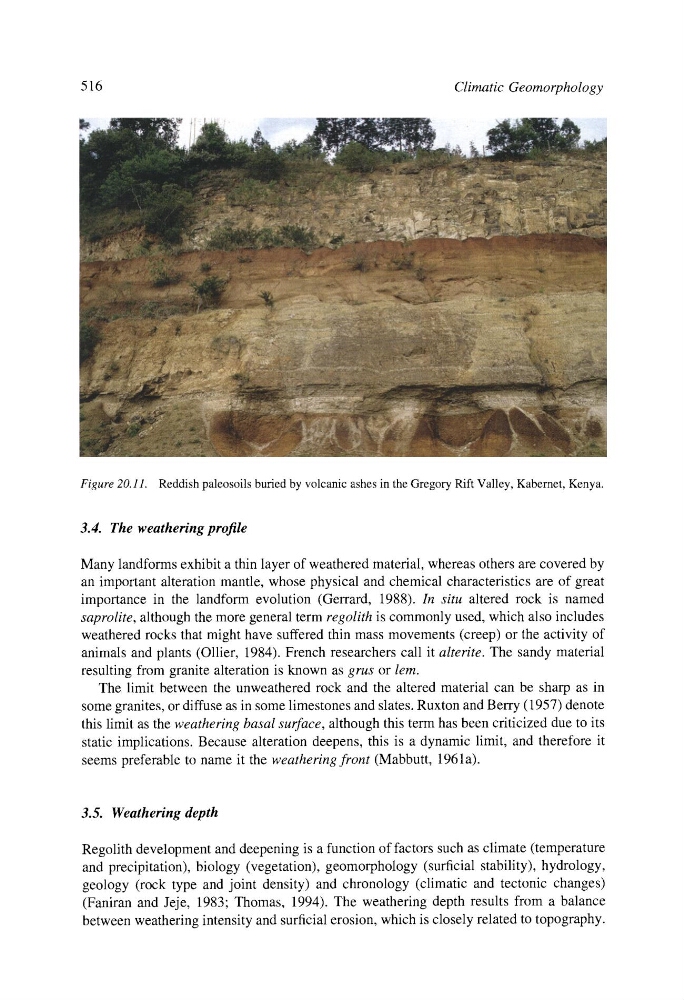
Figure 20.11. Reddish paleosoils buried by volcanic ashes in the Gregory Rift Valley, Kabernet, Kenya.
3.4. The weathering profile
Many landforms exhibit a thin layer of weathered material, whereas others are covered by
an important alteration mantle, whose physical and chemical characteristics are of great
importance in the landform evolution (Gerrard, 1988). In situ altered rock is named
saprolite, although the more general term regolith is commonly used, which also includes
weathered rocks that might have suffered thin mass movements (creep) or the activity of
animals and plants (Ollier, 1984). French researchers call it alterite. The sandy material
resulting from granite alteration is known as grus or lem.
The limit between the unweathered rock and the altered material can be sharp as in
some granites, or diffuse as in some limestones and slates. Ruxton and Berry (1957) denote
this limit as the weathering basal surface, although this term has been criticized due to its
static implications. Because alteration deepens, this is a dynamic limit, and therefore it
seems preferable to name it the weathering front (Mabbutt, 1961 a).
3.5. Weathering depth
Regolith development and deepening is a function of factors such as climate (temperature
and precipitation), biology (vegetation), geomorphology (surficial stability), hydrology,
geology (rock type and joint density) and chronology (climatic and tectonic changes)
(Faniran and Jeje, 1983; Thomas, 1994). The weathering depth results from a balance
between weathering intensity and surficial erosion, which is closely related to topography.
Climatic Geomorphology
Figure 20.11. Reddish paleosoils buried by volcanic ashes in the Gregory Rift Valley, Kabernet, Kenya.
3.4. The weathering profile
Many landforms exhibit a thin layer of weathered material, whereas others are covered by
an important alteration mantle, whose physical and chemical characteristics are of great
importance in the landform evolution (Gerrard, 1988). In situ altered rock is named
saprolite, although the more general term regolith is commonly used, which also includes
weathered rocks that might have suffered thin mass movements (creep) or the activity of
animals and plants (Ollier, 1984). French researchers call it alterite. The sandy material
resulting from granite alteration is known as grus or lem.
The limit between the unweathered rock and the altered material can be sharp as in
some granites, or diffuse as in some limestones and slates. Ruxton and Berry (1957) denote
this limit as the weathering basal surface, although this term has been criticized due to its
static implications. Because alteration deepens, this is a dynamic limit, and therefore it
seems preferable to name it the weathering front (Mabbutt, 1961 a).
3.5. Weathering depth
Regolith development and deepening is a function of factors such as climate (temperature
and precipitation), biology (vegetation), geomorphology (surficial stability), hydrology,
geology (rock type and joint density) and chronology (climatic and tectonic changes)
(Faniran and Jeje, 1983; Thomas, 1994). The weathering depth results from a balance
between weathering intensity and surficial erosion, which is closely related to topography.