

The humid tropics: weathering and laterites
515
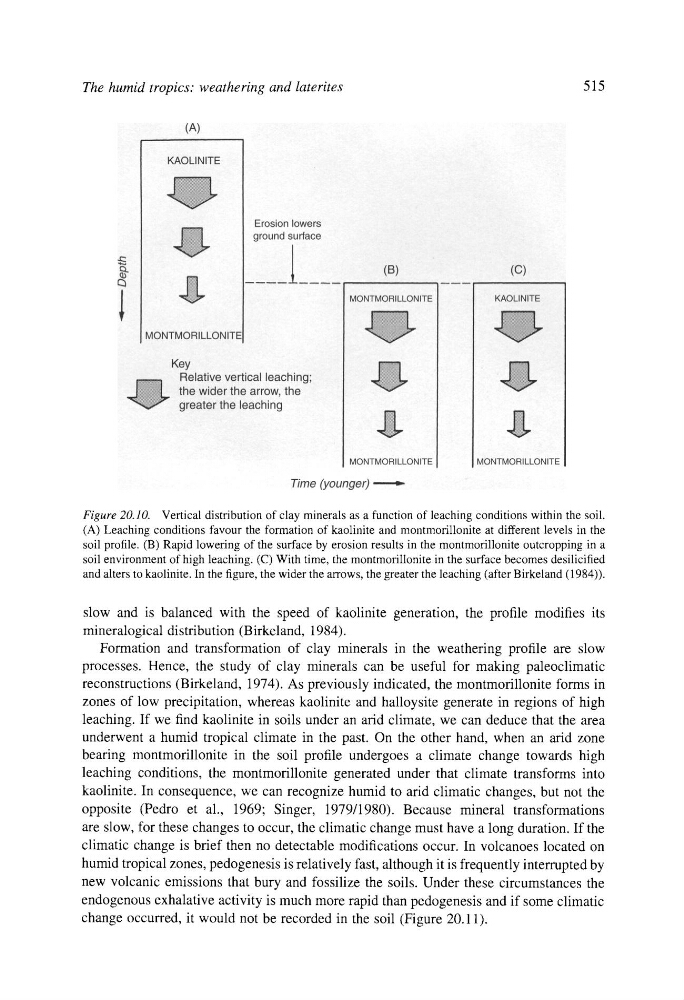
Figure 20.10. Vertical distribution of clay minerals as a function of leaching conditions within the soil.
(A) Leaching conditions favour the formation of kaolinite and montmorillonite at different levels in the
soil profile. (B) Rapid lowering of the surface by erosion results in the montmorillonite outcropping in a
soil environment of high leaching. (C) With time, the montmorillonite in the surface becomes desilicified
and alters to kaolinite. In the figure, the wider the arrows, the greater the leaching (after Birkeland (1984)).
slow and is balanced with the speed of kaolinite generation, the profile modifies its
mineralogical distribution (Birkeland, 1984).
Formation and transformation of clay minerals in the weathering profile are slow
processes. Hence, the study of clay minerals can be useful for making paleoclimatic
reconstructions (Birkeland, 1974). As previously indicated, the montmorillonite forms in
zones of low precipitation, whereas kaolinite and halloysite generate in regions of high
leaching. If we find kaolinite in soils under an arid climate, we can deduce that the area
underwent a humid tropical climate in the past. On the other hand, when an arid zone
bearing montmorillonite in the soil profile undergoes a climate change towards high
leaching conditions, the montmorillonite generated under that climate transforms into
kaolinite. In consequence, we can recognize humid to arid climatic changes, but not the
opposite (Pedro et al., 1969; Singer, 1979/1980). Because mineral transformations
are slow, for these changes to occur, the climatic change must have a long duration. If the
climatic change is brief then no detectable modifications occur. In volcanoes located on
humid tropical zones, pedogenesis is relatively fast, although it is frequently interrupted by
new volcanic emissions that bury and fossilize the soils. Under these circumstances the
endogenous exhalative activity is much more rapid than pedogenesis and if some climatic
change occurred, it would not be recorded in the soil (Figure 20.11).
515
Figure 20.10. Vertical distribution of clay minerals as a function of leaching conditions within the soil.
(A) Leaching conditions favour the formation of kaolinite and montmorillonite at different levels in the
soil profile. (B) Rapid lowering of the surface by erosion results in the montmorillonite outcropping in a
soil environment of high leaching. (C) With time, the montmorillonite in the surface becomes desilicified
and alters to kaolinite. In the figure, the wider the arrows, the greater the leaching (after Birkeland (1984)).
slow and is balanced with the speed of kaolinite generation, the profile modifies its
mineralogical distribution (Birkeland, 1984).
Formation and transformation of clay minerals in the weathering profile are slow
processes. Hence, the study of clay minerals can be useful for making paleoclimatic
reconstructions (Birkeland, 1974). As previously indicated, the montmorillonite forms in
zones of low precipitation, whereas kaolinite and halloysite generate in regions of high
leaching. If we find kaolinite in soils under an arid climate, we can deduce that the area
underwent a humid tropical climate in the past. On the other hand, when an arid zone
bearing montmorillonite in the soil profile undergoes a climate change towards high
leaching conditions, the montmorillonite generated under that climate transforms into
kaolinite. In consequence, we can recognize humid to arid climatic changes, but not the
opposite (Pedro et al., 1969; Singer, 1979/1980). Because mineral transformations
are slow, for these changes to occur, the climatic change must have a long duration. If the
climatic change is brief then no detectable modifications occur. In volcanoes located on
humid tropical zones, pedogenesis is relatively fast, although it is frequently interrupted by
new volcanic emissions that bury and fossilize the soils. Under these circumstances the
endogenous exhalative activity is much more rapid than pedogenesis and if some climatic
change occurred, it would not be recorded in the soil (Figure 20.11).