

514
Climatic Geomorphology
100
80
60
Cb
o)
40
2O
t
./"
Gibbsite ~,
Diaspo.re ~ Bauxite
~~.
Boehmite"
"
-
I
,I
~
|
I
I
76
152
228
304
380
Mean annual precipitation (cm)
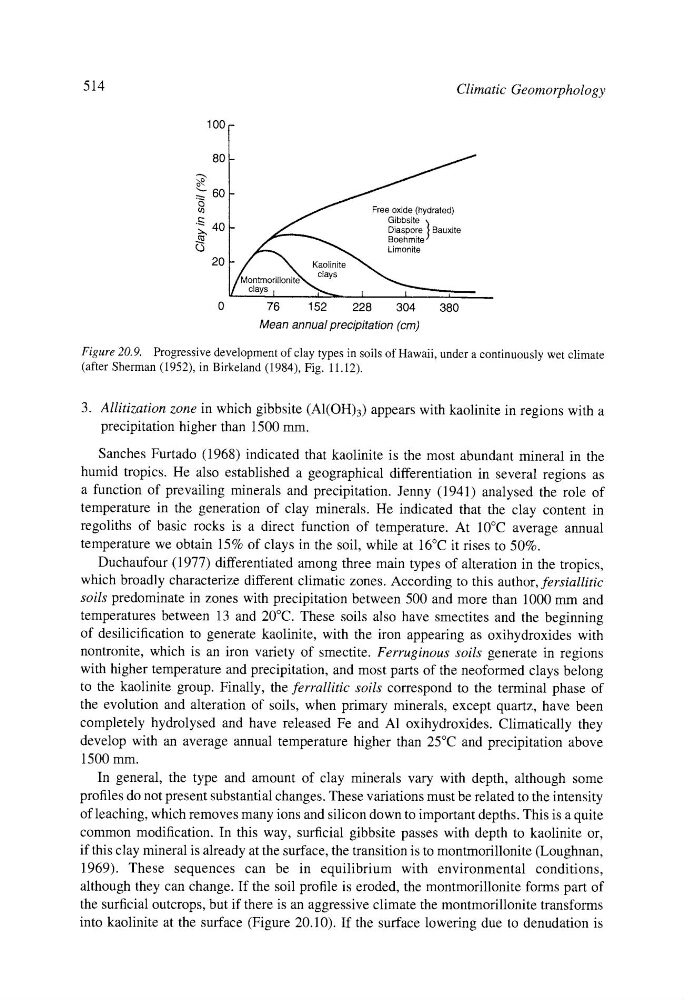
Figure 20.9. Progressive development of clay types in soils of Hawaii, under a continuously wet climate
(after Sherman (1952), in Birkeland (1984), Fig. 11.12).
3. Allitization zone in which gibbsite (AI(OH)3) appears with kaolinite in regions with a
precipitation higher than 1500 mm.
Sanches Furtado (1968) indicated that kaolinite is the most abundant mineral in the
humid tropics. He also established a geographical differentiation in several regions as
a function of prevailing minerals and precipitation. Jenny (1941) analysed the role of
temperature in the generation of clay minerals. He indicated that the clay content in
regoliths of basic rocks is a direct function of temperature. At 10~ average annual
temperature we obtain 15% of clays in the soil, while at 16~ it rises to 50%.
Duchaufour (1977) differentiated among three main types of alteration in the tropics,
which broadly characterize different climatic zones. According to this author, fersiallitic
soils predominate in zones with precipitation between 500 and more than 1000 mm and
temperatures between 13 and 20~ These soils also have smectites and the beginning
of desilicification to generate kaolinite, with the iron appearing as oxihydroxides with
nontronite, which is an iron variety of smectite. Ferruginous soils generate in regions
with higher temperature and precipitation, and most parts of the neoformed clays belong
to the kaolinite group. Finally, the ferrallitic soils correspond to the terminal phase of
the evolution and alteration of soils, when primary minerals, except quartz, have been
completely hydrolysed and have released Fe and A1 oxihydroxides. Climatically they
develop with an average annual temperature higher than 25~ and precipitation above
1500 mm.
In general, the type and amount of clay minerals vary with depth, although some
profiles do not present substantial changes. These variations must be related to the intensity
of leaching, which removes many ions and silicon down to important depths. This is a quite
common modification. In this way, surficial gibbsite passes with depth to kaolinite or,
if this clay mineral is already at the surface, the transition is to montmorillonite (Loughnan,
1969). These sequences can be in equilibrium with environmental conditions,
although they can change. If the soil profile is eroded, the montmorillonite forms part of
the surficial outcrops, but if there is an aggressive climate the montmorillonite transforms
into kaolinite at the surface (Figure 20.10). If the surface lowering due to denudation is
Climatic Geomorphology
100
80
60
Cb
o)
40
2O
t
./"
Gibbsite ~,
Diaspo.re ~ Bauxite
~~.
Boehmite"
"
-
I
,I
~
|
I
I
76
152
228
304
380
Mean annual precipitation (cm)
Figure 20.9. Progressive development of clay types in soils of Hawaii, under a continuously wet climate
(after Sherman (1952), in Birkeland (1984), Fig. 11.12).
3. Allitization zone in which gibbsite (AI(OH)3) appears with kaolinite in regions with a
precipitation higher than 1500 mm.
Sanches Furtado (1968) indicated that kaolinite is the most abundant mineral in the
humid tropics. He also established a geographical differentiation in several regions as
a function of prevailing minerals and precipitation. Jenny (1941) analysed the role of
temperature in the generation of clay minerals. He indicated that the clay content in
regoliths of basic rocks is a direct function of temperature. At 10~ average annual
temperature we obtain 15% of clays in the soil, while at 16~ it rises to 50%.
Duchaufour (1977) differentiated among three main types of alteration in the tropics,
which broadly characterize different climatic zones. According to this author, fersiallitic
soils predominate in zones with precipitation between 500 and more than 1000 mm and
temperatures between 13 and 20~ These soils also have smectites and the beginning
of desilicification to generate kaolinite, with the iron appearing as oxihydroxides with
nontronite, which is an iron variety of smectite. Ferruginous soils generate in regions
with higher temperature and precipitation, and most parts of the neoformed clays belong
to the kaolinite group. Finally, the ferrallitic soils correspond to the terminal phase of
the evolution and alteration of soils, when primary minerals, except quartz, have been
completely hydrolysed and have released Fe and A1 oxihydroxides. Climatically they
develop with an average annual temperature higher than 25~ and precipitation above
1500 mm.
In general, the type and amount of clay minerals vary with depth, although some
profiles do not present substantial changes. These variations must be related to the intensity
of leaching, which removes many ions and silicon down to important depths. This is a quite
common modification. In this way, surficial gibbsite passes with depth to kaolinite or,
if this clay mineral is already at the surface, the transition is to montmorillonite (Loughnan,
1969). These sequences can be in equilibrium with environmental conditions,
although they can change. If the soil profile is eroded, the montmorillonite forms part of
the surficial outcrops, but if there is an aggressive climate the montmorillonite transforms
into kaolinite at the surface (Figure 20.10). If the surface lowering due to denudation is