

The humid tropics: weathering and laterites
517
In the tropics overland flow erosion is low (Fournier, 1960; Douglas, 1969), which favours
weathering. Weathered material is easily eroded on slopes, but where these are gentle, or
where it develops on plains, erosion is very small. As a consequence, the maximum
weathering depth will be reached in plane zones with a climate suitable for rapid
weathering, smooth relief, and vegetation that hinder run-off. In these zones erosion is
minimum (Ollier, 1984).
Inside the profile, weathering reaches its maximum intensity in the aeration zone. In the
saturation zone processes like reduction, hydrolysis and chemical substitution also take
place, although with a lesser reaction velocity (Gerrard, 1988). These circumstances led
Lelong (1966) to differentiate between an upper alteration zone, where water flows easily
and increases hydrolysis processes, and a lower alteration zone in which percolating water
slowly flows through joints. All these processes help to explain the great thickness of
altered rocks.
Geological research in humid tropical zones focuses on outcrops of unaltered rock. On
the contrary, when the regolith is studied with an applied finality (civil engineering,
mining, agronomy, and others) it is necessary to know the surficial extent of rock outcrops
and the regolith depth. This is obtained by mechanical drilling supported with geophysical
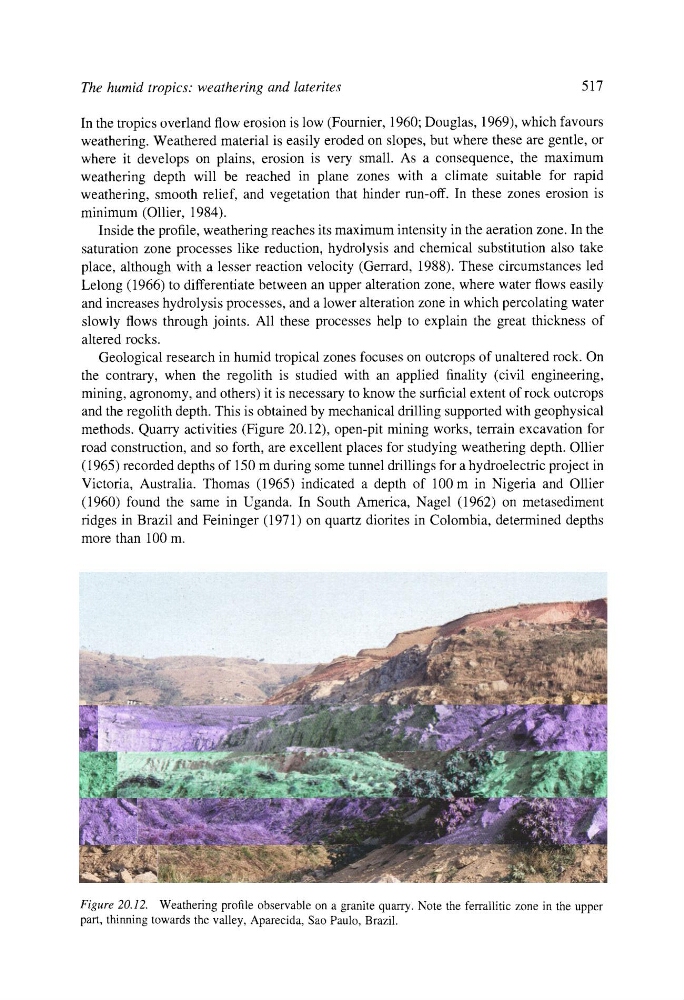
methods. Quarry activities (Figure 20.12), open-pit mining works, terrain excavation for
road construction, and so forth, are excellent places for studying weathering depth. Ollier
(1965) recorded depths of 150 m during some tunnel drillings for a hydroelectric project in
Victoria, Australia. Thomas (1965) indicated a depth of 100 m in Nigeria and Ollier
(1960) found the same in Uganda. In South America, Nagel (1962) on metasediment
ridges in Brazil and Feininger (1971) on quartz diorites in Colombia, determined depths
more than 100 m.
Figure 20.12. Weathering profile observable on a granite quarry. Note the ferrallitic zone in the upper
part, thinning towards the valley, Aparecida, Sao Paulo, Brazil.
517
In the tropics overland flow erosion is low (Fournier, 1960; Douglas, 1969), which favours
weathering. Weathered material is easily eroded on slopes, but where these are gentle, or
where it develops on plains, erosion is very small. As a consequence, the maximum
weathering depth will be reached in plane zones with a climate suitable for rapid
weathering, smooth relief, and vegetation that hinder run-off. In these zones erosion is
minimum (Ollier, 1984).
Inside the profile, weathering reaches its maximum intensity in the aeration zone. In the
saturation zone processes like reduction, hydrolysis and chemical substitution also take
place, although with a lesser reaction velocity (Gerrard, 1988). These circumstances led
Lelong (1966) to differentiate between an upper alteration zone, where water flows easily
and increases hydrolysis processes, and a lower alteration zone in which percolating water
slowly flows through joints. All these processes help to explain the great thickness of
altered rocks.
Geological research in humid tropical zones focuses on outcrops of unaltered rock. On
the contrary, when the regolith is studied with an applied finality (civil engineering,
mining, agronomy, and others) it is necessary to know the surficial extent of rock outcrops
and the regolith depth. This is obtained by mechanical drilling supported with geophysical
methods. Quarry activities (Figure 20.12), open-pit mining works, terrain excavation for
road construction, and so forth, are excellent places for studying weathering depth. Ollier
(1965) recorded depths of 150 m during some tunnel drillings for a hydroelectric project in
Victoria, Australia. Thomas (1965) indicated a depth of 100 m in Nigeria and Ollier
(1960) found the same in Uganda. In South America, Nagel (1962) on metasediment
ridges in Brazil and Feininger (1971) on quartz diorites in Colombia, determined depths
more than 100 m.
Figure 20.12. Weathering profile observable on a granite quarry. Note the ferrallitic zone in the upper
part, thinning towards the valley, Aparecida, Sao Paulo, Brazil.