

Glaciers
41
4. Snow-ice transformation
Glaciers are developed in situations in which snow accumulation exceeds melting.
Suitable climatic conditions are required, as well as topographic form providing ideal
places for their storage (Price, 1973).
Snow fallen in the accumulation zone undergoes deep changes until it finally
transforms into glacier ice. The grains constituting this ice are made up of crystals that vary
from millimetre to decimetre sizes and have been formed by numerous snowflakes.
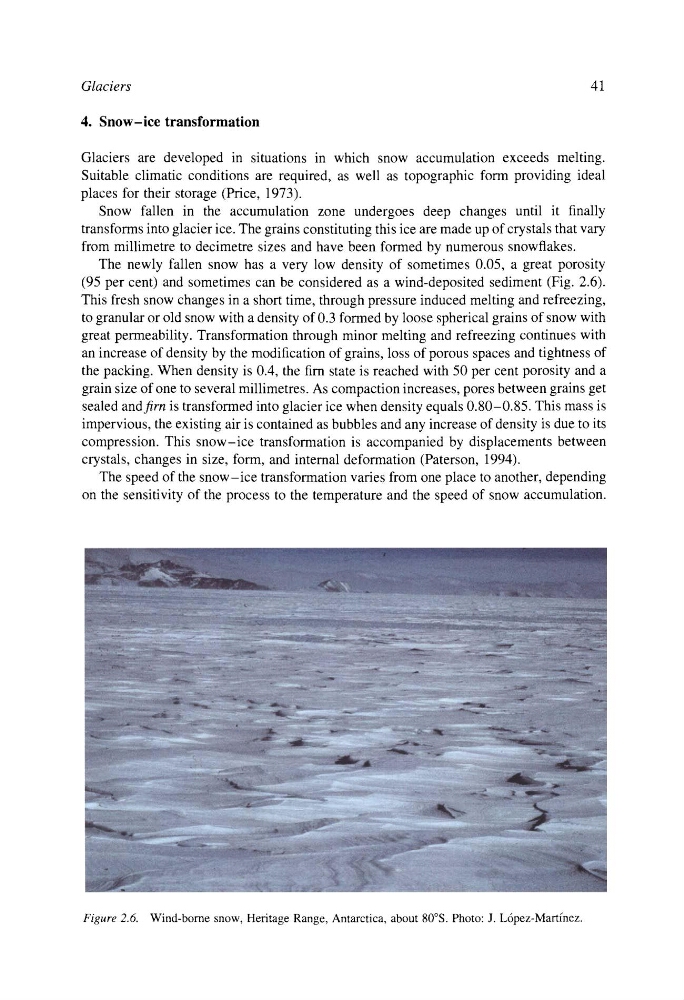
The newly fallen snow has a very low density of sometimes 0.05, a great porosity
(95 per cent) and sometimes can be considered as a wind-deposited sediment (Fig. 2.6).
This fresh snow changes in a short time, through pressure induced melting and refreezing,
to granular or old snow with a density of 0.3 formed by loose spherical grains of snow with
great permeability. Transformation through minor melting and refreezing continues with
an increase of density by the modification of grains, loss of porous spaces and tightness of
the packing. When density is 0.4, the firn state is reached with 50 per cent porosity and a
grain size of one to several millimetres. As compaction increases, pores between grains get
sealed andfirn is transformed into glacier ice when density equals 0.80-0.85. This mass is
impervious, the existing air is contained as bubbles and any increase of density is due to its
compression. This snow-ice transformation is accompanied by displacements between
crystals, changes in size, form, and internal deformation (Paterson, 1994).
The speed of the snow-ice transformation varies from one place to another, depending
on the sensitivity of the process to the temperature and the speed of snow accumulation.
Figure 2.6. Wind-borne snow, Heritage Range, Antarctica, about 80~ Photo: J. L6pez-Mart/nez.
41
4. Snow-ice transformation
Glaciers are developed in situations in which snow accumulation exceeds melting.
Suitable climatic conditions are required, as well as topographic form providing ideal
places for their storage (Price, 1973).
Snow fallen in the accumulation zone undergoes deep changes until it finally
transforms into glacier ice. The grains constituting this ice are made up of crystals that vary
from millimetre to decimetre sizes and have been formed by numerous snowflakes.
The newly fallen snow has a very low density of sometimes 0.05, a great porosity
(95 per cent) and sometimes can be considered as a wind-deposited sediment (Fig. 2.6).
This fresh snow changes in a short time, through pressure induced melting and refreezing,
to granular or old snow with a density of 0.3 formed by loose spherical grains of snow with
great permeability. Transformation through minor melting and refreezing continues with
an increase of density by the modification of grains, loss of porous spaces and tightness of
the packing. When density is 0.4, the firn state is reached with 50 per cent porosity and a
grain size of one to several millimetres. As compaction increases, pores between grains get
sealed andfirn is transformed into glacier ice when density equals 0.80-0.85. This mass is
impervious, the existing air is contained as bubbles and any increase of density is due to its
compression. This snow-ice transformation is accompanied by displacements between
crystals, changes in size, form, and internal deformation (Paterson, 1994).
The speed of the snow-ice transformation varies from one place to another, depending
on the sensitivity of the process to the temperature and the speed of snow accumulation.
Figure 2.6. Wind-borne snow, Heritage Range, Antarctica, about 80~ Photo: J. L6pez-Mart/nez.