

42
Climatic Geomorphology
E
.E
a
_
80'~".-.x
Upper Seward
Glacier
x~, x "Y~'Y''"K
Site 2, Greenland
I
. I .
I
I
I
..
120 400
500
600
700
800
900
Density, kg/m3
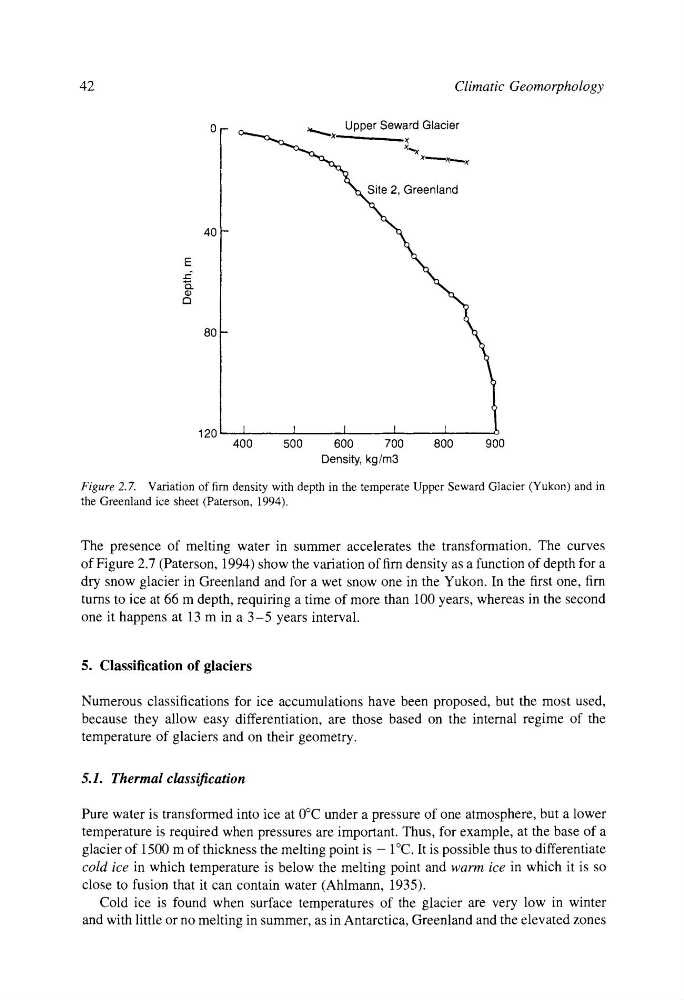
Figure 2.7. Variation of firn density with depth in the temperate Upper Seward Glacier (Yukon) and in
the Greenland ice sheet (Paterson, 1994).
The presence of melting water in summer accelerates the transformation. The curves
of Figure 2.7 (Paterson, 1994) show the variation of firn density as a function of depth for a
dry snow glacier in Greenland and for a wet snow one in the Yukon. In the first one, firn
turns to ice at 66 m depth, requiting a time of more than 100 years, whereas in the second
one it happens at 13 m in a 3-5 years interval.
5. Classification of glaciers
Numerous classifications for ice accumulations have been proposed, but the most used,
because they allow easy differentiation, are those based on the internal regime of the
temperature of glaciers and on their geometry.
5.1. Thermal classification
Pure water is transformed into ice at 0~ under a pressure of one atmosphere, but a lower
temperature is required when pressures are important. Thus, for example, at the base of a
glacier of 1500 m of thickness the melting point is - 1 ~ It is possible thus to differentiate
cold ice in which temperature is below the melting point and warm ice in which it is so
close to fusion that it can contain water (Ahlmann, 1935).
Cold ice is found when surface temperatures of the glacier are very low in winter
and with little or no melting in summer, as in Antarctica, Greenland and the elevated zones
Climatic Geomorphology
E
.E
a
_
80'~".-.x
Upper Seward
Glacier
x~, x "Y~'Y''"K
Site 2, Greenland
I
. I .
I
I
I
..
120 400
500
600
700
800
900
Density, kg/m3
Figure 2.7. Variation of firn density with depth in the temperate Upper Seward Glacier (Yukon) and in
the Greenland ice sheet (Paterson, 1994).
The presence of melting water in summer accelerates the transformation. The curves
of Figure 2.7 (Paterson, 1994) show the variation of firn density as a function of depth for a
dry snow glacier in Greenland and for a wet snow one in the Yukon. In the first one, firn
turns to ice at 66 m depth, requiting a time of more than 100 years, whereas in the second
one it happens at 13 m in a 3-5 years interval.
5. Classification of glaciers
Numerous classifications for ice accumulations have been proposed, but the most used,
because they allow easy differentiation, are those based on the internal regime of the
temperature of glaciers and on their geometry.
5.1. Thermal classification
Pure water is transformed into ice at 0~ under a pressure of one atmosphere, but a lower
temperature is required when pressures are important. Thus, for example, at the base of a
glacier of 1500 m of thickness the melting point is - 1 ~ It is possible thus to differentiate
cold ice in which temperature is below the melting point and warm ice in which it is so
close to fusion that it can contain water (Ahlmann, 1935).
Cold ice is found when surface temperatures of the glacier are very low in winter
and with little or no melting in summer, as in Antarctica, Greenland and the elevated zones