

Applied geomorphology and arid regions
489
Problems arise because of deflation, transport and sedimentation. Deflation can reduce
the quantity of fine particles and nutrients in the soil, causing it to lose its fertility
(Middleton, 1990). It can also undermine structures (e.g. lampposts or telephone posts),
causing them to collapse. During transport, the particles cause abrasion that produces
hollows and furrows. Dust in the wind can also reduce visibility at airports and choke
people and animals (Pew6, 1981; Pye, 1987; Middleton, 1997). For these reasons, a dust
storm alert system has been set up in Arizona, with electronic signboards on roads and
announcements on public radio warning of any threats. Dust can also enter houses, causing
health problems and contaminating food and drinking water. If the dust is saline, it could
affect buildings. The positive effect of wind-blown dust is that it can provide soil nutrients
to new areas.
The quantities of dust mobilized are of the same order of magnitude as those
transported by rivers (Livingstone and Warren, 1996). A significant part of windblown
dust comes from human activities. Ploughing activities break up soil aggregates, and in dry
periods plumes of dust can be seen behind tractors (Lee et al., 1993). Another source is
traffic driving over unsurfaced roads. The removal of vegetation by grazing or fire can also
increase wind erosion (O'Hara, 1997). The drying of the Aral Sea has increased the
amount of windblown dust (Goudie, 1994b). Wind sedimentation, on the other hand, can
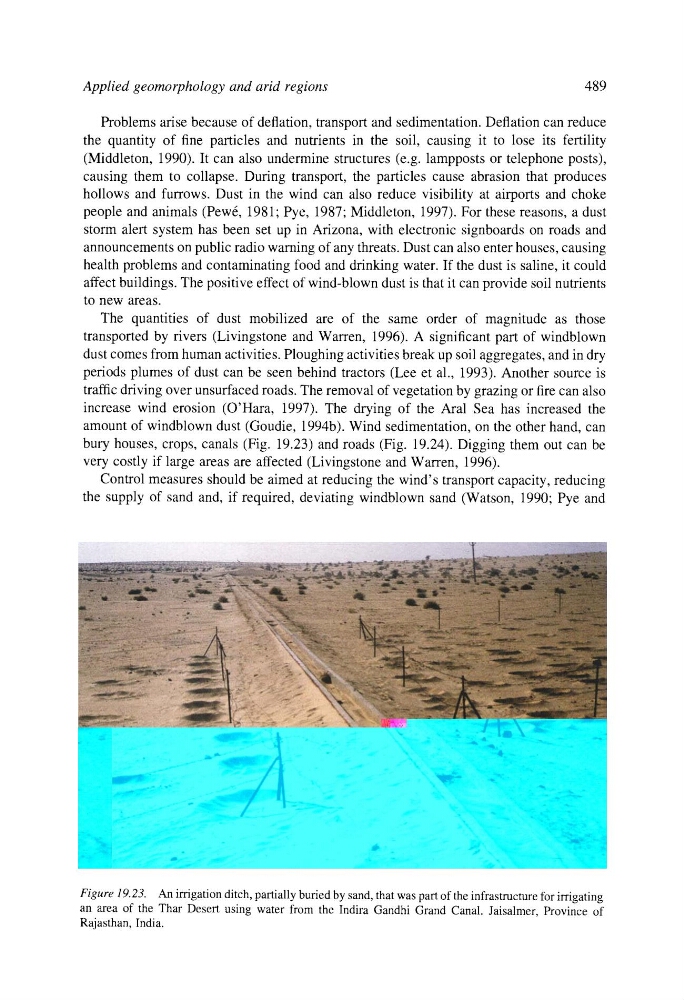
bury houses, crops, canals (Fig. 19.23) and roads (Fig. 19.24). Digging them out can be
very costly if large areas are affected (Livingstone and Warren, 1996).
Control measures should be aimed at reducing the wind's transport capacity, reducing
the supply of sand and, if required, deviating windblown sand (Watson, 1990; Pye and
Figure 19.23. An irrigation ditch, partially buried by sand, that was part of the infrastructure for irrigating
an area of the That Desert using water from the Indira Gandhi Grand Canal. Jaisalmer, Province of
Rajasthan, India.
489
Problems arise because of deflation, transport and sedimentation. Deflation can reduce
the quantity of fine particles and nutrients in the soil, causing it to lose its fertility
(Middleton, 1990). It can also undermine structures (e.g. lampposts or telephone posts),
causing them to collapse. During transport, the particles cause abrasion that produces
hollows and furrows. Dust in the wind can also reduce visibility at airports and choke
people and animals (Pew6, 1981; Pye, 1987; Middleton, 1997). For these reasons, a dust
storm alert system has been set up in Arizona, with electronic signboards on roads and
announcements on public radio warning of any threats. Dust can also enter houses, causing
health problems and contaminating food and drinking water. If the dust is saline, it could
affect buildings. The positive effect of wind-blown dust is that it can provide soil nutrients
to new areas.
The quantities of dust mobilized are of the same order of magnitude as those
transported by rivers (Livingstone and Warren, 1996). A significant part of windblown
dust comes from human activities. Ploughing activities break up soil aggregates, and in dry
periods plumes of dust can be seen behind tractors (Lee et al., 1993). Another source is
traffic driving over unsurfaced roads. The removal of vegetation by grazing or fire can also
increase wind erosion (O'Hara, 1997). The drying of the Aral Sea has increased the
amount of windblown dust (Goudie, 1994b). Wind sedimentation, on the other hand, can
bury houses, crops, canals (Fig. 19.23) and roads (Fig. 19.24). Digging them out can be
very costly if large areas are affected (Livingstone and Warren, 1996).
Control measures should be aimed at reducing the wind's transport capacity, reducing
the supply of sand and, if required, deviating windblown sand (Watson, 1990; Pye and
Figure 19.23. An irrigation ditch, partially buried by sand, that was part of the infrastructure for irrigating
an area of the That Desert using water from the Indira Gandhi Grand Canal. Jaisalmer, Province of
Rajasthan, India.