

490
Climatic Geomorphology
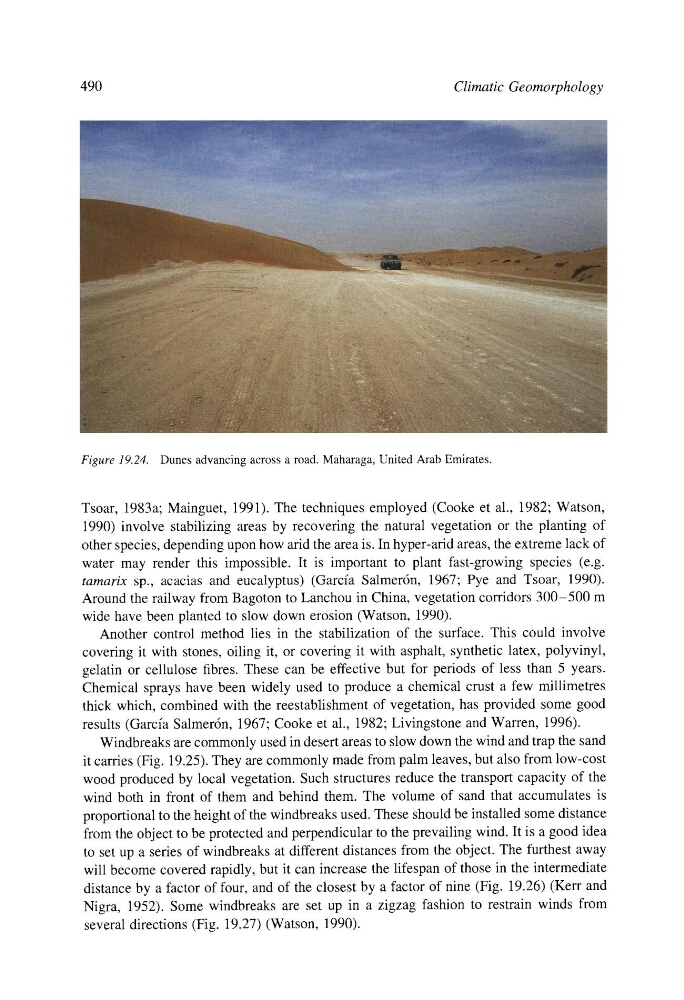
Figure 19.24. Dunes advancing across a road. Maharaga, United Arab Emirates.
Tsoar, 1983a; Mainguet, 1991). The techniques employed (Cooke et al., 1982; Watson,
1990) involve stabilizing areas by recovering the natural vegetation or the planting of
other species, depending upon how arid the area is. In hyper-arid areas, the extreme lack of
water may render this impossible. It is important to plant fast-growing species (e.g.
tamarix sp., acacias and eucalyptus) (Garcfa Salmer6n, 1967; Pye and Tsoar, 1990).
Around the railway from Bagoton to Lanchou in China, vegetation corridors 300-500 m
wide have been planted to slow down erosion (Watson, 1990).
Another control method lies in the stabilization of the surface. This could involve
covering it with stones, oiling it, or covering it with asphalt, synthetic latex, polyvinyl,
gelatin or cellulose fibres. These can be effective but for periods of less than 5 years.
Chemical sprays have been widely used to produce a chemical crust a few millimetres
thick which, combined with the reestablishment of vegetation, has provided some good
results (Garcfa Salmer6n, 1967; Cooke et al., 1982; Livingstone and Warren, 1996).
Windbreaks are commonly used in desert areas to slow down the wind and trap the sand
it carries (Fig. 19.25). They are commonly made from palm leaves, but also from low-cost
wood produced by local vegetation. Such structures reduce the transport capacity of the
wind both in front of them and behind them. The volume of sand that accumulates is
proportional to the height of the windbreaks used. These should be installed some distance
from the object to be protected and perpendicular to the prevailing wind. It is a good idea
to set up a series of windbreaks at different distances from the object. The furthest away
will become covered rapidly, but it can increase the lifespan of those in the intermediate
distance by a factor of four, and of the closest by a factor of nine (Fig. 19.26) (Kerr and
Nigra, 1952). Some windbreaks are set up in a zigzag fashion to restrain winds from
several directions (Fig. 19.27) (Watson, 1990).
Climatic Geomorphology
Figure 19.24. Dunes advancing across a road. Maharaga, United Arab Emirates.
Tsoar, 1983a; Mainguet, 1991). The techniques employed (Cooke et al., 1982; Watson,
1990) involve stabilizing areas by recovering the natural vegetation or the planting of
other species, depending upon how arid the area is. In hyper-arid areas, the extreme lack of
water may render this impossible. It is important to plant fast-growing species (e.g.
tamarix sp., acacias and eucalyptus) (Garcfa Salmer6n, 1967; Pye and Tsoar, 1990).
Around the railway from Bagoton to Lanchou in China, vegetation corridors 300-500 m
wide have been planted to slow down erosion (Watson, 1990).
Another control method lies in the stabilization of the surface. This could involve
covering it with stones, oiling it, or covering it with asphalt, synthetic latex, polyvinyl,
gelatin or cellulose fibres. These can be effective but for periods of less than 5 years.
Chemical sprays have been widely used to produce a chemical crust a few millimetres
thick which, combined with the reestablishment of vegetation, has provided some good
results (Garcfa Salmer6n, 1967; Cooke et al., 1982; Livingstone and Warren, 1996).
Windbreaks are commonly used in desert areas to slow down the wind and trap the sand
it carries (Fig. 19.25). They are commonly made from palm leaves, but also from low-cost
wood produced by local vegetation. Such structures reduce the transport capacity of the
wind both in front of them and behind them. The volume of sand that accumulates is
proportional to the height of the windbreaks used. These should be installed some distance
from the object to be protected and perpendicular to the prevailing wind. It is a good idea
to set up a series of windbreaks at different distances from the object. The furthest away
will become covered rapidly, but it can increase the lifespan of those in the intermediate
distance by a factor of four, and of the closest by a factor of nine (Fig. 19.26) (Kerr and
Nigra, 1952). Some windbreaks are set up in a zigzag fashion to restrain winds from
several directions (Fig. 19.27) (Watson, 1990).