

488
Climatic Geomorphology
faults vary from 1 - 16.7 km, and their escarpments are 1 m high. Serious damage has been
caused to roads and irrigation systems, and the trajectories of some aqueducts have had to
be modified (Coates, 1983).
In the San Joaqufn Valley and central-southern Arizona, a slow uprising has followed
the pumping out of groundwater. According to the US Geological Survey, this reached
6 cm between 1948 and 1967 in the area close to Casa Grande, Arizona. It is thought this
was caused by isostatic rebound following the extraction of the water, which eventually
reduced the load on the underlying materials (Costa and Baker, 1981).
7. Wind action: problems and control
The mobilization of sand and dust by the wind occurs in many types of climate, but in
arid areas it is at its greatest. Given the scant or absent vegetation in these areas, much
of the soil is subject to wind action. Further, the limited development of soils leads to
high erosion vulnerability with some 39 per cent of the world's arid land affected
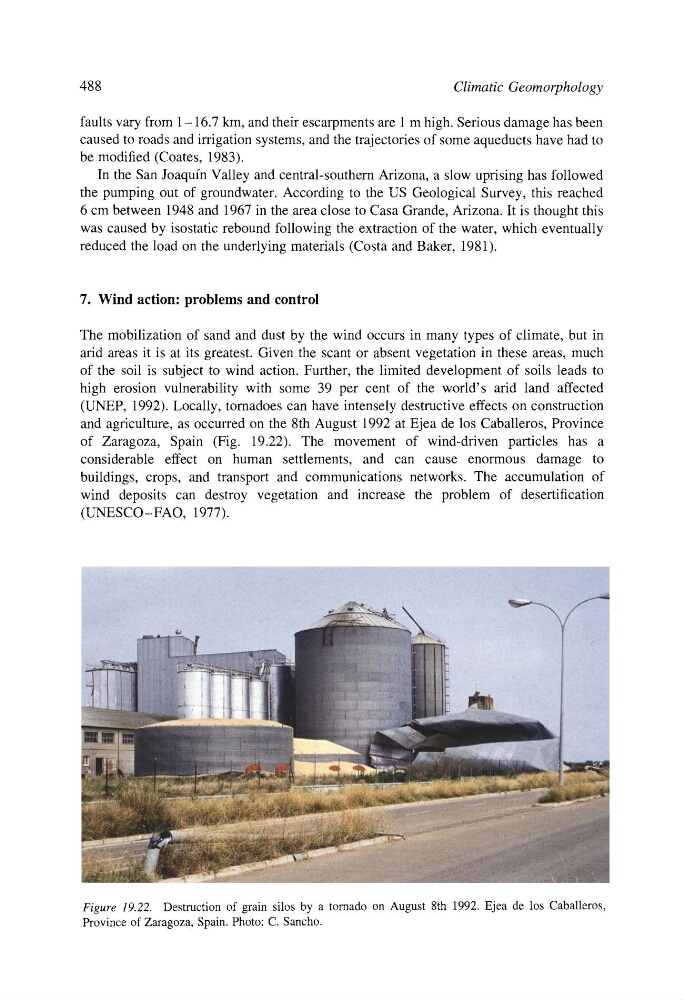
(UNEP, 1992). Locally, tornadoes can have intensely destructive effects on construction
and agriculture, as occurred on the 8th August 1992 at Ejea de los Caballeros, Province
of Zaragoza, Spain (Fig. 19.22). The movement of wind-driven particles has a
considerable effect on human settlements, and can cause enormous damage to
buildings, crops, and transport and communications networks. The accumulation of
wind deposits can destroy vegetation and increase the problem of desertification
(UNESCO-FAO, 1977).
Figure 19.22. Destruction of grain silos by a tornado on August 8th 1992. Ejea de los Caballeros,
Province of Zaragoza, Spain. Photo: C. Sancho.
Climatic Geomorphology
faults vary from 1 - 16.7 km, and their escarpments are 1 m high. Serious damage has been
caused to roads and irrigation systems, and the trajectories of some aqueducts have had to
be modified (Coates, 1983).
In the San Joaqufn Valley and central-southern Arizona, a slow uprising has followed
the pumping out of groundwater. According to the US Geological Survey, this reached
6 cm between 1948 and 1967 in the area close to Casa Grande, Arizona. It is thought this
was caused by isostatic rebound following the extraction of the water, which eventually
reduced the load on the underlying materials (Costa and Baker, 1981).
7. Wind action: problems and control
The mobilization of sand and dust by the wind occurs in many types of climate, but in
arid areas it is at its greatest. Given the scant or absent vegetation in these areas, much
of the soil is subject to wind action. Further, the limited development of soils leads to
high erosion vulnerability with some 39 per cent of the world's arid land affected
(UNEP, 1992). Locally, tornadoes can have intensely destructive effects on construction
and agriculture, as occurred on the 8th August 1992 at Ejea de los Caballeros, Province
of Zaragoza, Spain (Fig. 19.22). The movement of wind-driven particles has a
considerable effect on human settlements, and can cause enormous damage to
buildings, crops, and transport and communications networks. The accumulation of
wind deposits can destroy vegetation and increase the problem of desertification
(UNESCO-FAO, 1977).
Figure 19.22. Destruction of grain silos by a tornado on August 8th 1992. Ejea de los Caballeros,
Province of Zaragoza, Spain. Photo: C. Sancho.