

Glaciers
39
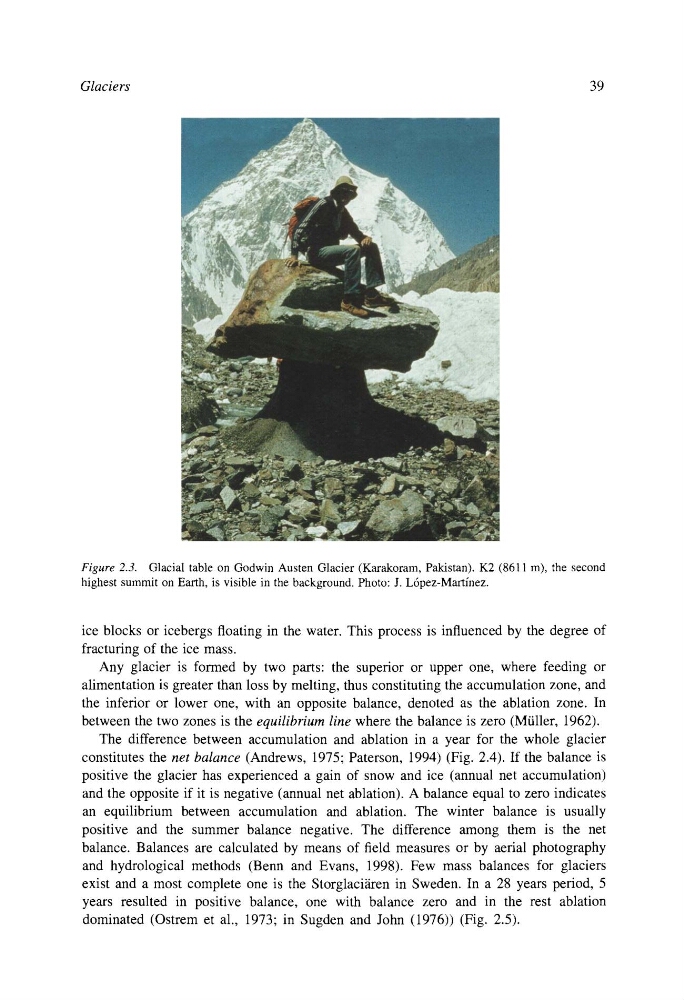
Figure 2.3. Glacial table on Godwin Austen Glacier (Karakoram, Pakistan). K2 (8611 m), the second
highest summit on Earth, is visible in the background. Photo: J. L6pez-Martfnez.
ice blocks or icebergs floating in the water. This process is influenced by the degree of
fracturing of the ice mass.
Any glacier is formed by two parts: the superior or upper one, where feeding or
alimentation is greater than loss by melting, thus constituting the accumulation zone, and
the inferior or lower one, with an opposite balance, denoted as the ablation zone. In
between the two zones is the equilibrium line where the balance is zero (Mtiller, 1962).
The difference between accumulation and ablation in a year for the whole glacier
constitutes the net balance (Andrews, 1975; Paterson, 1994) (Fig. 2.4). If the balance is
positive the glacier has experienced a gain of snow and ice (annual net accumulation)
and the opposite if it is negative (annual net ablation). A balance equal to zero indicates
an equilibrium between accumulation and ablation. The winter balance is usually
positive and the summer balance negative. The difference among them is the net
balance. Balances are calculated by means of field measures or by aerial photography
and hydrological methods (Benn and Evans, 1998). Few mass balances for glaciers
exist and a most complete one is the Storglaci~iren in Sweden. In a 28 years period, 5
years resulted in positive balance, one with balance zero and in the rest ablation
dominated (Ostrem et al., 1973; in Sugden and John (1976)) (Fig. 2.5).
39
Figure 2.3. Glacial table on Godwin Austen Glacier (Karakoram, Pakistan). K2 (8611 m), the second
highest summit on Earth, is visible in the background. Photo: J. L6pez-Martfnez.
ice blocks or icebergs floating in the water. This process is influenced by the degree of
fracturing of the ice mass.
Any glacier is formed by two parts: the superior or upper one, where feeding or
alimentation is greater than loss by melting, thus constituting the accumulation zone, and
the inferior or lower one, with an opposite balance, denoted as the ablation zone. In
between the two zones is the equilibrium line where the balance is zero (Mtiller, 1962).
The difference between accumulation and ablation in a year for the whole glacier
constitutes the net balance (Andrews, 1975; Paterson, 1994) (Fig. 2.4). If the balance is
positive the glacier has experienced a gain of snow and ice (annual net accumulation)
and the opposite if it is negative (annual net ablation). A balance equal to zero indicates
an equilibrium between accumulation and ablation. The winter balance is usually
positive and the summer balance negative. The difference among them is the net
balance. Balances are calculated by means of field measures or by aerial photography
and hydrological methods (Benn and Evans, 1998). Few mass balances for glaciers
exist and a most complete one is the Storglaci~iren in Sweden. In a 28 years period, 5
years resulted in positive balance, one with balance zero and in the rest ablation
dominated (Ostrem et al., 1973; in Sugden and John (1976)) (Fig. 2.5).