

Aeolian accumulations
451
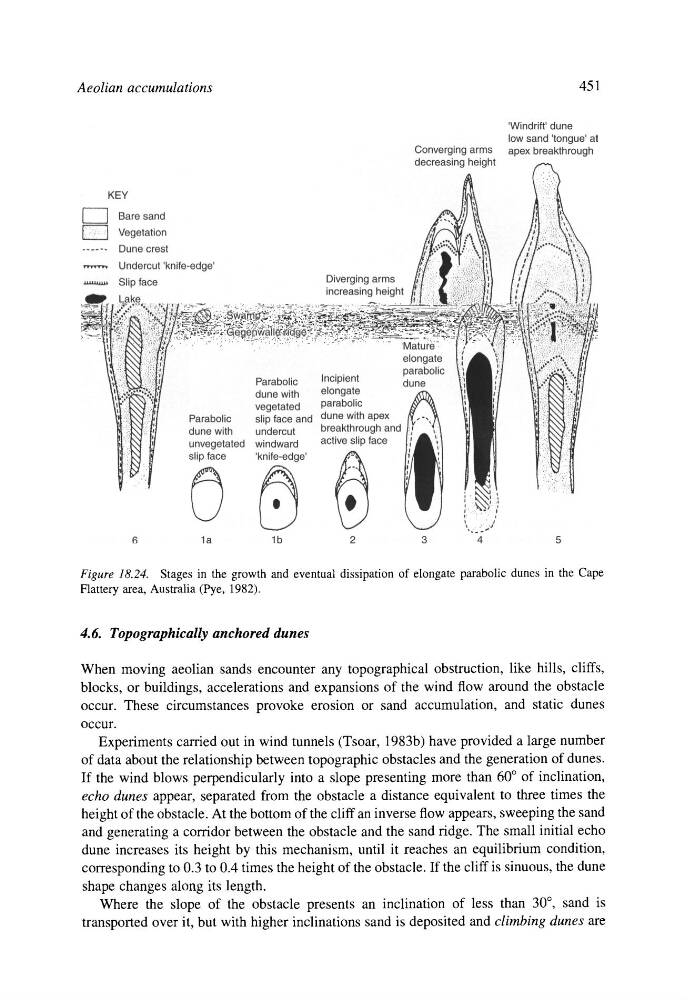
Figure 18.24. Stages in the growth and eventual dissipation of elongate parabolic dunes in the Cape
Flattery area, Australia (Pye, 1982).
4.6. Topographically anchored dunes
When moving aeolian sands encounter any topographical obstruction, like hills, cliffs,
blocks, or buildings, accelerations and expansions of the wind flow around the obstacle
occur. These circumstances provoke erosion or sand accumulation, and static dunes
occur.
Experiments carried out in wind tunnels (Tsoar, 1983b) have provided a large number
of data about the relationship between topographic obstacles and the generation of dunes.
If the wind blows perpendicularly into a slope presenting more than 60 ~ of inclination,
echo dunes appear, separated from the obstacle a distance equivalent to three times the
height of the obstacle. At the bottom of the cliff an inverse flow appears, sweeping the sand
and generating a corridor between the obstacle and the sand ridge. The small initial echo
dune increases its height by this mechanism, until it reaches an equilibrium condition,
corresponding to 0.3 to 0.4 times the height of the obstacle. If the cliff is sinuous, the dune
shape changes along its length.
Where the slope of the obstacle presents an inclination of less than 30 ~ , sand is
transported over it, but with higher inclinations sand is deposited and climbing dunes are
451
Figure 18.24. Stages in the growth and eventual dissipation of elongate parabolic dunes in the Cape
Flattery area, Australia (Pye, 1982).
4.6. Topographically anchored dunes
When moving aeolian sands encounter any topographical obstruction, like hills, cliffs,
blocks, or buildings, accelerations and expansions of the wind flow around the obstacle
occur. These circumstances provoke erosion or sand accumulation, and static dunes
occur.
Experiments carried out in wind tunnels (Tsoar, 1983b) have provided a large number
of data about the relationship between topographic obstacles and the generation of dunes.
If the wind blows perpendicularly into a slope presenting more than 60 ~ of inclination,
echo dunes appear, separated from the obstacle a distance equivalent to three times the
height of the obstacle. At the bottom of the cliff an inverse flow appears, sweeping the sand
and generating a corridor between the obstacle and the sand ridge. The small initial echo
dune increases its height by this mechanism, until it reaches an equilibrium condition,
corresponding to 0.3 to 0.4 times the height of the obstacle. If the cliff is sinuous, the dune
shape changes along its length.
Where the slope of the obstacle presents an inclination of less than 30 ~ , sand is
transported over it, but with higher inclinations sand is deposited and climbing dunes are