

450
Climatic Geomorphology
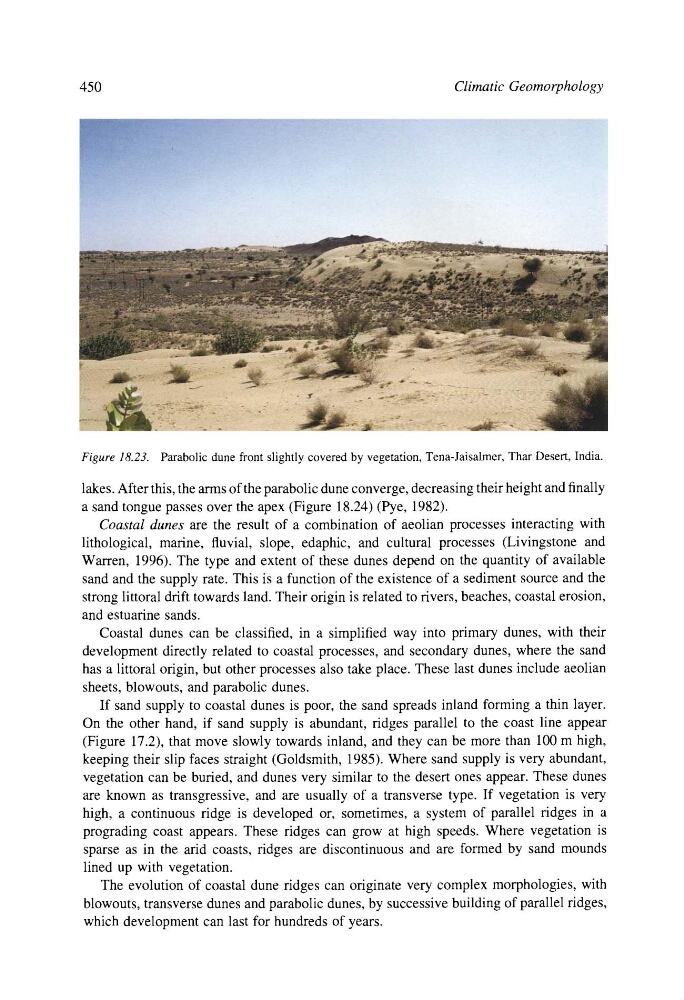
Figure 18.23. Parabolic dune front slightly covered by vegetation, Tena-Jaisalmer, Thar Desert, India.
lakes. After this, the arms of the parabolic dune converge, decreasing their height and finally
a sand tongue passes over the apex (Figure 18.24) (Pye, 1982).
Coastal dunes are the result of a combination of aeolian processes interacting with
lithological, marine, fluvial, slope, edaphic, and cultural processes (Livingstone and
Warren, 1996). The type and extent of these dunes depend on the quantity of available
sand and the supply rate. This is a function of the existence of a sediment source and the
strong littoral drift towards land. Their origin is related to rivers, beaches, coastal erosion,
and estuarine sands.
Coastal dunes can be classified, in a simplified way into primary dunes, with their
development directly related to coastal processes, and secondary dunes, where the sand
has a littoral origin, but other processes also take place. These last dunes include aeolian
sheets, blowouts, and parabolic dunes.
If sand supply to coastal dunes is poor, the sand spreads inland forming a thin layer.
On the other hand, if sand supply is abundant, ridges parallel to the coast line appear
(Figure 17.2), that move slowly towards inland, and they can be more than 100 m high,
keeping their slip faces straight (Goldsmith, 1985). Where sand supply is very abundant,
vegetation can be buffed, and dunes very similar to the desert ones appear. These dunes
are known as transgressive, and are usually of a transverse type. If vegetation is very
high, a continuous ridge is developed or, sometimes, a system of parallel ridges in a
prograding coast appears. These ridges can grow at high speeds. Where vegetation is
sparse as in the arid coasts, ridges are discontinuous and are formed by sand mounds
lined up with vegetation.
The evolution of coastal dune ridges can originate very complex morphologies, with
blowouts, transverse dunes and parabolic dunes, by successive building of parallel ridges,
which development can last for hundreds of years.
Climatic Geomorphology
Figure 18.23. Parabolic dune front slightly covered by vegetation, Tena-Jaisalmer, Thar Desert, India.
lakes. After this, the arms of the parabolic dune converge, decreasing their height and finally
a sand tongue passes over the apex (Figure 18.24) (Pye, 1982).
Coastal dunes are the result of a combination of aeolian processes interacting with
lithological, marine, fluvial, slope, edaphic, and cultural processes (Livingstone and
Warren, 1996). The type and extent of these dunes depend on the quantity of available
sand and the supply rate. This is a function of the existence of a sediment source and the
strong littoral drift towards land. Their origin is related to rivers, beaches, coastal erosion,
and estuarine sands.
Coastal dunes can be classified, in a simplified way into primary dunes, with their
development directly related to coastal processes, and secondary dunes, where the sand
has a littoral origin, but other processes also take place. These last dunes include aeolian
sheets, blowouts, and parabolic dunes.
If sand supply to coastal dunes is poor, the sand spreads inland forming a thin layer.
On the other hand, if sand supply is abundant, ridges parallel to the coast line appear
(Figure 17.2), that move slowly towards inland, and they can be more than 100 m high,
keeping their slip faces straight (Goldsmith, 1985). Where sand supply is very abundant,
vegetation can be buffed, and dunes very similar to the desert ones appear. These dunes
are known as transgressive, and are usually of a transverse type. If vegetation is very
high, a continuous ridge is developed or, sometimes, a system of parallel ridges in a
prograding coast appears. These ridges can grow at high speeds. Where vegetation is
sparse as in the arid coasts, ridges are discontinuous and are formed by sand mounds
lined up with vegetation.
The evolution of coastal dune ridges can originate very complex morphologies, with
blowouts, transverse dunes and parabolic dunes, by successive building of parallel ridges,
which development can last for hundreds of years.