

Aeolian accumulations
449
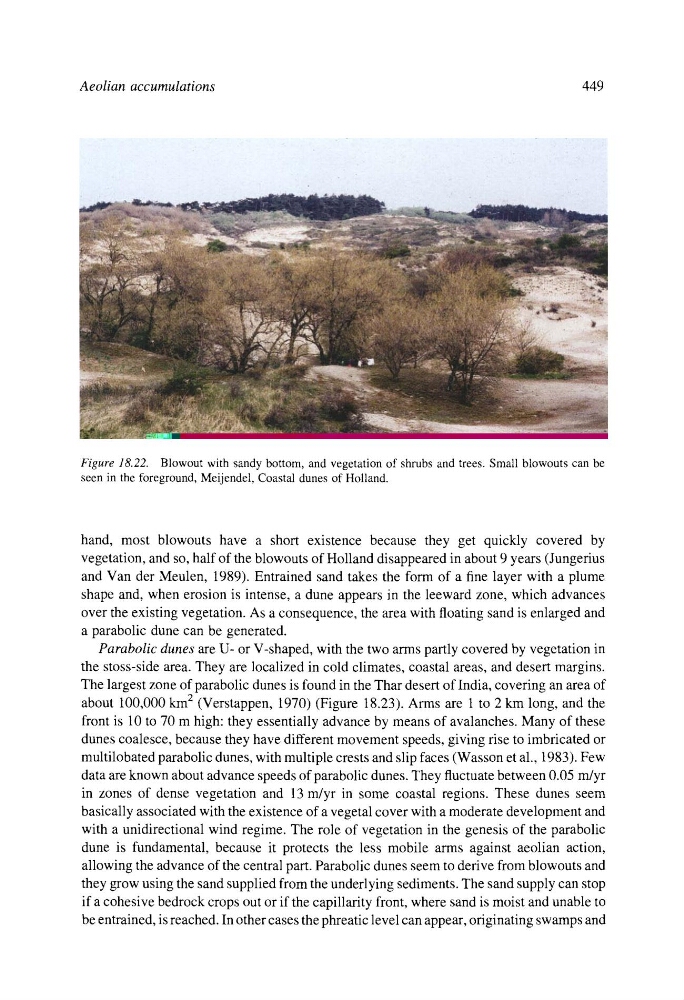
Figure 18.22. Blowout with sandy bottom, and vegetation of shrubs and trees. Small blowouts can be
seen in the foreground, Meijendel, Coastal dunes of Holland.
hand, most blowouts have a short existence because they get quickly covered by
vegetation, and so, half of the blowouts of Holland disappeared in about 9 years (Jungerius
and Van der Meulen, 1989). Entrained sand takes the form of a fine layer with a plume
shape and, when erosion is intense, a dune appears in the leeward zone, which advances
over the existing vegetation. As a consequence, the area with floating sand is enlarged and
a parabolic dune can be generated.
Parabolic dunes are U- or V-shaped, with the two arms partly covered by vegetation in
the stoss-side area. They are localized in cold climates, coastal areas, and desert margins.
The largest zone of parabolic dunes is found in the Thar desert of India, covering an area of
about 100,000 km 2 (Verstappen, 1970) (Figure 18.23). Arms are 1 to 2 km long, and the
front is 10 to 70 m high: they essentially advance by means of avalanches. Many of these
dunes coalesce, because they have different movement speeds, giving rise to imbricated or
multilobated parabolic dunes, with multiple crests and slip faces (Wasson et al., 1983). Few
data are known about advance speeds of parabolic dunes. They fluctuate between 0.05 m/yr
in zones of dense vegetation and 13 m/yr in some coastal regions. These dunes seem
basically associated with the existence of a vegetal cover with a moderate development and
with a unidirectional wind regime. The role of vegetation in the genesis of the parabolic
dune is fundamental, because it protects the less mobile arms against aeolian action,
allowing the advance of the central part. Parabolic dunes seem to derive from blowouts and
they grow using the sand supplied from the underlying sediments. The sand supply can stop
if a cohesive bedrock crops out or if the capillarity front, where sand is moist and unable to
be entrained, is reached. In other cases the phreatic level can appear, originating swamps and
449
Figure 18.22. Blowout with sandy bottom, and vegetation of shrubs and trees. Small blowouts can be
seen in the foreground, Meijendel, Coastal dunes of Holland.
hand, most blowouts have a short existence because they get quickly covered by
vegetation, and so, half of the blowouts of Holland disappeared in about 9 years (Jungerius
and Van der Meulen, 1989). Entrained sand takes the form of a fine layer with a plume
shape and, when erosion is intense, a dune appears in the leeward zone, which advances
over the existing vegetation. As a consequence, the area with floating sand is enlarged and
a parabolic dune can be generated.
Parabolic dunes are U- or V-shaped, with the two arms partly covered by vegetation in
the stoss-side area. They are localized in cold climates, coastal areas, and desert margins.
The largest zone of parabolic dunes is found in the Thar desert of India, covering an area of
about 100,000 km 2 (Verstappen, 1970) (Figure 18.23). Arms are 1 to 2 km long, and the
front is 10 to 70 m high: they essentially advance by means of avalanches. Many of these
dunes coalesce, because they have different movement speeds, giving rise to imbricated or
multilobated parabolic dunes, with multiple crests and slip faces (Wasson et al., 1983). Few
data are known about advance speeds of parabolic dunes. They fluctuate between 0.05 m/yr
in zones of dense vegetation and 13 m/yr in some coastal regions. These dunes seem
basically associated with the existence of a vegetal cover with a moderate development and
with a unidirectional wind regime. The role of vegetation in the genesis of the parabolic
dune is fundamental, because it protects the less mobile arms against aeolian action,
allowing the advance of the central part. Parabolic dunes seem to derive from blowouts and
they grow using the sand supplied from the underlying sediments. The sand supply can stop
if a cohesive bedrock crops out or if the capillarity front, where sand is moist and unable to
be entrained, is reached. In other cases the phreatic level can appear, originating swamps and