

448
Climatic Geomorphology
produce sudden modifications in the aeolian dynamics (Gile, 1975). Some nebkhas are
affected by processes other than the aeolian ones, such as impact and splash by raindrops,
runoff and animal activity. Therefore, there is a sum of processes, and it is difficult to
evaluate the input of each one (Cooke et al., 1993).
Blowouts or deflation basins are morphologies produced by deflation, as closed
depressions on unconsolidated aeolian sands, up to the limit of plant roots (Livingstone
and Warren, 1996). Some authors use the term blowout in a restricted way, only for those
generated in vegetated areas, whereas others such as Lancaster (1989c) extend
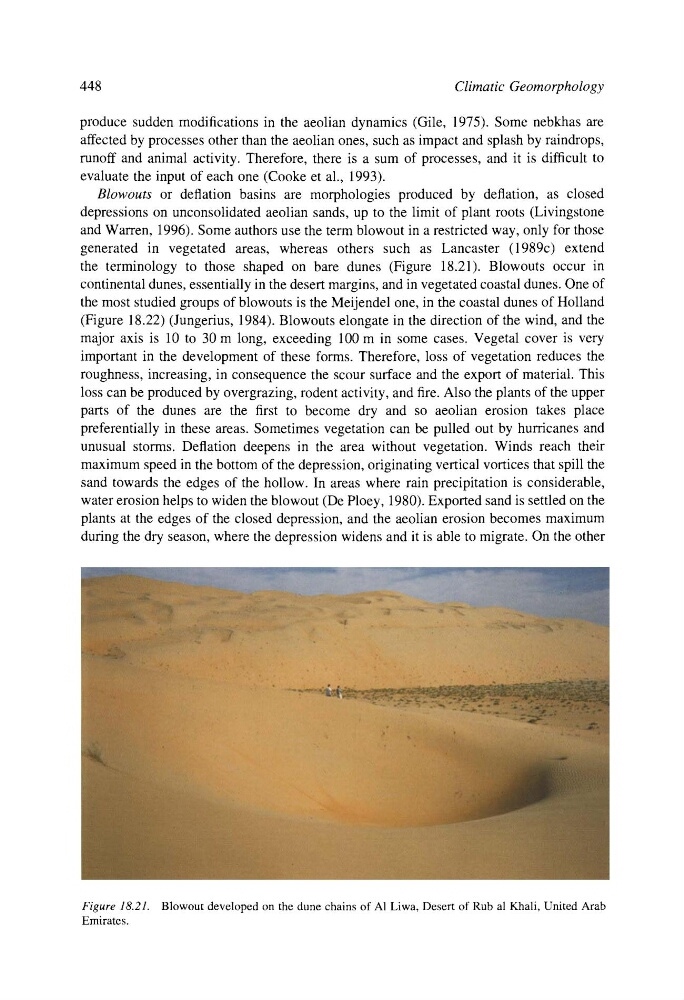
the terminology to those shaped on bare dunes (Figure 18.21). Blowouts occur in
continental dunes, essentially in the desert margins, and in vegetated coastal dunes. One of
the most studied groups of blowouts is the Meijendel one, in the coastal dunes of Holland
(Figure 18.22) (Jungerius, 1984). Blowouts elongate in the direction of the wind, and the
major axis is 10 to 30 m long, exceeding 100 m in some cases. Vegetal cover is very
important in the development of these forms. Therefore, loss of vegetation reduces the
roughness, increasing, in consequence the scour surface and the export of material. This
loss can be produced by overgrazing, rodent activity, and fire. Also the plants of the upper
parts of the dunes are the first to become dry and so aeolian erosion takes place
preferentially in these areas. Sometimes vegetation can be pulled out by hurricanes and
unusual storms. Deflation deepens in the area without vegetation. Winds reach their
maximum speed in the bottom of the depression, originating vertical vortices that spill the
sand towards the edges of the hollow. In areas where rain precipitation is considerable,
water erosion helps to widen the blowout (De Ploey, 1980). Exported sand is settled on the
plants at the edges of the closed depression, and the aeolian erosion becomes maximum
during the dry season, where the depression widens and it is able to migrate. On the other
Figure 18.21. Blowout developed on the dune chains of A1Liwa, Desert of Rub al Khali, United Arab
Emirates.
Climatic Geomorphology
produce sudden modifications in the aeolian dynamics (Gile, 1975). Some nebkhas are
affected by processes other than the aeolian ones, such as impact and splash by raindrops,
runoff and animal activity. Therefore, there is a sum of processes, and it is difficult to
evaluate the input of each one (Cooke et al., 1993).
Blowouts or deflation basins are morphologies produced by deflation, as closed
depressions on unconsolidated aeolian sands, up to the limit of plant roots (Livingstone
and Warren, 1996). Some authors use the term blowout in a restricted way, only for those
generated in vegetated areas, whereas others such as Lancaster (1989c) extend
the terminology to those shaped on bare dunes (Figure 18.21). Blowouts occur in
continental dunes, essentially in the desert margins, and in vegetated coastal dunes. One of
the most studied groups of blowouts is the Meijendel one, in the coastal dunes of Holland
(Figure 18.22) (Jungerius, 1984). Blowouts elongate in the direction of the wind, and the
major axis is 10 to 30 m long, exceeding 100 m in some cases. Vegetal cover is very
important in the development of these forms. Therefore, loss of vegetation reduces the
roughness, increasing, in consequence the scour surface and the export of material. This
loss can be produced by overgrazing, rodent activity, and fire. Also the plants of the upper
parts of the dunes are the first to become dry and so aeolian erosion takes place
preferentially in these areas. Sometimes vegetation can be pulled out by hurricanes and
unusual storms. Deflation deepens in the area without vegetation. Winds reach their
maximum speed in the bottom of the depression, originating vertical vortices that spill the
sand towards the edges of the hollow. In areas where rain precipitation is considerable,
water erosion helps to widen the blowout (De Ploey, 1980). Exported sand is settled on the
plants at the edges of the closed depression, and the aeolian erosion becomes maximum
during the dry season, where the depression widens and it is able to migrate. On the other
Figure 18.21. Blowout developed on the dune chains of A1Liwa, Desert of Rub al Khali, United Arab
Emirates.