

Aeolian accumulations
447
4.5. Dunes anchored by vegetation
The areas that present dunes with low mobility are suitable places for plant growth,
because water retention by sand occurs (Tsoar and Moiler, 1986). This vegetation cover
modifies the wind flow and favours aeolian sand trapping.
Dunes anchored by vegetation, also called phytogenetic dunes (Cooke et al., 1993), are
originated by the stabilization of aeolian sand around the plants (nebkhas and coastal
dunes) and by the erosion of surfaces covered by vegetation (blowouts and parabolic
dunes). Even though they are almost fixed dunes, many of them can undergo changes in
their shape and size, during seasonal or even longer cycles.
The most common type of dune anchored by vegetation are the nebkhas, also called
shrub dunes, shadow dunes, hummock dunes, rebdou, and other terms (Pye and Tsoar,
1990; Cooke et al., 1993). They occupy enormous areas in the lowlands of the semiarid
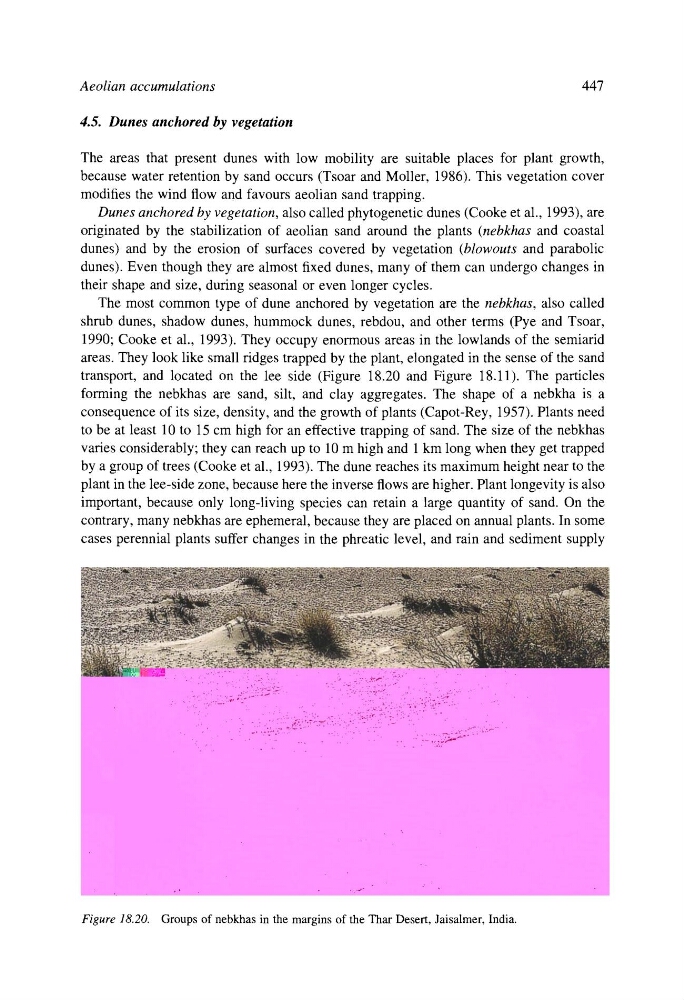
areas. They look like small ridges trapped by the plant, elongated in the sense of the sand
transport, and located on the lee side (Figure 18.20 and Figure 18.11). The particles
forming the nebkhas are sand, silt, and clay aggregates. The shape of a nebkha is a
consequence of its size, density, and the growth of plants (Capot-Rey, 1957). Plants need
to be at least 10 to 15 cm high for an effective trapping of sand. The size of the nebkhas
varies considerably; they can reach up to 10 m high and 1 km long when they get trapped
by a group of trees (Cooke et al., 1993). The dune reaches its maximum height near to the
plant in the lee-side zone, because here the inverse flows are higher. Plant longevity is also
important, because only long-living species can retain a large quantity of sand. On the
contrary, many nebkhas are ephemeral, because they are placed on annual plants. In some
cases perennial plants suffer changes in the phreatic level, and rain and sediment supply
Figure 18.20. Groups of nebkhas in the margins of the Thar Desert, Jaisalmer, India.
447
4.5. Dunes anchored by vegetation
The areas that present dunes with low mobility are suitable places for plant growth,
because water retention by sand occurs (Tsoar and Moiler, 1986). This vegetation cover
modifies the wind flow and favours aeolian sand trapping.
Dunes anchored by vegetation, also called phytogenetic dunes (Cooke et al., 1993), are
originated by the stabilization of aeolian sand around the plants (nebkhas and coastal
dunes) and by the erosion of surfaces covered by vegetation (blowouts and parabolic
dunes). Even though they are almost fixed dunes, many of them can undergo changes in
their shape and size, during seasonal or even longer cycles.
The most common type of dune anchored by vegetation are the nebkhas, also called
shrub dunes, shadow dunes, hummock dunes, rebdou, and other terms (Pye and Tsoar,
1990; Cooke et al., 1993). They occupy enormous areas in the lowlands of the semiarid
areas. They look like small ridges trapped by the plant, elongated in the sense of the sand
transport, and located on the lee side (Figure 18.20 and Figure 18.11). The particles
forming the nebkhas are sand, silt, and clay aggregates. The shape of a nebkha is a
consequence of its size, density, and the growth of plants (Capot-Rey, 1957). Plants need
to be at least 10 to 15 cm high for an effective trapping of sand. The size of the nebkhas
varies considerably; they can reach up to 10 m high and 1 km long when they get trapped
by a group of trees (Cooke et al., 1993). The dune reaches its maximum height near to the
plant in the lee-side zone, because here the inverse flows are higher. Plant longevity is also
important, because only long-living species can retain a large quantity of sand. On the
contrary, many nebkhas are ephemeral, because they are placed on annual plants. In some
cases perennial plants suffer changes in the phreatic level, and rain and sediment supply
Figure 18.20. Groups of nebkhas in the margins of the Thar Desert, Jaisalmer, India.