

440
Climatic Geomorphology
-0.s-....._> /
..; .22,..=-:: z -
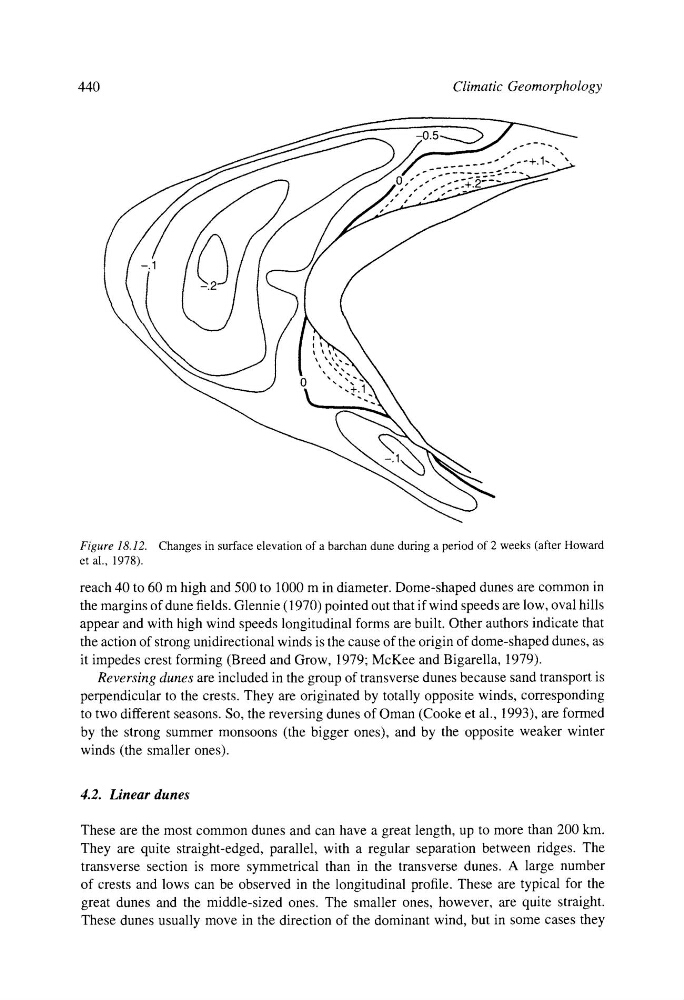
Figure 18.12. Changes in surface elevation of a barchan dune during a period of 2 weeks (after Howard
et al., 1978).
reach 40 to 60 m high and 500 to 1000 m in diameter. Dome-shaped dunes are common in
the margins of dune fields. Glennie (1970) pointed out that if wind speeds are low, oval hills
appear and with high wind speeds longitudinal forms are built. Other authors indicate that
the action of strong unidirectional winds is the cause of the origin of dome-shaped dunes, as
it impedes crest forming (Breed and Grow, 1979; McKee and Bigarella, 1979).
Reversing dunes are included in the group of transverse dunes because sand transport is
perpendicular to the crests. They are originated by totally opposite winds, corresponding
to two different seasons. So, the reversing dunes of Oman (Cooke et al., 1993), are formed
by the strong summer monsoons (the bigger ones), and by the opposite weaker winter
winds (the smaller ones).
4.2. Linear dunes
These are the most common dunes and can have a great length, up to more than 200 km.
They are quite straight-edged, parallel, with a regular separation between ridges. The
transverse section is more symmetrical than in the transverse dunes. A large number
of crests and lows can be observed in the longitudinal profile. These are typical for the
great dunes and the middle-sized ones. The smaller ones, however, are quite straight.
These dunes usually move in the direction of the dominant wind, but in some cases they
Climatic Geomorphology
-0.s-....._> /
..; .22,..=-:: z -
Figure 18.12. Changes in surface elevation of a barchan dune during a period of 2 weeks (after Howard
et al., 1978).
reach 40 to 60 m high and 500 to 1000 m in diameter. Dome-shaped dunes are common in
the margins of dune fields. Glennie (1970) pointed out that if wind speeds are low, oval hills
appear and with high wind speeds longitudinal forms are built. Other authors indicate that
the action of strong unidirectional winds is the cause of the origin of dome-shaped dunes, as
it impedes crest forming (Breed and Grow, 1979; McKee and Bigarella, 1979).
Reversing dunes are included in the group of transverse dunes because sand transport is
perpendicular to the crests. They are originated by totally opposite winds, corresponding
to two different seasons. So, the reversing dunes of Oman (Cooke et al., 1993), are formed
by the strong summer monsoons (the bigger ones), and by the opposite weaker winter
winds (the smaller ones).
4.2. Linear dunes
These are the most common dunes and can have a great length, up to more than 200 km.
They are quite straight-edged, parallel, with a regular separation between ridges. The
transverse section is more symmetrical than in the transverse dunes. A large number
of crests and lows can be observed in the longitudinal profile. These are typical for the
great dunes and the middle-sized ones. The smaller ones, however, are quite straight.
These dunes usually move in the direction of the dominant wind, but in some cases they