

438
Climatic Geomorphology
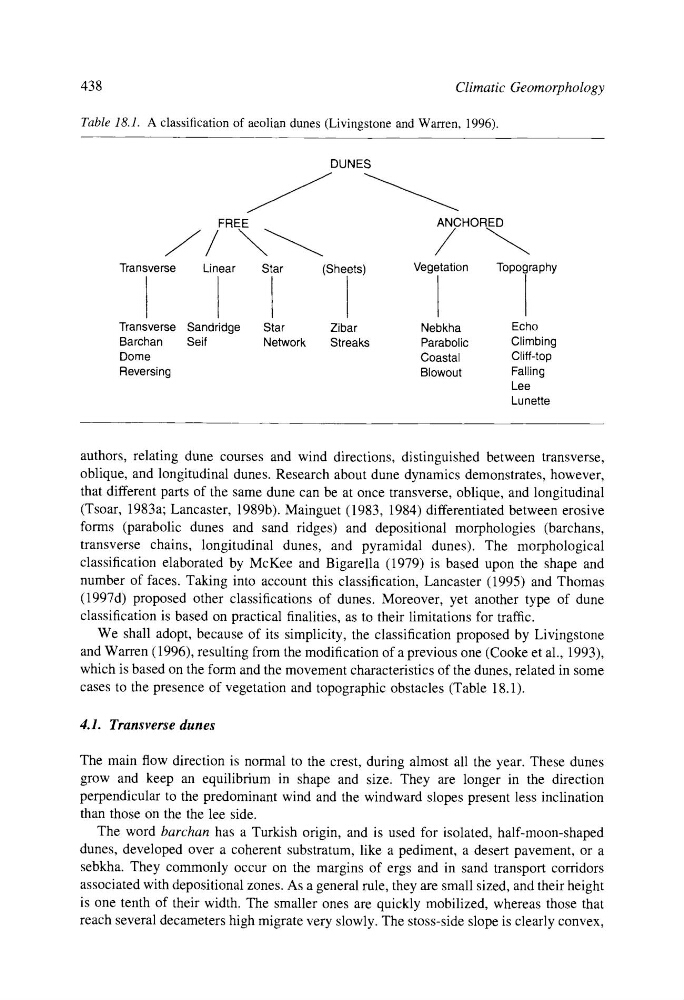
Table 18.1. A classification of aeolian dunes (Livingstone and Warren, 1996).
DUNES
FREE
ANCHORED
Transverse
Linear
Star
(Sheets)
Vegetation Topography
Transverse Sandridge
Star
Zibar
Nebkha
Echo
Barchan
Seif
Network
Streaks
Parabolic
Climbing
Dome
Coastal
Cliff-top
Reversing
Blowout
Falling
Lee
Lunette
authors, relating dune courses and wind directions, distinguished between transverse,
oblique, and longitudinal dunes. Research about dune dynamics demonstrates, however,
that different parts of the same dune can be at once transverse, oblique, and longitudinal
(Tsoar, 1983a; Lancaster, 1989b). Mainguet (1983, 1984) differentiated between erosive
forms (parabolic dunes and sand ridges) and depositional morphologies (barchans,
transverse chains, longitudinal dunes, and pyramidal dunes). The morphological
classification elaborated by McKee and Bigarella (1979) is based upon the shape and
number of faces. Taking into account this classification, Lancaster (1995) and Thomas
(1997d) proposed other classifications of dunes. Moreover, yet another type of dune
classification is based on practical finalities, as to their limitations for traffic.
We shall adopt, because of its simplicity, the classification proposed by Livingstone
and Warren (1996), resulting from the modification of a previous one (Cooke et al., 1993),
which is based on the form and the movement characteristics of the dunes, related in some
cases to the presence of vegetation and topographic obstacles (Table 18.1).
4.1. Transverse dunes
The main flow direction is normal to the crest, during almost all the year. These dunes
grow and keep an equilibrium in shape and size. They are longer in the direction
perpendicular to the predominant wind and the windward slopes present less inclination
than those on the the lee side.
The word barchan has a Turkish origin, and is used for isolated, half-moon-shaped
dunes, developed over a coherent substratum, like a pediment, a desert pavement, or a
sebkha. They commonly occur on the margins of ergs and in sand transport corridors
associated with depositional zones. As a general rule, they are small sized, and their height
is one tenth of their width. The smaller ones are quickly mobilized, whereas those that
reach several decameters high migrate very slowly. The stoss-side slope is clearly convex,
Climatic Geomorphology
Table 18.1. A classification of aeolian dunes (Livingstone and Warren, 1996).
DUNES
FREE
ANCHORED
Transverse
Linear
Star
(Sheets)
Vegetation Topography
Transverse Sandridge
Star
Zibar
Nebkha
Echo
Barchan
Seif
Network
Streaks
Parabolic
Climbing
Dome
Coastal
Cliff-top
Reversing
Blowout
Falling
Lee
Lunette
authors, relating dune courses and wind directions, distinguished between transverse,
oblique, and longitudinal dunes. Research about dune dynamics demonstrates, however,
that different parts of the same dune can be at once transverse, oblique, and longitudinal
(Tsoar, 1983a; Lancaster, 1989b). Mainguet (1983, 1984) differentiated between erosive
forms (parabolic dunes and sand ridges) and depositional morphologies (barchans,
transverse chains, longitudinal dunes, and pyramidal dunes). The morphological
classification elaborated by McKee and Bigarella (1979) is based upon the shape and
number of faces. Taking into account this classification, Lancaster (1995) and Thomas
(1997d) proposed other classifications of dunes. Moreover, yet another type of dune
classification is based on practical finalities, as to their limitations for traffic.
We shall adopt, because of its simplicity, the classification proposed by Livingstone
and Warren (1996), resulting from the modification of a previous one (Cooke et al., 1993),
which is based on the form and the movement characteristics of the dunes, related in some
cases to the presence of vegetation and topographic obstacles (Table 18.1).
4.1. Transverse dunes
The main flow direction is normal to the crest, during almost all the year. These dunes
grow and keep an equilibrium in shape and size. They are longer in the direction
perpendicular to the predominant wind and the windward slopes present less inclination
than those on the the lee side.
The word barchan has a Turkish origin, and is used for isolated, half-moon-shaped
dunes, developed over a coherent substratum, like a pediment, a desert pavement, or a
sebkha. They commonly occur on the margins of ergs and in sand transport corridors
associated with depositional zones. As a general rule, they are small sized, and their height
is one tenth of their width. The smaller ones are quickly mobilized, whereas those that
reach several decameters high migrate very slowly. The stoss-side slope is clearly convex,