

Aeolian accumulations
437
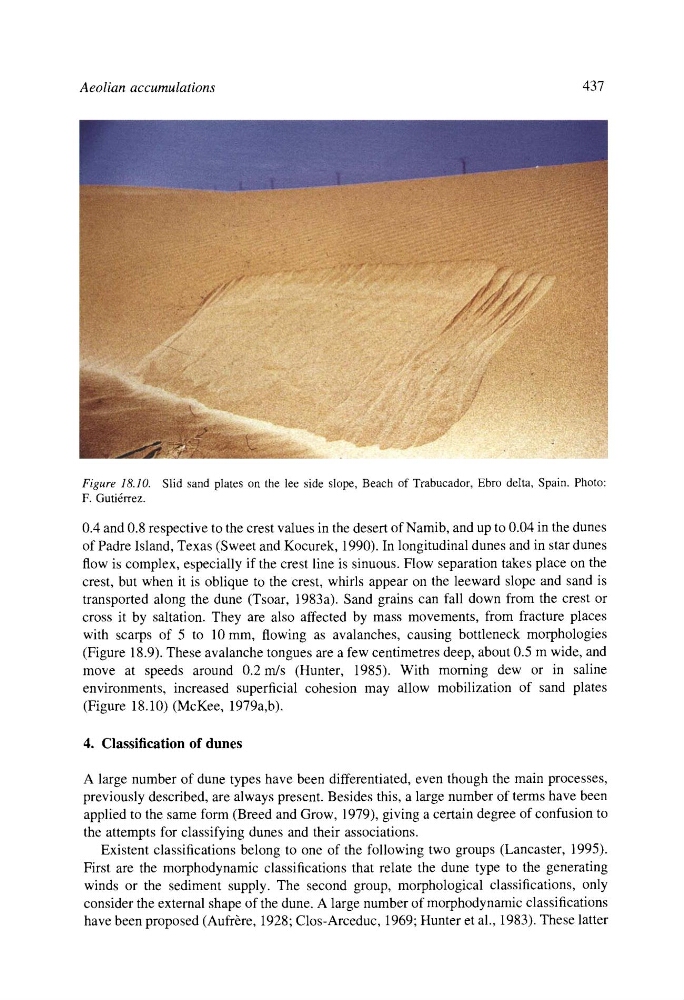
Figure 18.10. Slid sand plates on the lee side slope, Beach of Trabucador, Ebro delta, Spain. Photo:
F. Guti6rrez.
0.4 and 0.8 respective to the crest values in the desert of Namib, and up to 0.04 in the dunes
of Padre Island, Texas (Sweet and Kocurek, 1990). In longitudinal dunes and in star dunes
flow is complex, especially if the crest line is sinuous. Flow separation takes place on the
crest, but when it is oblique to the crest, whirls appear on the leeward slope and sand is
transported along the dune (Tsoar, 1983a). Sand grains can fall down from the crest or
cross it by saltation. They are also affected by mass movements, from fracture places
with scarps of 5 to 10 mm, flowing as avalanches, causing bottleneck morphologies
(Figure 18.9). These avalanche tongues are a few centimetres deep, about 0.5 m wide, and
move at speeds around 0.2 m/s (Hunter, 1985). With morning dew or in saline
environments, increased superficial cohesion may allow mobilization of sand plates
(Figure 18.10) (McKee, 1979a,b).
4. Classification of dunes
A large number of dune types have been differentiated, even though the main processes,
previously described, are always present. Besides this, a large number of terms have been
applied to the same form (Breed and Grow, 1979), giving a certain degree of confusion to
the attempts for classifying dunes and their associations.
Existent classifications belong to one of the following two groups (Lancaster, 1995).
First are the morphodynamic classifications that relate the dune type to the generating
winds or the sediment supply. The second group, morphological classifications, only
consider the external shape of the dune. A large number of morphodynamic classifications
have been proposed (Aufr~re, 1928; Clos-Arceduc, 1969; Hunter et al., 1983). These latter
437
Figure 18.10. Slid sand plates on the lee side slope, Beach of Trabucador, Ebro delta, Spain. Photo:
F. Guti6rrez.
0.4 and 0.8 respective to the crest values in the desert of Namib, and up to 0.04 in the dunes
of Padre Island, Texas (Sweet and Kocurek, 1990). In longitudinal dunes and in star dunes
flow is complex, especially if the crest line is sinuous. Flow separation takes place on the
crest, but when it is oblique to the crest, whirls appear on the leeward slope and sand is
transported along the dune (Tsoar, 1983a). Sand grains can fall down from the crest or
cross it by saltation. They are also affected by mass movements, from fracture places
with scarps of 5 to 10 mm, flowing as avalanches, causing bottleneck morphologies
(Figure 18.9). These avalanche tongues are a few centimetres deep, about 0.5 m wide, and
move at speeds around 0.2 m/s (Hunter, 1985). With morning dew or in saline
environments, increased superficial cohesion may allow mobilization of sand plates
(Figure 18.10) (McKee, 1979a,b).
4. Classification of dunes
A large number of dune types have been differentiated, even though the main processes,
previously described, are always present. Besides this, a large number of terms have been
applied to the same form (Breed and Grow, 1979), giving a certain degree of confusion to
the attempts for classifying dunes and their associations.
Existent classifications belong to one of the following two groups (Lancaster, 1995).
First are the morphodynamic classifications that relate the dune type to the generating
winds or the sediment supply. The second group, morphological classifications, only
consider the external shape of the dune. A large number of morphodynamic classifications
have been proposed (Aufr~re, 1928; Clos-Arceduc, 1969; Hunter et al., 1983). These latter