

436
Climatic Geomorphology
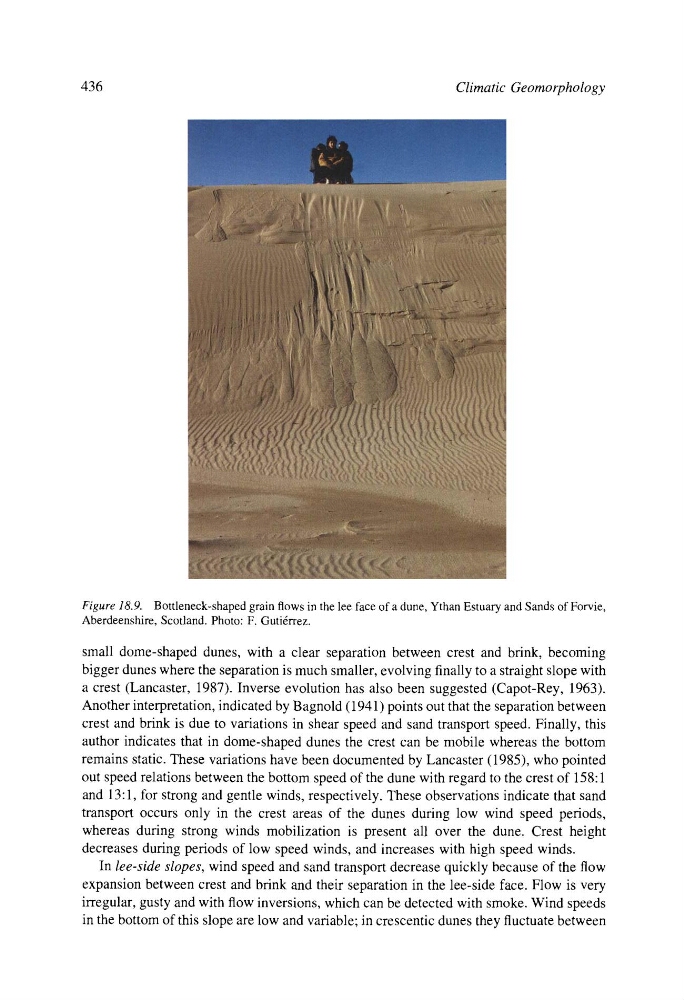
Figure 18.9. Bottleneck-shaped grain flows in the lee face of a dune, Ythan Estuary and Sands of Forvie,
Aberdeenshire, Scotland. Photo: F. Guti6rrez.
small dome-shaped dunes, with a clear separation between crest and brink, becoming
bigger dunes where the separation is much smaller, evolving finally to a straight slope with
a crest (Lancaster, 1987). Inverse evolution has also been suggested (Capot-Rey, 1963).
Another interpretation, indicated by Bagnold (1941) points out that the separation between
crest and brink is due to variations in shear speed and sand transport speed. Finally, this
author indicates that in dome-shaped dunes the crest can be mobile whereas the bottom
remains static. These variations have been documented by Lancaster (1985), who pointed
out speed relations between the bottom speed of the dune with regard to the crest of 158:1
and 13:1, for strong and gentle winds, respectively. These observations indicate that sand
transport occurs only in the crest areas of the dunes during low wind speed periods,
whereas during strong winds mobilization is present all over the dune. Crest height
decreases during periods of low speed winds, and increases with high speed winds.
In lee-side slopes, wind speed and sand transport decrease quickly because of the flow
expansion between crest and brink and their separation in the lee-side face. Flow is very
irregular, gusty and with flow inversions, which can be detected with smoke. Wind speeds
in the bottom of this slope are low and variable; in crescentic dunes they fluctuate between
Climatic Geomorphology
Figure 18.9. Bottleneck-shaped grain flows in the lee face of a dune, Ythan Estuary and Sands of Forvie,
Aberdeenshire, Scotland. Photo: F. Guti6rrez.
small dome-shaped dunes, with a clear separation between crest and brink, becoming
bigger dunes where the separation is much smaller, evolving finally to a straight slope with
a crest (Lancaster, 1987). Inverse evolution has also been suggested (Capot-Rey, 1963).
Another interpretation, indicated by Bagnold (1941) points out that the separation between
crest and brink is due to variations in shear speed and sand transport speed. Finally, this
author indicates that in dome-shaped dunes the crest can be mobile whereas the bottom
remains static. These variations have been documented by Lancaster (1985), who pointed
out speed relations between the bottom speed of the dune with regard to the crest of 158:1
and 13:1, for strong and gentle winds, respectively. These observations indicate that sand
transport occurs only in the crest areas of the dunes during low wind speed periods,
whereas during strong winds mobilization is present all over the dune. Crest height
decreases during periods of low speed winds, and increases with high speed winds.
In lee-side slopes, wind speed and sand transport decrease quickly because of the flow
expansion between crest and brink and their separation in the lee-side face. Flow is very
irregular, gusty and with flow inversions, which can be detected with smoke. Wind speeds
in the bottom of this slope are low and variable; in crescentic dunes they fluctuate between