

Aeolian accumulations
435
m12.~
10
8
"- 1.20
Z 6
~ 1.00
~-'""~
0.80
4
o02
2
.20
0
-1.0
-0.5
0.0
0.5
1.0 m
X/L
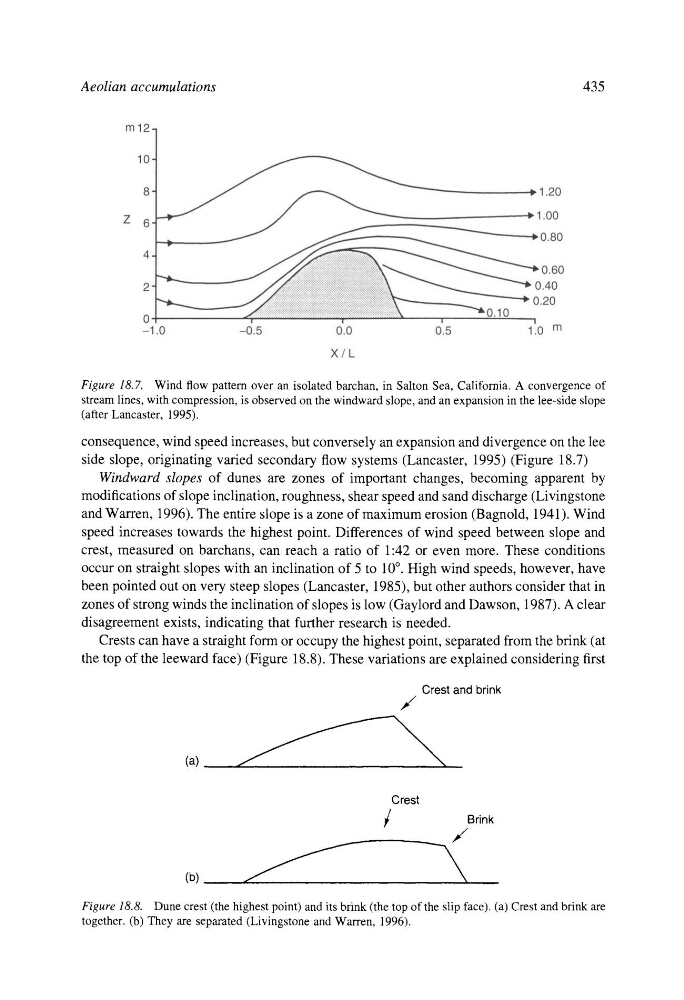
Figure 18.7. Wind flow pattern over an isolated barchan, in Salton Sea, California. A convergence of
stream lines, with compression, is observed on the windward slope, and an expansion in the lee-side slope
(after Lancaster, 1995).
consequence, wind speed increases, but conversely an expansion and divergence on the lee
side slope, originating varied secondary flow systems (Lancaster, 1995) (Figure 18.7)
Windward slopes of dunes are zones of important changes, becoming apparent by
modifications of slope inclination, roughness, shear speed and sand discharge (Livingstone
and Warren, 1996). The entire slope is a zone of maximum erosion (Bagnold, 1941). Wind
speed increases towards the highest point. Differences of wind speed between slope and
crest, measured on barchans, can reach a ratio of 1:42 or even more. These conditions
occur on straight slopes with an inclination of 5 to 10 ~ High wind speeds, however, have
been pointed out on very steep slopes (Lancaster, 1985), but other authors consider that in
zones of strong winds the inclination of slopes is low (Gaylord and Dawson, 1987). A clear
disagreement exists, indicating that further research is needed.
Crests can have a straight form or occupy the highest point, separated from the brink (at
the top of the leeward face) (Figure 18.8). These variations are explained considering first
(a)
Crest and brink
/
(b) ..
Crest
Brink
/
Figure 18.8. Dune crest (the highest point) and its brink (the top of the slip face). (a) Crest and brink are
together. (b) They are separated (Livingstone and Warren, 1996).
435
m12.~
10
8
"- 1.20
Z 6
~ 1.00
~-'""~
0.80
4
o02
2
.20
0
-1.0
-0.5
0.0
0.5
1.0 m
X/L
Figure 18.7. Wind flow pattern over an isolated barchan, in Salton Sea, California. A convergence of
stream lines, with compression, is observed on the windward slope, and an expansion in the lee-side slope
(after Lancaster, 1995).
consequence, wind speed increases, but conversely an expansion and divergence on the lee
side slope, originating varied secondary flow systems (Lancaster, 1995) (Figure 18.7)
Windward slopes of dunes are zones of important changes, becoming apparent by
modifications of slope inclination, roughness, shear speed and sand discharge (Livingstone
and Warren, 1996). The entire slope is a zone of maximum erosion (Bagnold, 1941). Wind
speed increases towards the highest point. Differences of wind speed between slope and
crest, measured on barchans, can reach a ratio of 1:42 or even more. These conditions
occur on straight slopes with an inclination of 5 to 10 ~ High wind speeds, however, have
been pointed out on very steep slopes (Lancaster, 1985), but other authors consider that in
zones of strong winds the inclination of slopes is low (Gaylord and Dawson, 1987). A clear
disagreement exists, indicating that further research is needed.
Crests can have a straight form or occupy the highest point, separated from the brink (at
the top of the leeward face) (Figure 18.8). These variations are explained considering first
(a)
Crest and brink
/
(b) ..
Crest
Brink
/
Figure 18.8. Dune crest (the highest point) and its brink (the top of the slip face). (a) Crest and brink are
together. (b) They are separated (Livingstone and Warren, 1996).