

434
Climatic Geomorphology
The onset of dune formation is not a well-known process. The starting of a dune implies
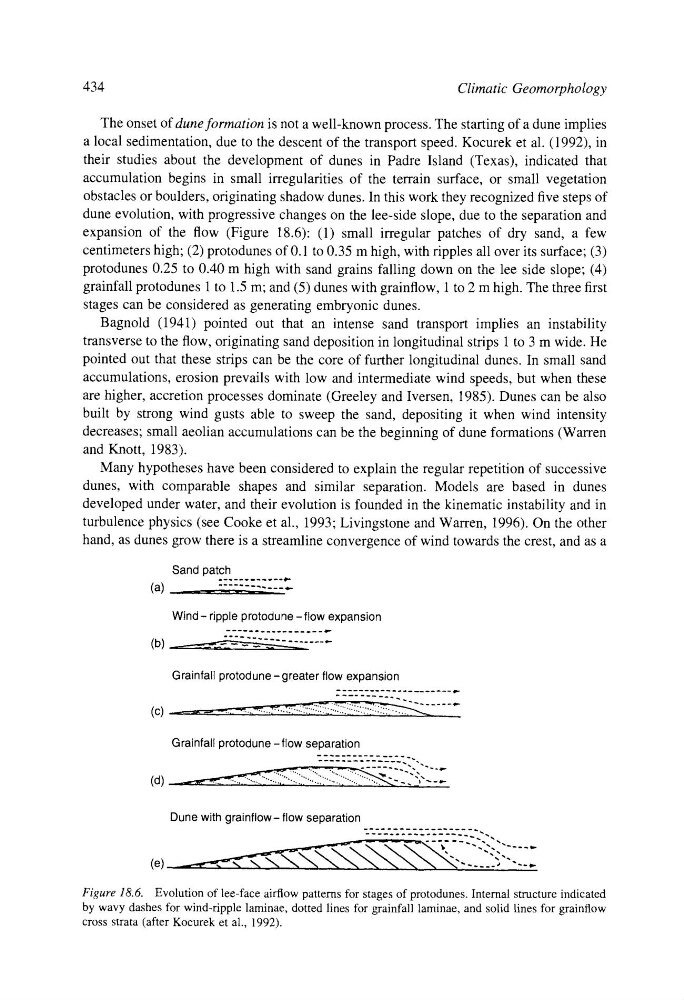
a local sedimentation, due to the descent of the transport speed. Kocurek et al. (1992), in
their studies about the development of dunes in Padre Island (Texas), indicated that
accumulation begins in small irregularities of the terrain surface, or small vegetation
obstacles or boulders, originating shadow dunes. In this work they recognized five steps of
dune evolution, with progressive changes on the lee-side slope, due to the separation and
expansion of the flow (Figure 18.6): (1) small irregular patches of dry sand, a few
centimeters high; (2) protodunes of 0.1 to 0.35 m high, with tipples all over its surface; (3)
protodunes 0.25 to 0.40 m high with sand grains falling down on the lee side slope; (4)
grainfall protodunes 1 to 1.5 m; and (5) dunes with grainflow, 1 to 2 m high. The three first
stages can be considered as generating embryonic dunes.
Bagnold (1941) pointed out that an intense sand transport implies an instability
transverse to the flow, originating sand deposition in longitudinal strips 1 to 3 m wide. He
pointed out that these strips can be the core of further longitudinal dunes. In small sand
accumulations, erosion prevails with low and intermediate wind speeds, but when these
are higher, accretion processes dominate (Greeley and Iversen, 1985). Dunes can be also
built by strong wind gusts able to sweep the sand, depositing it when wind intensity
decreases; small aeolian accumulations can be the beginning of dune formations (Warren
and Knott, 1983).
Many hypotheses have been considered to explain the regular repetition of successive
dunes, with comparable shapes and similar separation. Models are based in dunes
developed under water, and their evolution is founded in the kinematic instability and in
turbulence physics (see Cooke et al., 1993; Livingstone and Warren, 1996). On the other
hand, as dunes grow there is a streamline convergence of wind towards the crest, and as a
Sand patch
(a)
~__ .............
Wind- ripple protodune- flow expansion
(b)
_ .,.-_- - _ ._
Grainfall protodune- greater flow expansion
(c)
Grainfall protodune- flow separation
.
. ....
. ....
..... . ....
....
....
....... .;.:.
_, ,_,.
Dune with grainflow-flow separation
(e)
- ......
,--,.
Figure 18.6. Evolution of lee-face airflow pattems for stages of protodunes. Internal structure indicated
by wavy dashes for wind-ripple laminae, dotted lines for grainfall laminae, and solid lines for grainflow
cross strata (after Kocurek et al., 1992).
Climatic Geomorphology
The onset of dune formation is not a well-known process. The starting of a dune implies
a local sedimentation, due to the descent of the transport speed. Kocurek et al. (1992), in
their studies about the development of dunes in Padre Island (Texas), indicated that
accumulation begins in small irregularities of the terrain surface, or small vegetation
obstacles or boulders, originating shadow dunes. In this work they recognized five steps of
dune evolution, with progressive changes on the lee-side slope, due to the separation and
expansion of the flow (Figure 18.6): (1) small irregular patches of dry sand, a few
centimeters high; (2) protodunes of 0.1 to 0.35 m high, with tipples all over its surface; (3)
protodunes 0.25 to 0.40 m high with sand grains falling down on the lee side slope; (4)
grainfall protodunes 1 to 1.5 m; and (5) dunes with grainflow, 1 to 2 m high. The three first
stages can be considered as generating embryonic dunes.
Bagnold (1941) pointed out that an intense sand transport implies an instability
transverse to the flow, originating sand deposition in longitudinal strips 1 to 3 m wide. He
pointed out that these strips can be the core of further longitudinal dunes. In small sand
accumulations, erosion prevails with low and intermediate wind speeds, but when these
are higher, accretion processes dominate (Greeley and Iversen, 1985). Dunes can be also
built by strong wind gusts able to sweep the sand, depositing it when wind intensity
decreases; small aeolian accumulations can be the beginning of dune formations (Warren
and Knott, 1983).
Many hypotheses have been considered to explain the regular repetition of successive
dunes, with comparable shapes and similar separation. Models are based in dunes
developed under water, and their evolution is founded in the kinematic instability and in
turbulence physics (see Cooke et al., 1993; Livingstone and Warren, 1996). On the other
hand, as dunes grow there is a streamline convergence of wind towards the crest, and as a
Sand patch
(a)
~__ .............
Wind- ripple protodune- flow expansion
(b)
_ .,.-_- - _ ._
Grainfall protodune- greater flow expansion
(c)
Grainfall protodune- flow separation
.
. ....
. ....
..... . ....
....
....
....... .;.:.
_, ,_,.
Dune with grainflow-flow separation
(e)
- ......
,--,.
Figure 18.6. Evolution of lee-face airflow pattems for stages of protodunes. Internal structure indicated
by wavy dashes for wind-ripple laminae, dotted lines for grainfall laminae, and solid lines for grainflow
cross strata (after Kocurek et al., 1992).