

Aeolian accumulations
433
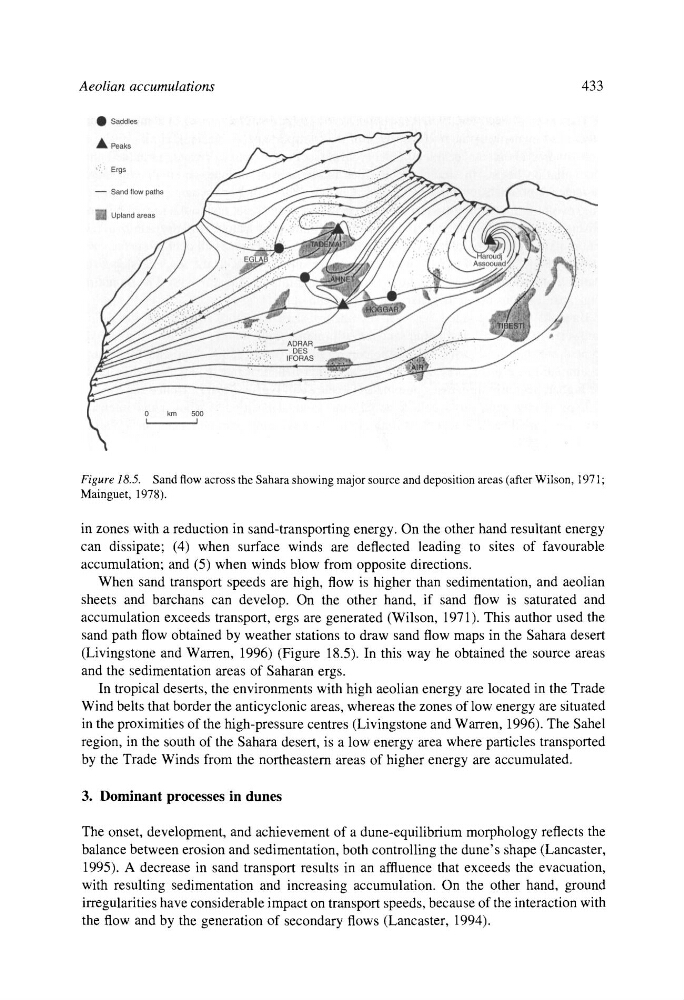
Figure 18.5. Sand flow across the Sahara showing major source and deposition areas (after Wilson, 1971;
Mainguet, 1978).
in zones with a reduction in sand-transporting energy. On the other hand resultant energy
can dissipate; (4) when surface winds are deflected leading to sites of favourable
accumulation; and (5) when winds blow from opposite directions.
When sand transport speeds are high, flow is higher than sedimentation, and aeolian
sheets and barchans can develop. On the other hand, if sand flow is saturated and
accumulation exceeds transport, ergs are generated (Wilson, 1971). This author used the
sand path flow obtained by weather stations to draw sand flow maps in the Sahara desert
(Livingstone and Warren, 1996) (Figure 18.5). In this way he obtained the source areas
and the sedimentation areas of Saharan ergs.
In tropical deserts, the environments with high aeolian energy are located in the Trade
Wind belts that border the anticyclonic areas, whereas the zones of low energy are situated
in the proximities of the high-pressure centres (Livingstone and Warren, 1996). The Sahel
region, in the south of the Sahara desert, is a low energy area where particles transported
by the Trade Winds from the northeastern areas of higher energy are accumulated.
3. Dominant processes in dunes
The onset, development, and achievement of a dune-equilibrium morphology reflects the
balance between erosion and sedimentation, both controlling the dune's shape (Lancaster,
1995). A decrease in sand transport results in an affluence that exceeds the evacuation,
with resulting sedimentation and increasing accumulation. On the other hand, ground
irregularities have considerable impact on transport speeds, because of the interaction with
the flow and by the generation of secondary flows (Lancaster, 1994).
433
Figure 18.5. Sand flow across the Sahara showing major source and deposition areas (after Wilson, 1971;
Mainguet, 1978).
in zones with a reduction in sand-transporting energy. On the other hand resultant energy
can dissipate; (4) when surface winds are deflected leading to sites of favourable
accumulation; and (5) when winds blow from opposite directions.
When sand transport speeds are high, flow is higher than sedimentation, and aeolian
sheets and barchans can develop. On the other hand, if sand flow is saturated and
accumulation exceeds transport, ergs are generated (Wilson, 1971). This author used the
sand path flow obtained by weather stations to draw sand flow maps in the Sahara desert
(Livingstone and Warren, 1996) (Figure 18.5). In this way he obtained the source areas
and the sedimentation areas of Saharan ergs.
In tropical deserts, the environments with high aeolian energy are located in the Trade
Wind belts that border the anticyclonic areas, whereas the zones of low energy are situated
in the proximities of the high-pressure centres (Livingstone and Warren, 1996). The Sahel
region, in the south of the Sahara desert, is a low energy area where particles transported
by the Trade Winds from the northeastern areas of higher energy are accumulated.
3. Dominant processes in dunes
The onset, development, and achievement of a dune-equilibrium morphology reflects the
balance between erosion and sedimentation, both controlling the dune's shape (Lancaster,
1995). A decrease in sand transport results in an affluence that exceeds the evacuation,
with resulting sedimentation and increasing accumulation. On the other hand, ground
irregularities have considerable impact on transport speeds, because of the interaction with
the flow and by the generation of secondary flows (Lancaster, 1994).