

432
Climatic Geomorphology
ergs, distinctive accumulative phases and hiati can be identified as an evidence of past
climatic changes, as we can see in the Gulf of Oman (Cooke et al., 1993).
According to their mobility, ergs can be dynamic or static. First, they occur in flat areas
where the migration of the erg, in the direction of the predominant wind, does not
encounter significant obstacles (Pye and Tsoar, 1990). On the contrary, static ergs are
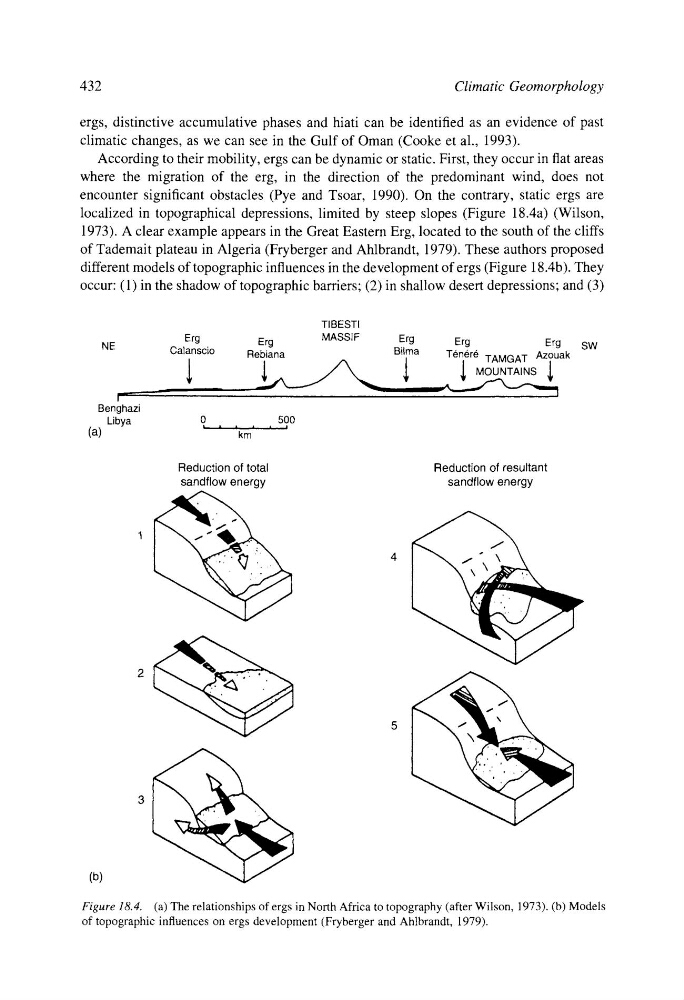
localized in topographical depressions, limited by steep slopes (Figure 18.4a) (Wilson,
1973). A clear example appears in the Great Eastern Erg, located to the south of the cliffs
of Tademait plateau in Algeria (Fryberger and Ahlbrandt, 1979). These authors proposed
different models of topographic influences in the development of ergs (Figure 18.4b). They
occur: (1) in the shadow of topographic barriers; (2) in shallow desert depressions; and (3)
TIBESTI
Erg
Erg
MASSIF
Erg
Erg
Erg
SW
NE
Calanscio
Rebiana
Bilma
Tenere TAMGAT Azouak
o
500
L
9
9
9
km " '
Reduction of total
sandflow energy
3
1
F
'
Benghazi
Libya
(a)
2
(b)
Reduction of resultant
sandflow energy
Figure 18.4. (a) The relationships of ergs in North Africa to topography (after Wilson, 1973). (b) Models
of topographic influences on ergs development (Fryberger and Ahlbrandt, 1979).
Climatic Geomorphology
ergs, distinctive accumulative phases and hiati can be identified as an evidence of past
climatic changes, as we can see in the Gulf of Oman (Cooke et al., 1993).
According to their mobility, ergs can be dynamic or static. First, they occur in flat areas
where the migration of the erg, in the direction of the predominant wind, does not
encounter significant obstacles (Pye and Tsoar, 1990). On the contrary, static ergs are
localized in topographical depressions, limited by steep slopes (Figure 18.4a) (Wilson,
1973). A clear example appears in the Great Eastern Erg, located to the south of the cliffs
of Tademait plateau in Algeria (Fryberger and Ahlbrandt, 1979). These authors proposed
different models of topographic influences in the development of ergs (Figure 18.4b). They
occur: (1) in the shadow of topographic barriers; (2) in shallow desert depressions; and (3)
TIBESTI
Erg
Erg
MASSIF
Erg
Erg
Erg
SW
NE
Calanscio
Rebiana
Bilma
Tenere TAMGAT Azouak
o
500
L
9
9
9
km " '
Reduction of total
sandflow energy
3
1
F
'
Benghazi
Libya
(a)
2
(b)
Reduction of resultant
sandflow energy
Figure 18.4. (a) The relationships of ergs in North Africa to topography (after Wilson, 1973). (b) Models
of topographic influences on ergs development (Fryberger and Ahlbrandt, 1979).