

Aeolian accumulations
431
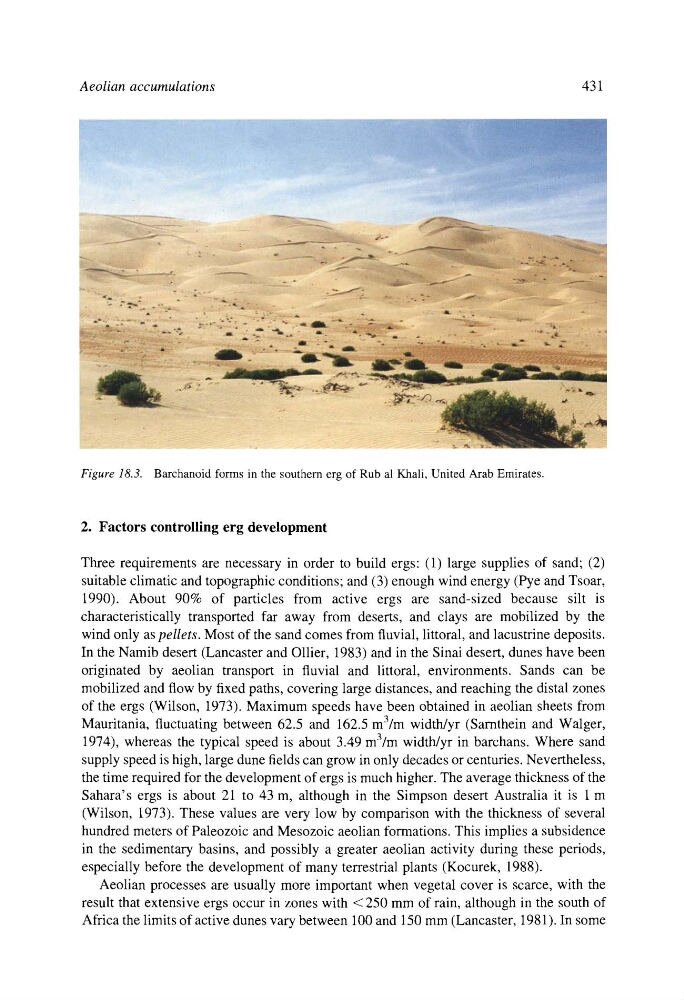
Figure 18.3. Barchanoid forms in the southern erg of Rub al Khali, United Arab Emirates.
2. Factors controlling erg development
Three requirements are necessary in order to build ergs: (1) large supplies of sand; (2)
suitable climatic and topographic conditions; and (3) enough wind energy (Pye and Tsoar,
1990). About 90% of particles from active ergs are sand-sized because silt is
characteristically transported far away from deserts, and clays are mobilized by the
wind only as pellets. Most of the sand comes from fluvial, littoral, and lacustrine deposits.
In the Namib desert (Lancaster and Ollier, 1983) and in the Sinai desert, dunes have been
originated by aeolian transport in fluvial and littoral, environments. Sands can be
mobilized and flow by fixed paths, covering large distances, and reaching the distal zones
of the ergs (Wilson, 1973). Maximum speeds have been obtained in aeolian sheets from
Mauritania, fluctuating between 62.5 and 162.5 m3/m width/yr (Sarnthein and Walger,
1974), whereas the typical speed is about 3.49 m3/m width/yr in barchans. Where sand
supply speed is high, large dune fields can grow in only decades or centuries. Nevertheless,
the time required for the development of ergs is much higher. The average thickness of the
Sahara's ergs is about 21 to 43 m, although in the Simpson desert Australia it is 1 m
(Wilson, 1973). These values are very low by comparison with the thickness of several
hundred meters of Paleozoic and Mesozoic aeolian formations. This implies a subsidence
in the sedimentary basins, and possibly a greater aeolian activity during these periods,
especially before the development of many terrestrial plants (Kocurek, 1988).
Aeolian processes are usually more important when vegetal cover is scarce, with the
result that extensive ergs occur in zones with < 250 mm of rain, although in the south of
Africa the limits of active dunes vary between 100 and 150 mm (Lancaster, 1981). In some
431
Figure 18.3. Barchanoid forms in the southern erg of Rub al Khali, United Arab Emirates.
2. Factors controlling erg development
Three requirements are necessary in order to build ergs: (1) large supplies of sand; (2)
suitable climatic and topographic conditions; and (3) enough wind energy (Pye and Tsoar,
1990). About 90% of particles from active ergs are sand-sized because silt is
characteristically transported far away from deserts, and clays are mobilized by the
wind only as pellets. Most of the sand comes from fluvial, littoral, and lacustrine deposits.
In the Namib desert (Lancaster and Ollier, 1983) and in the Sinai desert, dunes have been
originated by aeolian transport in fluvial and littoral, environments. Sands can be
mobilized and flow by fixed paths, covering large distances, and reaching the distal zones
of the ergs (Wilson, 1973). Maximum speeds have been obtained in aeolian sheets from
Mauritania, fluctuating between 62.5 and 162.5 m3/m width/yr (Sarnthein and Walger,
1974), whereas the typical speed is about 3.49 m3/m width/yr in barchans. Where sand
supply speed is high, large dune fields can grow in only decades or centuries. Nevertheless,
the time required for the development of ergs is much higher. The average thickness of the
Sahara's ergs is about 21 to 43 m, although in the Simpson desert Australia it is 1 m
(Wilson, 1973). These values are very low by comparison with the thickness of several
hundred meters of Paleozoic and Mesozoic aeolian formations. This implies a subsidence
in the sedimentary basins, and possibly a greater aeolian activity during these periods,
especially before the development of many terrestrial plants (Kocurek, 1988).
Aeolian processes are usually more important when vegetal cover is scarce, with the
result that extensive ergs occur in zones with < 250 mm of rain, although in the south of
Africa the limits of active dunes vary between 100 and 150 mm (Lancaster, 1981). In some