

416
Climatic Geomorphology
E
E
v
L_
E
"O
t'tl:i
(.9
0.1
0.01
0.001
10
II
ed load
-
,,,. / (rolling and saltation)
i /
f
( .;';o,'~
l
i,'/
/
z- ey" #
ii oess
/
fff
/ / /
.neg~\ Og
Sand Sheets
Dune Sands
dust storms
i
1
i
i
i
9
9 llll9
1
30
50 70 100
200
U* (cm s -1)
tl:i
(O
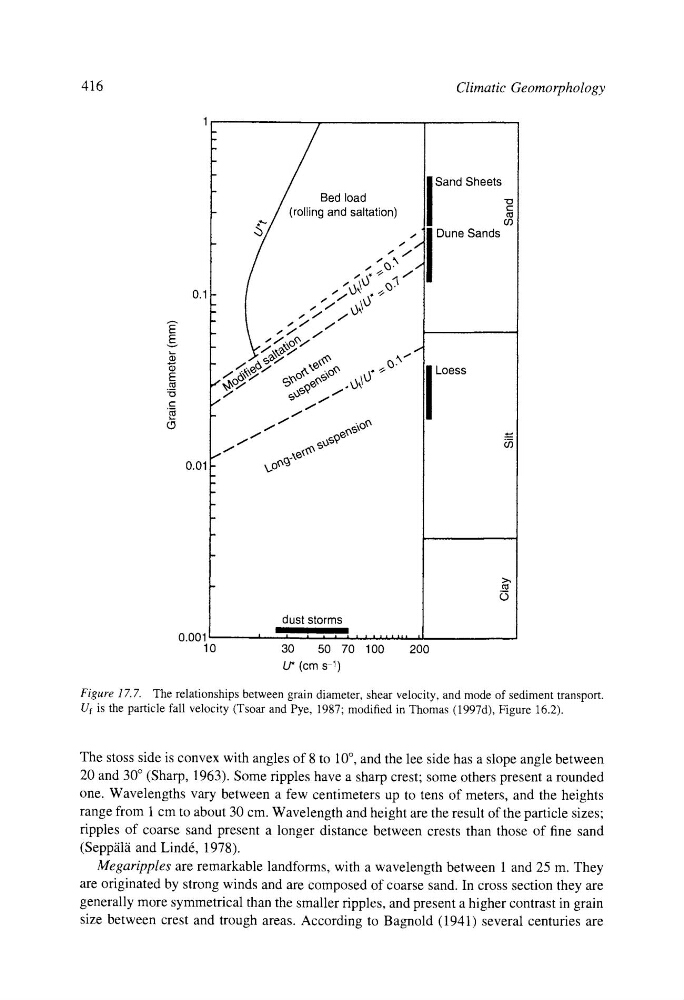
Figure 17. 7. The relationships between grain diameter, shear velocity, and mode of sediment transport.
Uf is the particle fall velocity (Tsoar and Pye, 1987; modified in Thomas (1997d), Figure 16.2).
The stoss side is convex with angles of 8 to 10 ~ and the lee side has a slope angle between
20 and 30 ~ (Sharp, 1963). Some tipples have a sharp crest; some others present a rounded
one. Wavelengths vary between a few centimeters up to tens of meters, and the heights
range from 1 cm to about 30 cm. Wavelength and height are the result of the particle sizes;
tipples of coarse sand present a longer distance between crests than those of fine sand
(Sepp~il~i and Lindt, 1978).
Megaripples are remarkable landforms, with a wavelength between 1 and 25 m. They
are originated by strong winds and are composed of coarse sand. In cross section they are
generally more symmetrical than the smaller tipples, and present a higher contrast in grain
size between crest and trough areas. According to Bagnold (1941) several centuries are
Climatic Geomorphology
E
E
v
L_
E
"O
t'tl:i
(.9
0.1
0.01
0.001
10
II
ed load
-
,,,. / (rolling and saltation)
i /
f
( .;';o,'~
l
i,'/
/
z- ey" #
ii oess
/
fff
/ / /
.neg~\ Og
Sand Sheets
Dune Sands
dust storms
i
1
i
i
i
9
9 llll9
1
30
50 70 100
200
U* (cm s -1)
tl:i
(O
Figure 17. 7. The relationships between grain diameter, shear velocity, and mode of sediment transport.
Uf is the particle fall velocity (Tsoar and Pye, 1987; modified in Thomas (1997d), Figure 16.2).
The stoss side is convex with angles of 8 to 10 ~ and the lee side has a slope angle between
20 and 30 ~ (Sharp, 1963). Some tipples have a sharp crest; some others present a rounded
one. Wavelengths vary between a few centimeters up to tens of meters, and the heights
range from 1 cm to about 30 cm. Wavelength and height are the result of the particle sizes;
tipples of coarse sand present a longer distance between crests than those of fine sand
(Sepp~il~i and Lindt, 1978).
Megaripples are remarkable landforms, with a wavelength between 1 and 25 m. They
are originated by strong winds and are composed of coarse sand. In cross section they are
generally more symmetrical than the smaller tipples, and present a higher contrast in grain
size between crest and trough areas. According to Bagnold (1941) several centuries are