

Aeolian processes and erosive landforms
415
I
I
I
i
I
l
I
i
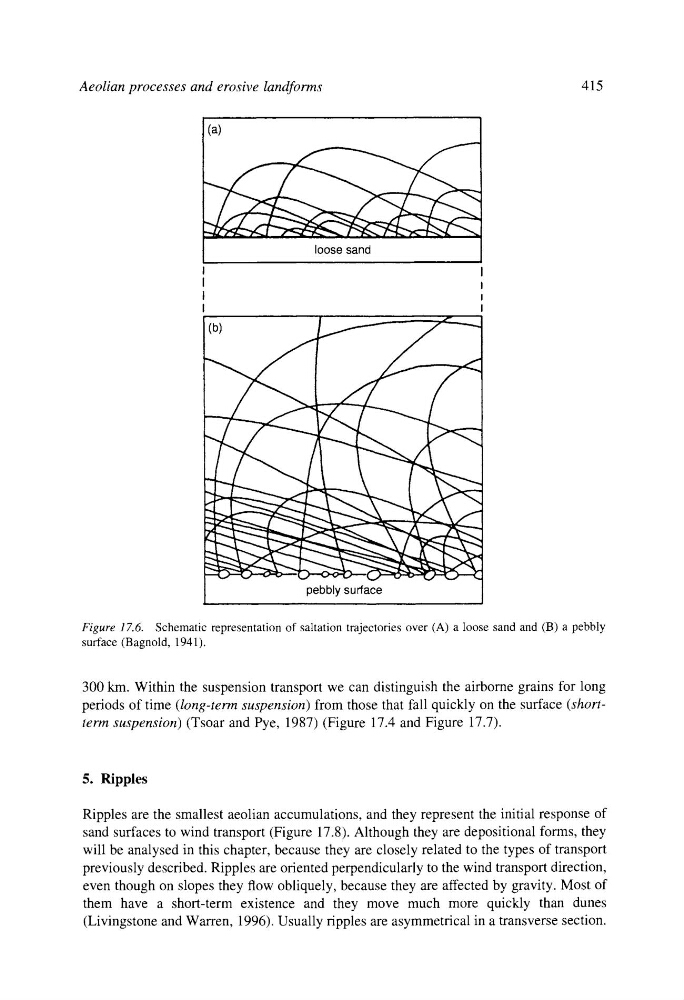
Figure 17.6. Schematic representation of saltation trajectories over (A) a loose sand and (B) a pebbly
surface (Bagnold, 1941).
300 km. Within the suspension transport we can distinguish the airborne grains for long
periods of time (long-term suspension) from those that fall quickly on the surface (shortterm suspension) (Tsoar and Pye, 1987) (Figure 17.4 and Figure 17.7).
5. Ripples
Ripples are the smallest aeolian accumulations, and they represent the initial response of
sand surfaces to wind transport (Figure 17.8). Although they are depositional forms, they
will be analysed in this chapter, because they are closely related to the types of transport
previously described. Ripples are oriented perpendicularly to the wind transport direction,
even though on slopes they flow obliquely, because they are affected by gravity. Most of
them have a short-term existence and they move much more quickly than dunes
(Livingstone and Warren, 1996). Usually tipples are asymmetrical in a transverse section.
415
I
I
I
i
I
l
I
i
Figure 17.6. Schematic representation of saltation trajectories over (A) a loose sand and (B) a pebbly
surface (Bagnold, 1941).
300 km. Within the suspension transport we can distinguish the airborne grains for long
periods of time (long-term suspension) from those that fall quickly on the surface (shortterm suspension) (Tsoar and Pye, 1987) (Figure 17.4 and Figure 17.7).
5. Ripples
Ripples are the smallest aeolian accumulations, and they represent the initial response of
sand surfaces to wind transport (Figure 17.8). Although they are depositional forms, they
will be analysed in this chapter, because they are closely related to the types of transport
previously described. Ripples are oriented perpendicularly to the wind transport direction,
even though on slopes they flow obliquely, because they are affected by gravity. Most of
them have a short-term existence and they move much more quickly than dunes
(Livingstone and Warren, 1996). Usually tipples are asymmetrical in a transverse section.