

414
Climatic Geomorphology
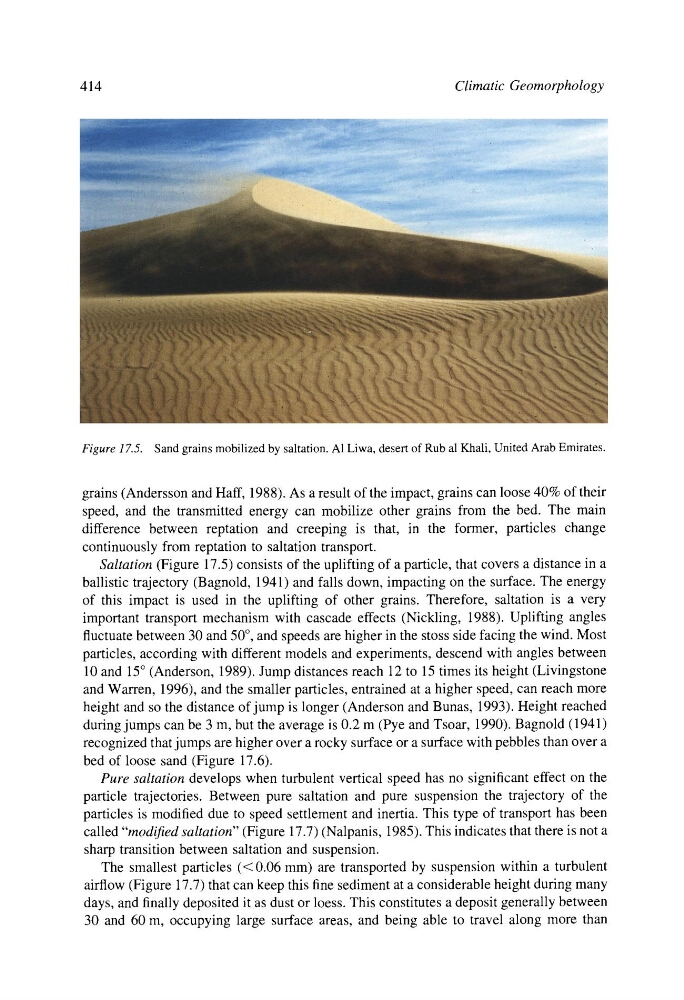
Figure 17.5. Sand grains mobilized by saltation. A1Liwa, desert of Rub al Khali, United Arab Emirates.
grains (Andersson and Haft, 1988). As a result of the impact, grains can loose 40% of their
speed, and the transmitted energy can mobilize other grains from the bed. The main
difference between reptation and creeping is that, in the former, particles change
continuously from reptation to saltation transport.
Saltation (Figure 17.5) consists of the uplifting of a particle, that covers a distance in a
ballistic trajectory (Bagnold, 1941) and falls down, impacting on the surface. The energy
of this impact is used in the uplifting of other grains. Therefore, saltation is a very
important transport mechanism with cascade effects (Nickling, 1988). Uplifting angles
fluctuate between 30 and 50 ~ and speeds are higher in the stoss side facing the wind. Most
particles, according with different models and experiments, descend with angles between
10 and 15 ~ (Anderson, 1989). Jump distances reach 12 to 15 times its height (Livingstone
and Warren, 1996), and the smaller particles, entrained at a higher speed, can reach more
height and so the distance of jump is longer (Anderson and Bunas, 1993). Height reached
during jumps can be 3 m, but the average is 0.2 m (Pye and Tsoar, 1990). Bagnold (1941)
recognized that jumps are higher over a rocky surface or a surface with pebbles than over a
bed of loose sand (Figure 17.6).
Pure saltation develops when turbulent vertical speed has no significant effect on the
particle trajectories. Between pure saltation and pure suspension the trajectory of the
particles is modified due to speed settlement and inertia. This type of transport has been
called "modified saltation" (Figure 17.7) (Nalpanis, 1985). This indicates that there is not a
sharp transition between saltation and suspension.
The smallest particles (< 0.06 mm) are transported by suspension within a turbulent
airflow (Figure 17.7) that can keep this fine sediment at a considerable height during many
days, and finally deposited it as dust or loess. This constitutes a deposit generally between
30 and 60 m, occupying large surface areas, and being able to travel along more than
Climatic Geomorphology
Figure 17.5. Sand grains mobilized by saltation. A1Liwa, desert of Rub al Khali, United Arab Emirates.
grains (Andersson and Haft, 1988). As a result of the impact, grains can loose 40% of their
speed, and the transmitted energy can mobilize other grains from the bed. The main
difference between reptation and creeping is that, in the former, particles change
continuously from reptation to saltation transport.
Saltation (Figure 17.5) consists of the uplifting of a particle, that covers a distance in a
ballistic trajectory (Bagnold, 1941) and falls down, impacting on the surface. The energy
of this impact is used in the uplifting of other grains. Therefore, saltation is a very
important transport mechanism with cascade effects (Nickling, 1988). Uplifting angles
fluctuate between 30 and 50 ~ and speeds are higher in the stoss side facing the wind. Most
particles, according with different models and experiments, descend with angles between
10 and 15 ~ (Anderson, 1989). Jump distances reach 12 to 15 times its height (Livingstone
and Warren, 1996), and the smaller particles, entrained at a higher speed, can reach more
height and so the distance of jump is longer (Anderson and Bunas, 1993). Height reached
during jumps can be 3 m, but the average is 0.2 m (Pye and Tsoar, 1990). Bagnold (1941)
recognized that jumps are higher over a rocky surface or a surface with pebbles than over a
bed of loose sand (Figure 17.6).
Pure saltation develops when turbulent vertical speed has no significant effect on the
particle trajectories. Between pure saltation and pure suspension the trajectory of the
particles is modified due to speed settlement and inertia. This type of transport has been
called "modified saltation" (Figure 17.7) (Nalpanis, 1985). This indicates that there is not a
sharp transition between saltation and suspension.
The smallest particles (< 0.06 mm) are transported by suspension within a turbulent
airflow (Figure 17.7) that can keep this fine sediment at a considerable height during many
days, and finally deposited it as dust or loess. This constitutes a deposit generally between
30 and 60 m, occupying large surface areas, and being able to travel along more than